


What Borderless Access research reveals about consumer trust, purchase decisions and the true impact of influencer marketing in Saudi Arabia and the UAE.
Imagine a consumer in Riyadh, one of the world’s most digitally connected regions, starting the day by watching an influencer unbox a skincare product on Instagram. Intrigued, they saved the post. Later, they watch a detailed YouTube review, seek a friend’s opinion on WhatsApp, explore the brand’s website that evening, and eventually make a purchase through an e-commerce platform 3 days later.
The question is simple: Which touchpoint truly influenced the purchase, and which one deserves the credit?
Our consumer research across Saudi Arabia and the UAE reveals an interesting disconnect between influencer engagement, brand discovery and actual purchase behavior.
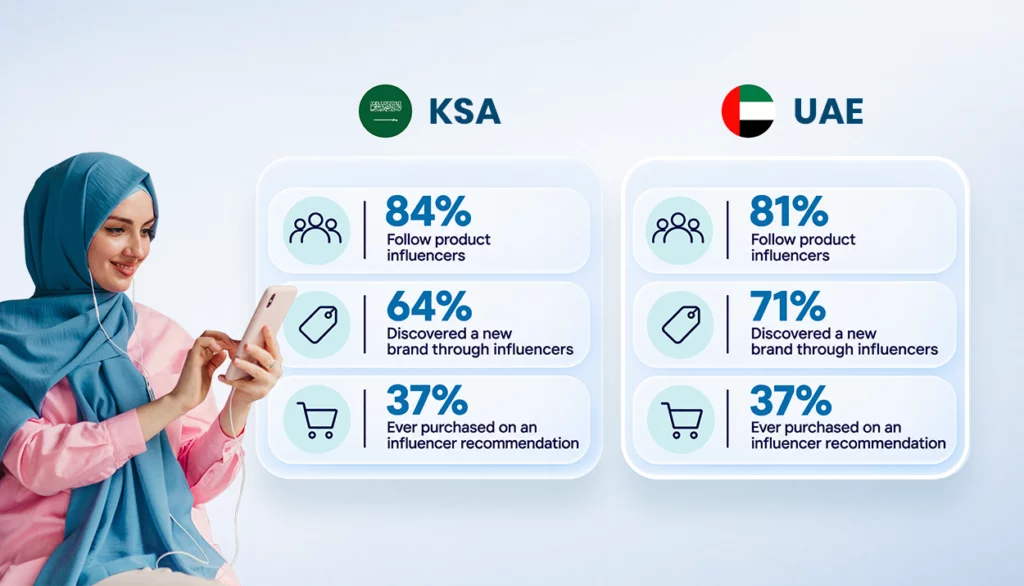
In Saudi Arabia, 84% of consumers follow influencers who create product-related content. Sixty-four % have discovered a new brand through influencer content. And only 37% have ever purchased based on an influencer recommendation.
In the UAE, the pattern is almost identical. 81% follow product-related influencer content and 37% have converted.
Influencers can play an important role in building awareness, stimulating curiosity, shaping perceptions and encouraging consideration, even when they are not the final trigger for purchase. That gap between reach and conversion is not a failure of influencer marketing. The challenge, therefore, is not simply to measure how many consumers influencers reach or convert, but to understand where, how and to what extent they contribute to the broader consumer decision journey.
The Ecosystem Nobody Is Mapping Correctly
Understanding how consumers navigate their purchase decisions requires looking beyond the conventional marketing funnel.
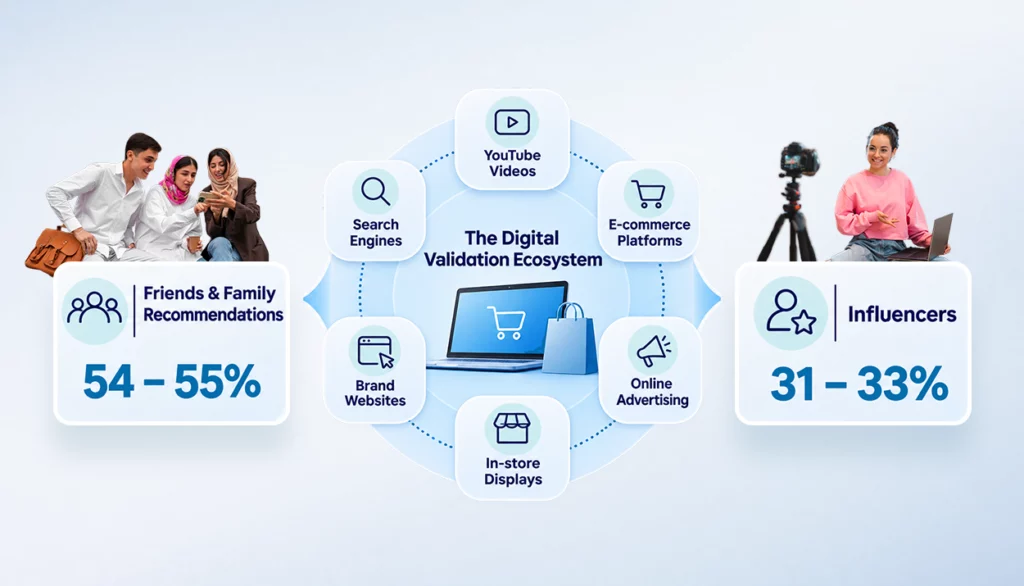
In both the UAE and KSA, the most relied-upon information source before a purchase is friends and family recommendations, used by 54 to 55 % of consumers. Influencers come in behind that, consulted by around 31 to 33 %. But sitting between those two touchpoints is a dense ecosystem of digital validation: YouTube videos, e-commerce platforms, search engines, online advertising, brand websites, and in-store displays, all of which consumers are actively using simultaneously and in no fixed sequence.
What this means is that consumer journey is increasingly dynamic, interconnected, shaped by multiple digital touchpoints, social influences and evolving purchase triggers. Rather than following a linear path, consumers accumulate information and reassurance across channels from discovering a product through an influencer to evaluating reviews, seeking recommendations and ultimately purchasing through an e-commerce platform.
Influence is therefore cumulative rather than channel specific. It has direct implications for how brands should be thinking about influencer investment and measurement.
Influencers Are Opening the Funnel, Not Closing It
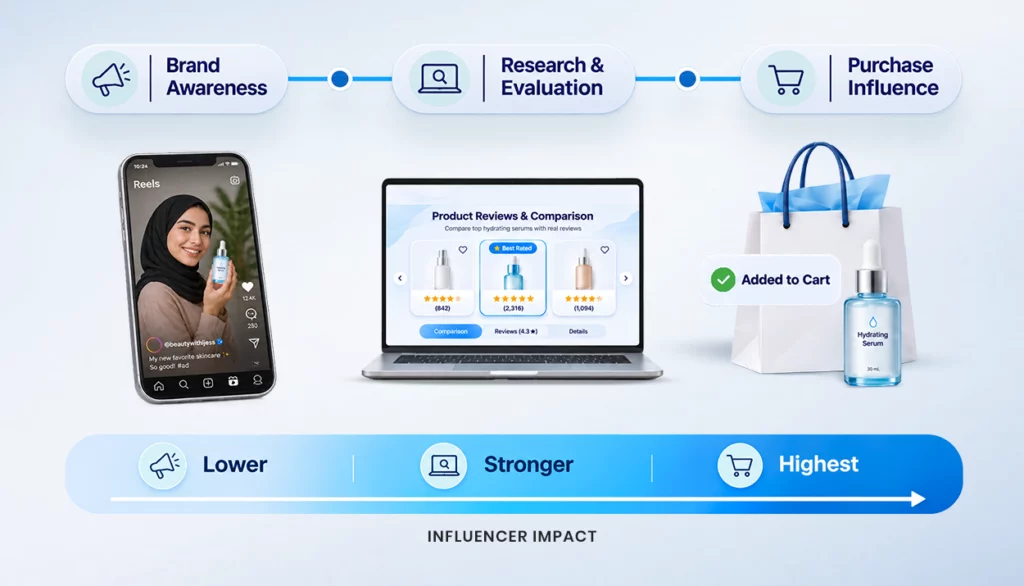
The data is consistent and worth stating plainly. In the UAE, social media influencers are the most commonly used source for basic brand awareness at 23%. They strengthen their role during the research and evaluation stage and remain a key driver at the purchase influence stage at 41%, alongside friends and family recommendations at 42% and YouTube at 33%.
Influencers play distinct roles throughout the consumer decision journey. At the top of the funnel, they are introducers. In the middle, they are validators. At the bottom they are the voice reinforcing confidence closer to purchase. The challenge arises when brands expect a single influencer, platform or piece of content to deliver across all three stages simultaneously.
Influencer effectiveness should be measured by its contribution at each stage of the consumer journey, rather than judged solely on immediate conversions.
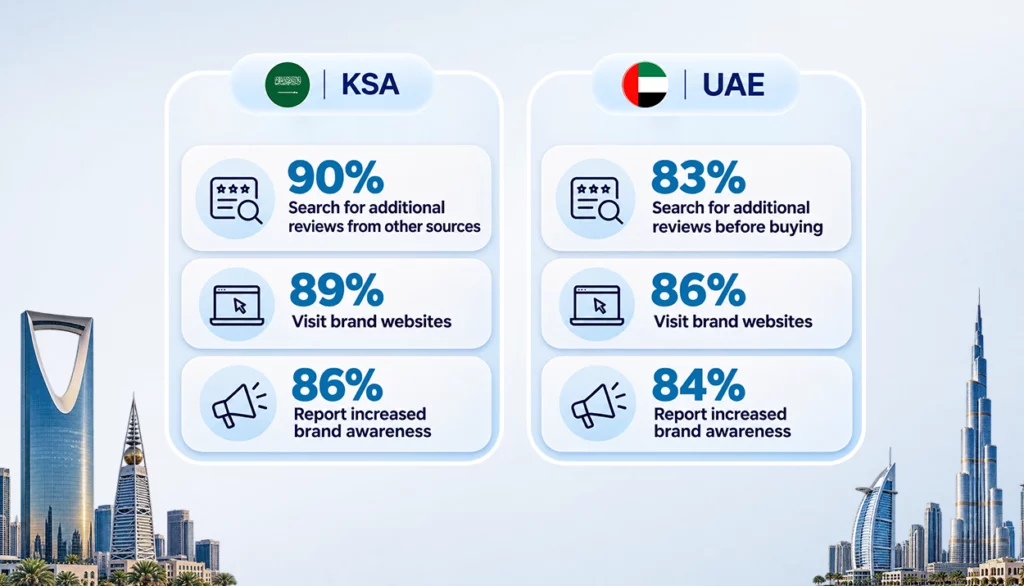
In KSA specifically, the study found that 90 % of consumers search for reviews from other sources after engaging with influencer content, 89 % visit brand websites, and 86 % report increased brand awareness because of influencer exposure.
These findings reinforce that influencers initiate discovery, while consumers independently validate information across multiple touchpoints before making purchase decisions.
Brands must look beyond influencer-generated awareness and ensure that every subsequent consumer touchpoint builds trust, reinforces consideration and facilitates conversion
The Platform Question Most Brands Are Getting Wrong
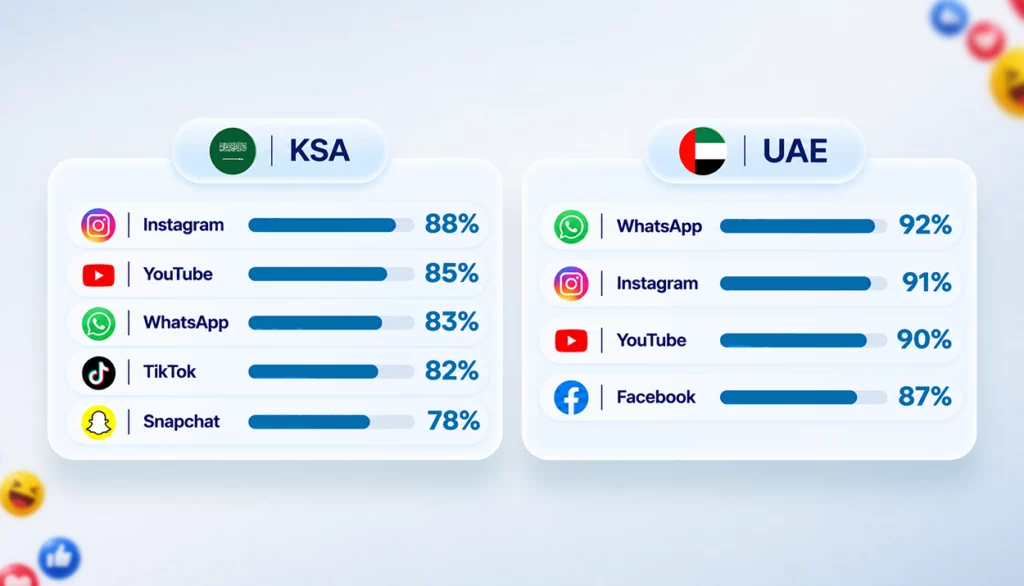
In the UAE, WhatsApp reaches 92 % of consumers, Instagram 91%, YouTube 90%, and Facebook 87%. In KSA, Instagram, YouTube, WhatsApp, TikTok, and Snapchat all operate at comparably high levels of penetration.
With influencers active across almost every social media platform, brands often focus on the channels they know best or where influencers have the largest following.
Are these necessarily the platforms that deliver the greatest impact? Our research suggests that different platforms play different roles in how consumers discover, evaluate and eventually purchase products. The opportunity for brands is to understand these differences and invest in platforms based on the role they play in the consumer journey, rather than reach alone.
Gender and Socioeconomic Class Shape Who Responds to What
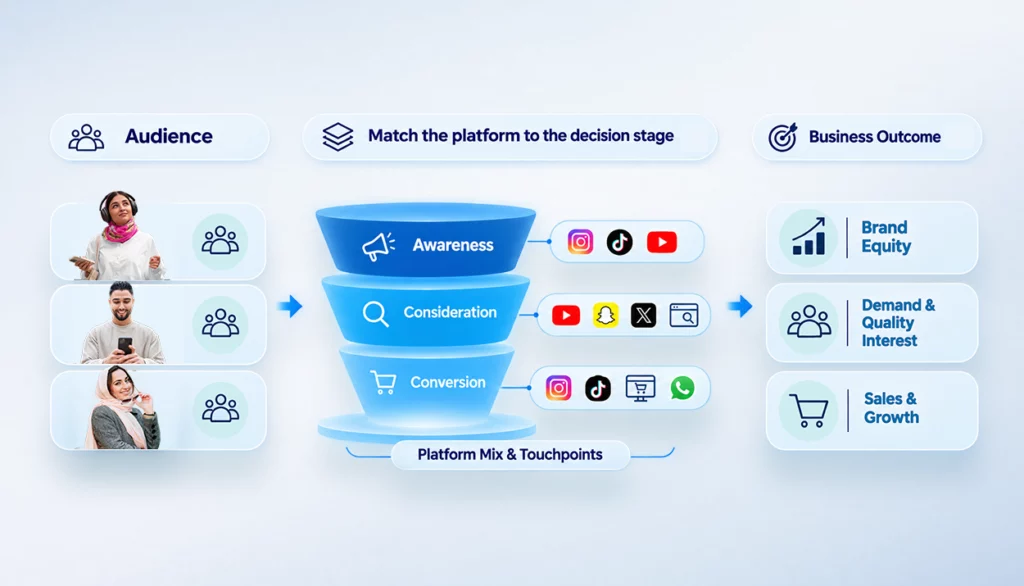
The study surfaces clear segmentation in how different groups interact with influencer content, and these differences have direct implications for targeting and creative strategy.
In Saudi Arabia (KSA):
- Male consumers primarily use social media for brand awareness, product discovery and information gathering.
- Female consumers are more likely to translate social media exposure into purchase consideration and decisions.
- Higher SEC (AB) consumers demonstrate stronger purchase influence from social media, supported by greater digital confidence and purchasing power.
In United Arab Emirates (UAE):
- Female consumers are more likely than males to make purchase decisions influenced by social media.
- Younger consumers (18–30 years) demonstrate the strongest purchase influence from social media exposure.
- Asian expatriates engage more actively with influencer content across Facebook, Instagram and YouTube compared to Arab consumers.
- Higher SEC (AB) consumers show greater engagement with Pinterest, reflecting stronger interest in aspirational and lifestyle-oriented content.
Category Changes Everything
One of the most commercially important findings in the study is how dramatically the role of influencers shifts depending on what is being sold.
In fashion, food and beverages, and beauty and skincare, influencer-driven purchase rates reach 62–72% across Saudi Arabia and the UAE. These visually engaging categories benefit from authentic product experiences, demonstrations and relatable recommendations that generate interest, build confidence and encourage purchase.
In contrast, banking, fintech, travel and electronics require a more credibility-led approach. Consumers place greater value on expert opinions, detailed reviews, product comparisons and practical information. In banking and fintech, expertise-led content performs especially well, while electronics buyers prefer comparisons and hands-on demonstrations. In travel, detailed hotel reviews and honest budget breakdowns build more trust than aspirational content alone.
The key takeaway is simple: There is no one-size-fits-all influencer strategy. Brands must align influencer selection, content formats and messaging with category-specific consumer motivations and decision-making needs. In high-consideration categories, credibility and expertise often matter more than reach or entertainment value.
Trust Is High But Consumers Are Smart About It
Trust remains a critical driver of influencer effectiveness across Saudi Arabia and UAE. Our research indicates that 62–63% of consumers express trust in social media influencers, placing them on par with, or ahead of, traditional recommendations from friends and family. Interestingly, macro influencers (with 100K to 1M followers) record the highest individual trust levels (~42%).
While sponsored partnerships are widely recognised and accepted, trust is built through authenticity, demonstrated expertise and transparency rather than follower counts or visual appeal alone. Influencers who combine honest, balanced recommendations with credible product knowledge are better positioned to earn consumer confidence.
Importantly, trust does not automatically translate into purchase. Consumers continue to validate influencer recommendations through independent reviews, brand websites and other information sources before making decisions. This reflects the digitally informed and increasingly considered purchase behaviour of Gulf consumers, where influencers contribute to decisions rather than determine them independently.
For brands, the opportunity lies in creating a connected consumer experience that reinforces influencer credibility across subsequent touchpoints, helping translate initial interest into purchase confidence.
Key Takeout: Influencers create trust and consideration, but the broader brand ecosystem helps convert that influence into action. Brands must invest in both credible influencer partnerships and a seamless consumer journey to maximise marketing effectiveness.
What This Means for Brands Operating in the Gulf
Our study highlights the need for brands to rethink how they allocate influencer marketing budgets, measure campaign effectiveness and integrate influencer activity into the broader consumer journey.
Influencers are not simply conversion drivers; they are catalysts for trust, discovery and consideration. Their real value emerges when the wider brand ecosystem from websites and search results to customer reviews and e-commerce platforms, reinforces the interest they generate and supports consumers through to purchase.
Platform selection should be driven by strategic purpose, not reach alone. Different platforms serve distinct roles in the consumer journey: TikTok can drive discovery and persuasion, Instagram can inspire and stimulate purchase interest, YouTube supports deeper product evaluation, WhatsApp facilitates peer validation, and LinkedIn builds professional credibility. Brands need to align platform investments with audience behaviour and campaign objectives.
Content strategy must reflect category-specific consumer motivations. What influences a fashion or food purchase may be fundamentally different from what builds confidence in banking, fintech or electronics. Our research across twelve categories reinforces the importance of tailoring influencer content to the nature of the purchase decision, rather than adopting a uniform approach across platforms.
Key Takeout: The future of influencer marketing lies in moving beyond reach and immediate conversions towards a more integrated, insight-led strategy where the right influencers, platforms and content work together to build trust, influence decisions and deliver measurable business impact.
To explore what this kind of market-specific intelligence could reveal about your consumers, your category, and your platform strategy, connect with our experts today