



How Nando’s and Borderless Access built a new metric for measuring consumer insights, and what it means for brands trying to build loyalty through customer experience
Presented at Esomar Congress 2026 by Borderless Access and Nando’s
A guest walks into a Nando’s restaurant. She stands there for a few seconds. The person behind the counter who is supposed to take the order looks up, then looks back down. “It made me feel unwanted,” the guest said afterwards.
The food was fine and the order was right. The entire incident was one person not making eye contact. And if you had asked the guest a week later how the visit was, she would have said it was fine. That moment would have dissolved into an average, disappeared into a satisfaction score, and nobody would have known it happened.
But it happened to her. And it left a mark.
This is the challenge that Nando’s and Borderless Access addressed with their research paper called Decoding the Dine-in Micro-Moments that Build Brand Love.
The guests are always delighted at Nando’s, and the scores reflect that. The real question is which specific moments inside the restaurant experience are doing the emotional heavy lifting, and which ones are silently costing the brand without ever appearing in a tracker.
Why Satisfaction Scores Were Never Going to Provide an Answer
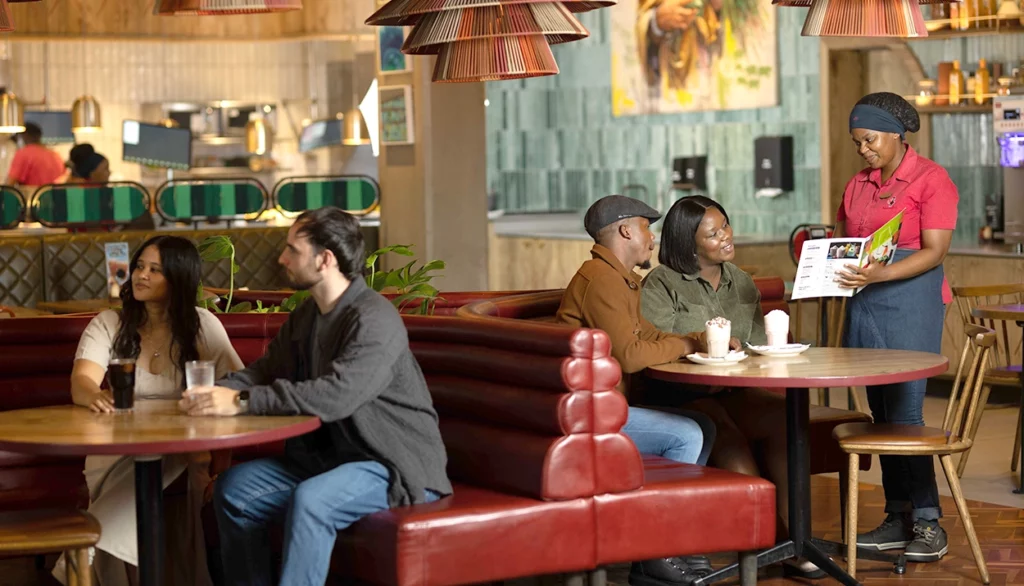
Nando’s already tracks customer satisfaction and brand health over time through well-established research programmes that provide a strong view of how the brand is perceived. The opportunity was to add another layer: understanding what customers feel while the restaurant experience is actually unfolding, not just before or after the visit.
Satisfaction surveys happen after the experience. Brand health tracking happens between experiences. Neither captures what is happening emotionally in the moment, at the specific junctures in a visit when the feeling of the brand is actually being formed. By the time a customer fills in a tracker, the memory has already been edited. The small moments have been averaged out. The emotion has been replaced by a considered view.
Decades of research in psychology have established that this is not how memory actually works. People do not judge experiences by adding up all the moments and dividing by the number of them. They judge by the peak and the end, the most intense moment and the way it closed. Duration barely registers. And first impressions are formed remarkably quickly and tend to stick with a stability that most brands would find surprising.
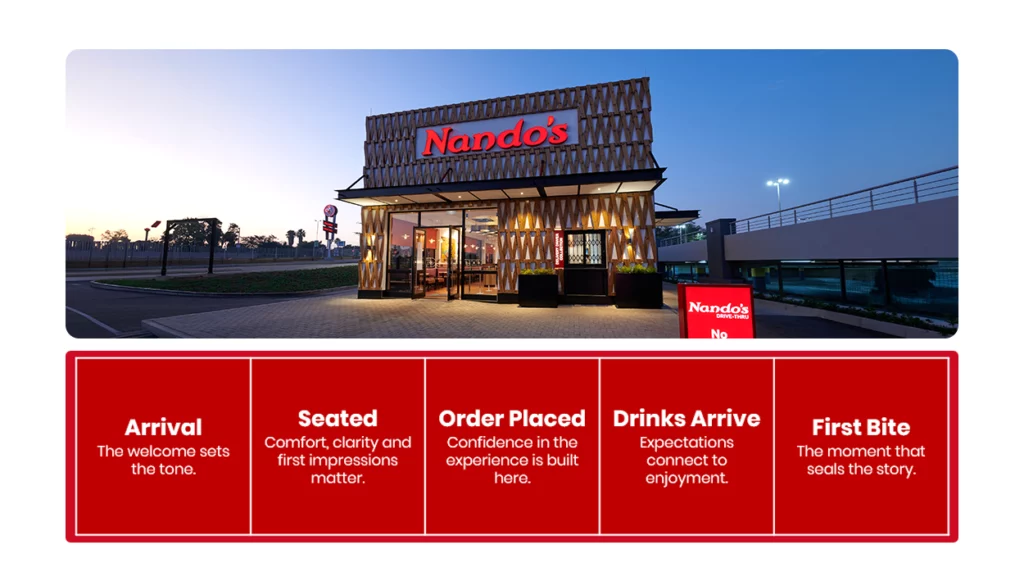
To understand what was building or eroding Brand Love inside Nando’s restaurants, the research needed to happen in real time at five natural moments in the visit: arrival, being seated, ordering, drinks arriving, and first bite.
Designing the Study: Non-Intrusive, Rigorous, and Built for Action
The study ran across three culturally distinct markets — Western Europe, Southern Africa, and South Asia — chosen deliberately because they represent three very different points in Nando’s relationship with its guests. The brand relationship in Southern Africa is deep, social and already emotionally loaded. In Western Europe it is more personal than social, built around the quality of the meal itself. In South Asia it is newer and still forming, with guests who are often trying the brand for the first time and picking up on every service cue quite quickly.
120 dining parties across the three markets, 40 per region, self-logged a single seven-second emotion tap at each of the five milestones. No push notifications, no staff prompts, no disruption to the meal itself. A short post-visit survey, two to three minutes, captured brand love as a composite measure, covering identity fit, emotional connection, passion-driven behaviours, long-term bond and what the academic literature calls separation distress. And then, within 48 hours, six depth interviews per market were conducted with the same guests; long enough after the meal to allow some reflection, but close enough that the feeling of the room was still physically available to them.
The seven-second tap itself is grounded in well-established research on thin-slice judgements. Ambady and Rosenthal’s work demonstrated that very brief exposures are sufficient to form reliable impressions, with validity that holds up against longer measurement windows. The design was not a shortcut. It was practically essential and anything longer would have interrupted the experience it was trying to measure.
After capturing these in-the-moment reactions, Brand Love was calculated as the overall measure of the consumer-brand relationship. In this study, Brand Love was not used as a loose marketing term, but as a defined composite KPI drawn from peer-reviewed literature and tested for internal consistency before analysis.
What the Emotional Account Revealed
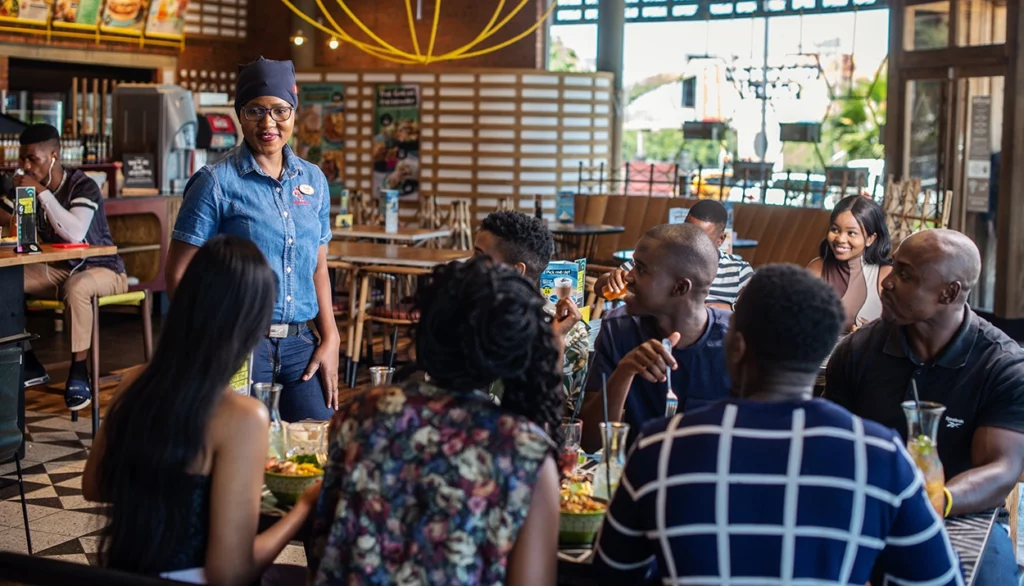
The framework the team developed to make sense of the data was called The Emotional Account.
Every moment in the visit either makes a deposit or a withdrawal. A deposit is any experience that leaves a guest feeling noticed, informed, or expected. Catching their eye, telling them what is happening, and treating them as if their arrival was anticipated. A withdrawal is friction — waiting without knowing, having to ask twice, feeling like an interruption rather than a guest. The account runs in real time, and the Brand Love score at the end of the visit is, in meaningful part, a function of how that account has moved across the visit.
What struck the team was how small the individual entries were. Nobody described a disaster. There was no terrible meal, no catastrophic service failure. The deposits and withdrawals were gestures like eye contact, a single sentence from a member of staff, thirty seconds of attention at a specific moment. And because they were so small and subtle, they were exactly the factors that existing research frameworks walk straight past.
Small does not mean easy to change, though. Changing these moments means retraining people, which requires investment and conviction. Which is precisely why understanding which moments actually matter and being able to quantify what changing them would be worth was the real point of the exercise.
The data across the five moments produced distinct patterns in how the emotional account moved across the visit, which varied significantly by market.
In Western Europe, the experience dipped in the middle of the visit and peaked sharply at first bite. Southern Africa followed a different pattern: because guests order at the counter, the ordering moment effectively becomes the heart of the experience, which is why it peaks early and again at the end. South Asia started high but was the only market where first bite actually dropped, not because the food was disappointing, but because the anticipation had not been built through the earlier moments.
What this means practically is that a universal intervention designed from the data derived from the experiences in a single market would be wrong for at least two of the others. Market specificity in this kind of research is the difference between an insight you can act on and one you cannot.
The Most Available Opportunity in the Visit
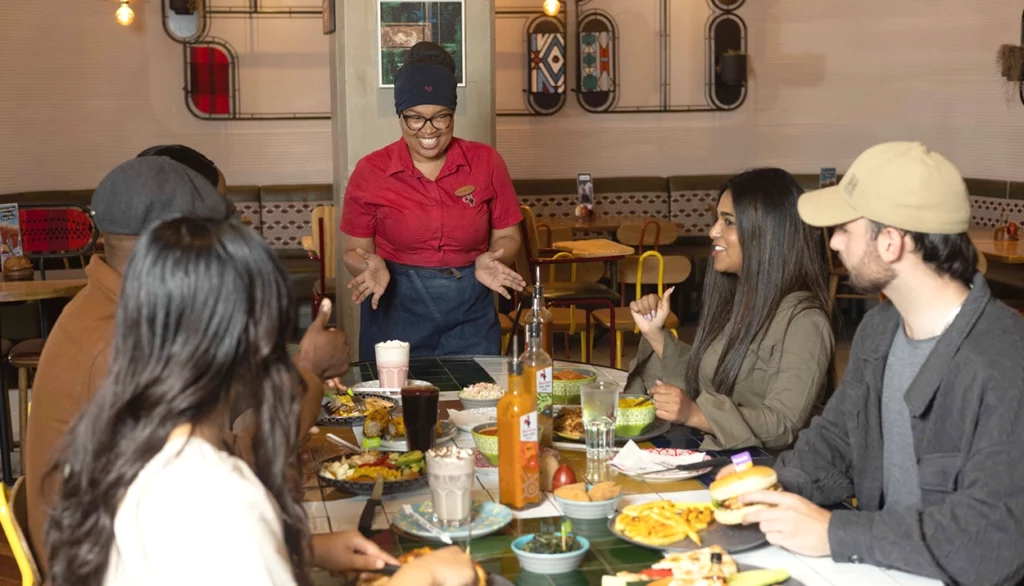
Of all the findings, ordering the drinks was the moment that surprised the team most, and the one with the clearest commercial implication.
When guests were asked which moment was their least favorite, just 8 percent named drinks as a high point across all three markets. The instinct was to assume something was going wrong there. The ratings said otherwise. Drinks scored between 4.3 and 4.7 out of 5, relatively consistent with other moments.
Ordering drinks is the only moment in the visit where a guest is sitting still, holding something, with staff nearby, and nothing is happening. They have ordered and are hungry. They have no idea how long the food will take. They take a sip and then sit there watching the kitchen. That is where ‘hungry turns into hangry’ because nobody attended to the guest’s waiting time.
One guest put it plainly: “The drink should have come earlier. There’s nothing to cook in it, but it took so long.”
The staff could have brought the drink earlier, and then simply say “Here’s your drink, your food is about two minutes away”.
In one sentence, the limbo is gone, the guest is informed, and a withdrawal becomes a deposit. This is the reframe the research produced: drinks are not a functional service step. It is the most emotionally available moment in the visit, and right now nobody is owning it.
The Moment Twin: Pricing the Value of Change Before You Make It
Identifying the moments that matter is one thing. Knowing what it is worth to change them before committing the investment is another question entirely, and it is the one that most experience research cannot answer.
This is where the Moment Twin came in. It is a small predictive model, trained only on data from Nando’s own study, that acts as a digital replica of the arrival-to-first-bite journey. Its job is to run change scenarios: what happens to Brand Love if we (for example) add a credible wait-time cue at the seated moment, with everything else held steady? What is the effect of adding a warmth cue at drinks? How much does a brief authentic framing line at first bite move the needle?
The word small here is deliberate. This is not a general-purpose AI system that makes broad claims. It is a narrow, purpose-built tool trained on a specific dataset to answer a specific set of questions within clearly defined parameters. And the step that matters most in the process is human review.
Every suggestion from the twin was assessed by Nando’s and Borderless Access teams for tone, realism, and whether it actually sounded like something Nando’s could and would do in a real restaurant on a busy Friday night. A significant number of suggestions were filtered out. The ones that survived that review were then quantified for impact.
The outputs were specific and actionable by market. In Western Europe, the two strongest opportunities were at the seated stage—through a check-in and clear wait estimate—and at first bite, by building anticipation as the food arrives. Together, these could lift Brand Love from 4.19 to 4.74, the largest increase across the three markets.
In Southern Africa, the focus was on arrival, by introducing a host at the entrance, and first bite, through a warmer food handover. With Brand Love already high, these changes were designed to protect and strengthen an established relationship, lifting the score from 4.58 to 4.74.
In South Asia, a check-in and wait estimate while seated, combined with a freshness message at first bite, could raise Brand Love from 3.95 to 4.45. In a newer market, these moments also help explain what makes the Nando’s experience distinctive.
In every single market, the intervention that moved brand love the most was a gesture or a sentence, at the right moment, from a member of staff. The question was never solely about the food, the environment, or the operational process. It was about the language of experience, and which words, spoken at which moment, leave the maximum emotional impact.
Download the eBook to find out which sentence, at which moment, and what that means for your brand.
The Pattern That Lives Outside of Restaurants
Before closing, the presenters made the point that is most important for any CXO audience reading this outside the restaurant industry.
A hotel invests heavily in the lobby and the room. Some of the relationships with the guest is decided at checkout, when they are tired, when there is a queue, and all they want is to leave without friction. A bank invests in its branches and its app. Some of the customer relationship is decided at the call centre queue when something has gone wrong, and the customer does not know if they have even been heard. A car retailer invests everything in the showroom and the test drive. Some of the relationship is decided at the first service visit, when something has already gone wrong and the brand has one opportunity to recover it.
In every case the pattern holds: the moment where the customer is waiting, uninformed, and not in control tends to receive the least design attention of any moment in the journey. And it is also, almost always, the moment with the most available emotional opportunity.
Look for the one in your customer journey has never actually been looked at properly. Measure that one while it is happening. Build a model to understand what changes it would be worth before the investment is committed. Then make the change with confidence rather than hope.
That is what this methodology offers. Not a theory about experience, but a repeatable, pilot-friendly instrument for turning real-time emotion into brand-building decisions that hold up under commercial scrutiny.
Your biggest CX opportunity may be hiding in a moment nobody is measuring. Connect with our experts to uncover the moments that can strengthen customer experience, loyalty and brand connection.