
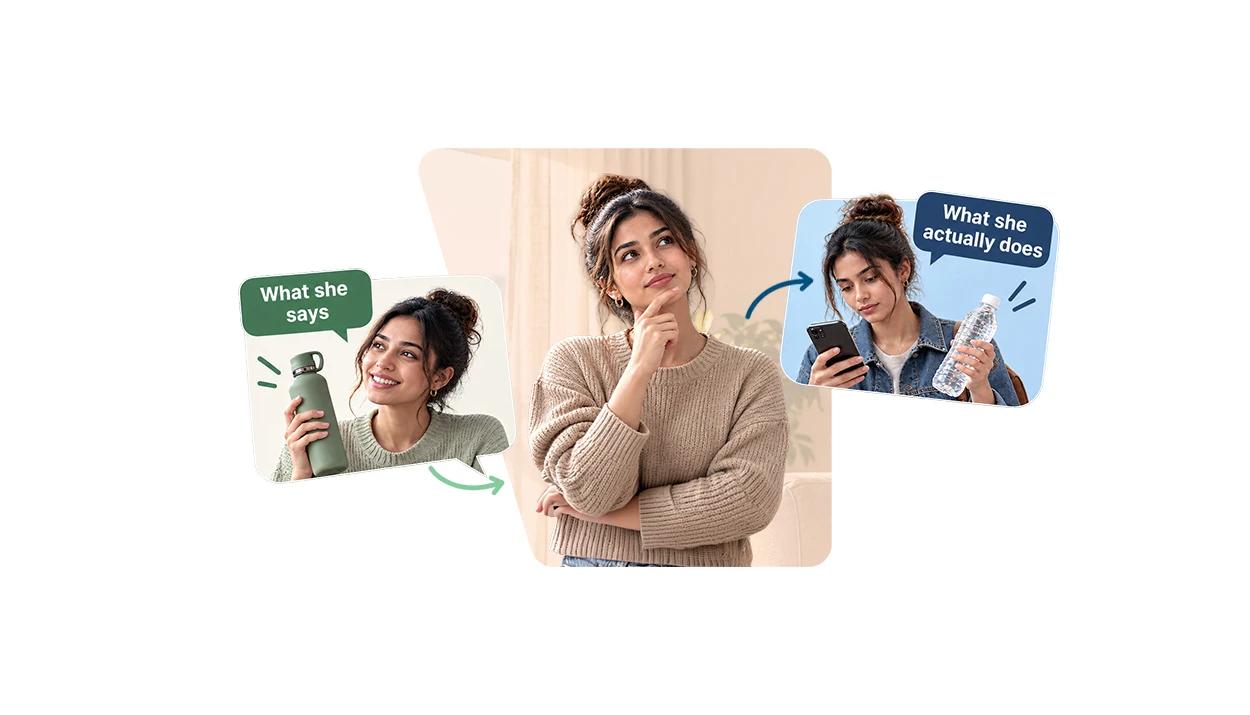

Consumer behavior is not always as predictable as consumer research suggests. People may say they prefer one product, intend to change a habit, or are willing to pay more for a certain feature. Yet what consumers say they will do does not always match what they actually do. This difference is known as the say-do gap.
According to NielsenIQ, this disconnect has contributed to more than 13 billion lost unit sales over 5 years across the industry.
The issue here is not that consumers are dishonest. Rather, their decisions are shaped by changing factors such as price, availability, habits, emotions and social pressure, which can make actual behavior differ from what they initially intended. As a market researcher, the real challenge is how do we capture behavior beyond stated intent.
Why Do Consumers Say One Thing and Do Another?
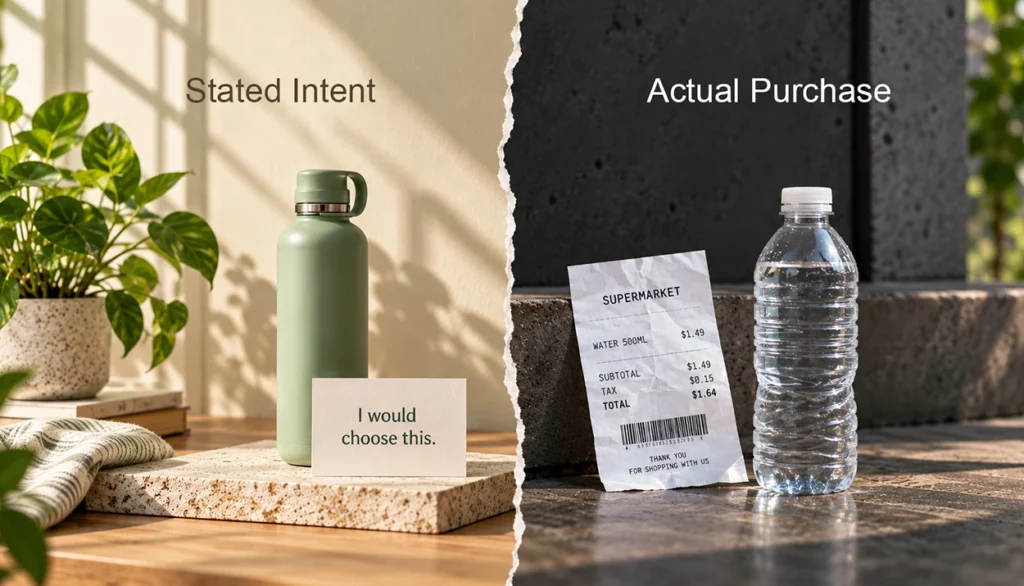
Consumers can give honest answers and still behave differently later. A person thinks or intends at a specific moment. On the other hand, a purchase captures the decision the consumer made under the influence of real-world factors.
A 2024 study by PwC shows us that 80% of consumers said they were willing to pay more for sustainably produced goods, with an average stated premium of 9.7%. But still, inflation, macroeconomic volatility, cost-of-living pressures, etc., may prevent this intention from translating into actual spending.
This highlights why understanding what consumers say is important, but understanding how those preferences hold up against real-world pressures can reveal a much clearer picture of consumer behaviour.
What is the Reason for the Increasing Say-Do Gap in Market Research?
The increasing say-do gap is driven by the difference between research conditions and real decision environments. Here is a detailed understanding of why the say-do gap happens.
1. Social Desirability Bias
People do not always report what they genuinely think or do. They can provide answers that feel socially acceptable or align with how they want to see themselves. This can affect research on various factors. This can affect sustainability, health, spending, technology adoption and personal values.
For example, employees may claim to use AI tools regularly to appear tech-savvy and productive for a survey on workplace technology. In practice, they may rarely use these tools. The response reflects the image they want to project rather than their actual behavior.
2. The Intention-Behavior Gap
People often have clear intentions about what they want to do, but intention alone does not always lead to action. This is known as the intention-behavior gap. The gap can appear when a person is motivated to make a certain decision but lacks the right conditions or ability to follow through.
A consumer may tell a researcher that they plan to buy a reusable water bottle instead of using disposable ones. They are motivated to make the switch, but when it is time to buy, they keep putting it off and continue purchasing bottled water.

3. Recall and Memory Bias
Consumers may also struggle to remember exactly what they did. According to a study by DISQO, 38% of consumers incorrectly recalled their digital shopping behavior. The study also looked at how confident respondents were in recalling their online behaviour. Interestingly, even when their answers were accurate, consumers were not always certain that they remembered their actions correctly.
How to Close the Say-Do Gap with Behavioral Measurement?
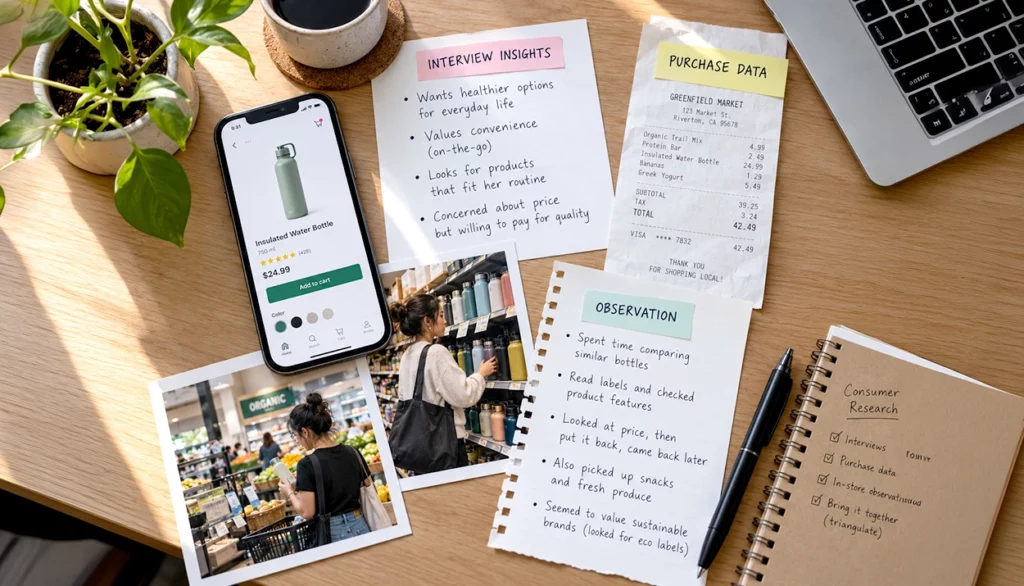
If you want to close the say-do gap, it requires you to move from isolated statements toward evidence that reflects real choices and decision contexts. Here are some approaches which can help you closing say-do gap effectively.
- Measure Revealed Preferences: Track purchase records, clicks, product selections and usage patterns to understand what consumers actually choose.
- Add Implicit and Emotion Measurement: Explore how emotions, subconscious cues and instinctive reactions influence consumer buying decisions.
- Observe Consumer Behavior Beyond Stated Intent: Compare what consumers say with how they behave at the point of purchase to identify contradictions.
- Recreate Real-World Decision Contexts: Test consumer choices under conditions such as price changes, competing offers, limited availability and time pressure.
- Scale Research to Reveal Behavioral Patterns: Use large, targeted samples to identify recurring behavioural differences across demographics, regions and consumer groups.
- Triangulate Multiple Data Sources: Combine surveys, qualitative research, purchase data, behavioural signals and experimental evidence for a more complete picture.
Key Observation: According to NIQ’s 2026 Outlook, 54% of CMOs struggled to connect data across different sources. It shows a broader problem in modern insight management. The challenge here is not collecting more data. The challenge here is connecting the right data.
- Validate Against Real-World Outcomes: Compare research findings with sales, repeat purchases and campaign performance to assess whether stated intent translates into action.
Going Beyond What Consumers Say
Consumers may know what they want or what they want to do. At the same time, their decisions can change when they encounter real-world trade-offs, emotions, social influences or practical constraints. Here, qualitative research can help you uncover what happens beneath the surface, when the stated preferences do not fully explain consumer buying decisions.

At Borderless Access, we combine immersive qualitative capabilities, connected communities and our proprietary Deep Sense™ solution to move beyond what consumers remember or report.
Instead of treating contradictions in consumer responses, it explores the tensions behind purchase moments and helps brands understand why those choices matter. Deep Sense™ helps brands with the following:
- Uncovers hidden emotions of consumers
- Explores consumer contradictions
- Explains the ‘why’ behind consumer behaviour
- Captures consumers’ decision-making contexts
These capabilities make Deep Sense™ valuable across different industries such as CPG, retail, food and beverages, technology, beauty, BFSI, automotive, healthcare and travel. It helps brands uncover the human motivations behind consumer choices and understand what drives decisions beyond stated preferences.
Turning Behavioural Signals into Better Decisions

The say-do gap is not a problem that research can remove. It is a signal which shows that consumer buying decisions are shaped by more than stated intent. The more useful question here is what changes between interest and action, and also what that means for the next business decision.
For brands across different industries, that context can make the difference between a research finding that sounds positive and an insight that can guide a real product or marketing decision.
With Deep Sense™, Borderless Access helps bring behavioural signals, consumer language and cultural context together. So, brands can explore what sits behind the final choice.
FAQ’S
- What causes the say-do gap in consumer research?
The say-do gap can happen when brands capture stated preferences without any real-world context of the final decision. Price, habits, social influence, availability and emotional responses can all change what consumers eventually do.
- What is the role of behavioral measurement in consumer research?
Behavioral measurement captures actions. For example, it captures product choices, interactions, usage and purchase patterns. It adds evidence beyond what consumers report in surveys.
- How does Borderless Access support consumer behavior research?
At Borderless Access, we combine global consumer panels, qualitative research, behavioral testing, concept testing and data-quality frameworks. Through our approach, we help brands understand real consumer decisions.
Understanding what consumers say is only part of the picture. To uncover what drives their actual choices, connect with our team at Borderless Access.
Contact us to discuss your consumer research needs.