

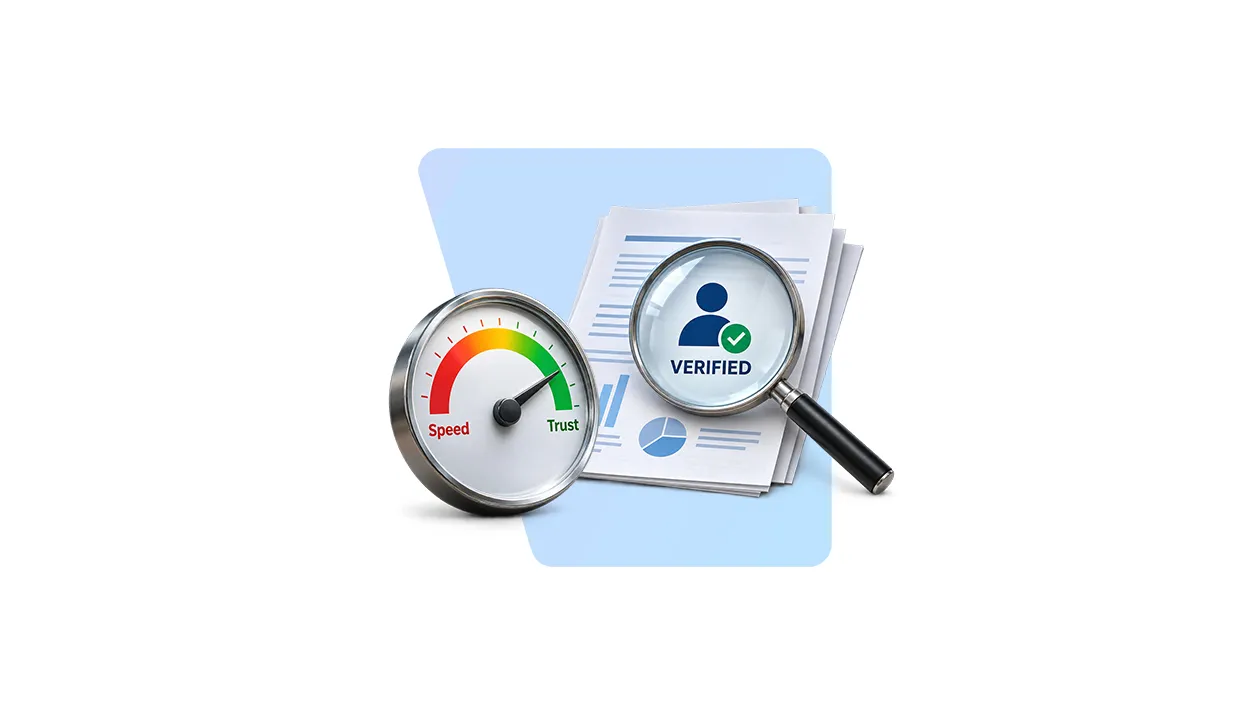

Research workflows have become substantially faster, particularly in data processing, synthesis and reporting. McKinsey documented the shift from traditional research timelines measured in months to digitally enabled studies completed in days or weeks. A 2025 global survey by the Market Research Institute International involving 426 market researchers found that 85 percent identified time savings as a benefit of AI. Separately, a 2025 US insights-professional study by The Harris Poll found that 56 percent reported saving at least five hours a week using AI, while 43 percent said AI accelerated insights delivery.
Questions that once required weeks of fieldwork, analysis and reporting can increasingly be answered in days, sometimes hours. Automation is compressing workflows. AI is accelerating survey design, coding, analysis, and synthesis. Social media listening, behavioural and transactional data, and other connected sources are also expanding how quickly market signals can be captured and examined. Programmatic sampling can connect studies to respondents instantly.
For business leaders, research directors and procurement teams, this is progress. Markets do not wait for research. Decisions about pricing, innovation, communications, customer experience, and market entry often must be made while circumstances are still changing.
Slow insight can become irrelevant insight. But the pursuit of speed has created another risk.
When research becomes faster than our ability to establish where the evidence came from, who contributed it and whether it can be trusted, speed stops being an advantage. It becomes exposure. That is why I believe the next competitive frontier in research is not speed alone. It is trusted speed.
Speed Has Value. False Confidence Has a Cost.
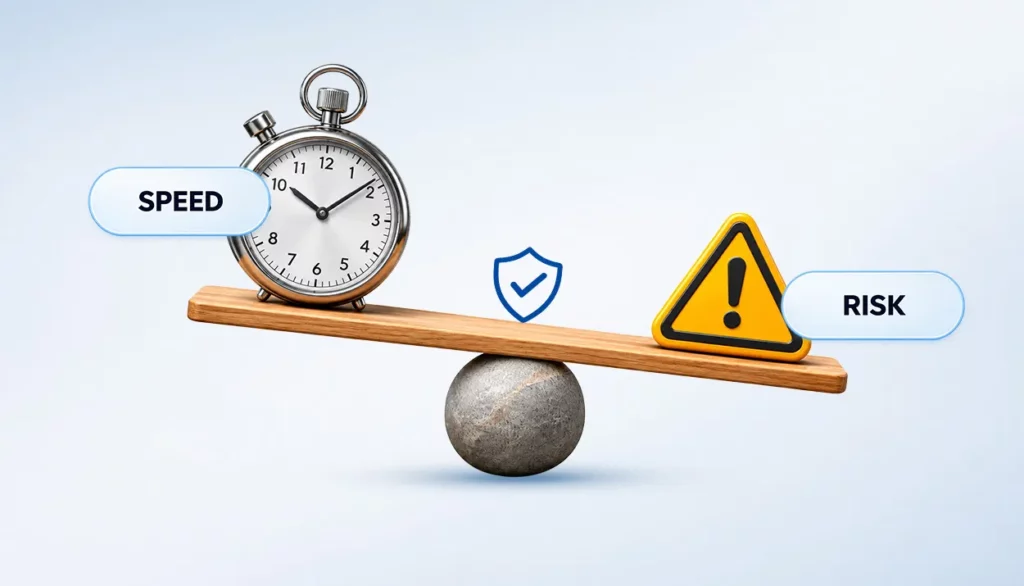
There is a natural temptation to treat research turnaround time as a measure of efficiency.
- Can we deliver decision-ready insights faster?
- Can fieldwork close sooner?
- Can AI generate the report instantly?
- Can we reduce the cost per interview?
All are legitimate questions. But none answers the most important one:
Would I make a consequential business decision based on this evidence?
That distinction matters because a research output does not create value when it reaches the inbox. It creates value when someone is sufficiently confident in it to act.
The broader business consequences of poor data quality are already substantial. IBM reported in 2026 that 43 percent of chief operations officers identified data quality issues as their most significant data priority. More than a quarter of organisations estimated losses exceeding US$5 million annually from poor data quality, while 7 percent reported losses of US$25 million or more.
Those figures extend beyond market research, but the principle is directly relevant. A fast answer that sends a business in the wrong direction is not cheaper research. It is an expensive decision delivered inefficiently.
The Quality Problem is not Theoretical
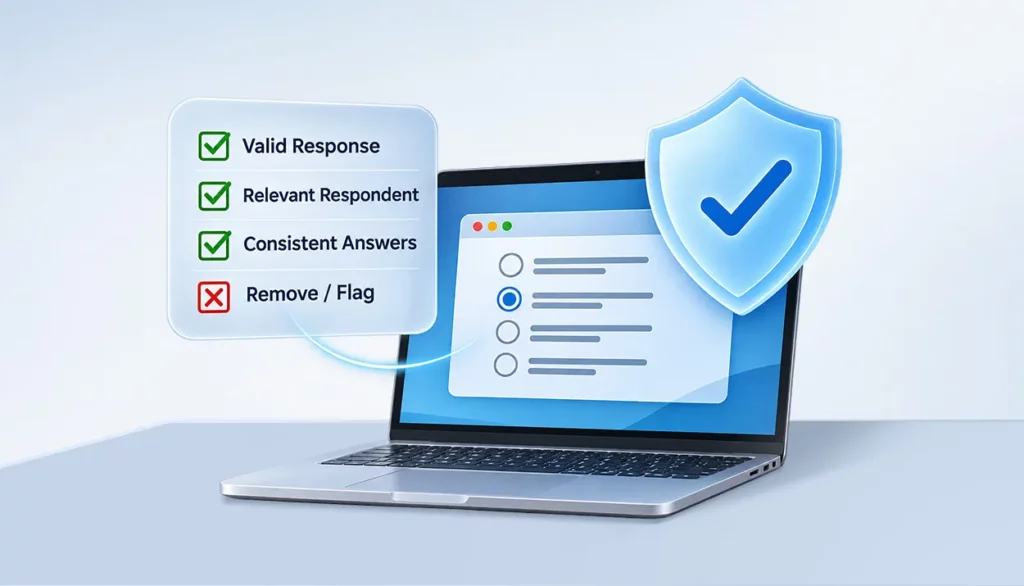
The insights industry has good reason to take this seriously. Insights Association’s H1 2026 Global Data Quality Benchmarking Report analysed 1.8 million survey records across 13 countries.
It found global pre-survey and in-survey respondent removal rates of 28.5 percent among research agencies and 21.2 percent among sample suppliers. B2B research was identified as the most challenging environment for data quality, with particularly high removal and post survey cleanout levels.
Think about what those numbers mean.
Before interpretation begins, before an insight enters a presentation, before a recommendation reaches a decision maker, a sizeable proportion of incoming activity may already require detection, validation, or removal.
Fraud is no longer a peripheral operational issue. The Insights Association has described survey fraud as an existential challenge for the research industry, noting that researchers frequently remove double digit percentages of completes during cleaning. And as AI generated responses, automated traffic and increasingly sophisticated digital identities become easier to create, the distinction between a completed interview and a trustworthy interview becomes even more important.
Completion is a transaction. Credibility is an outcome.
Speed Can Hide the Supply Chain
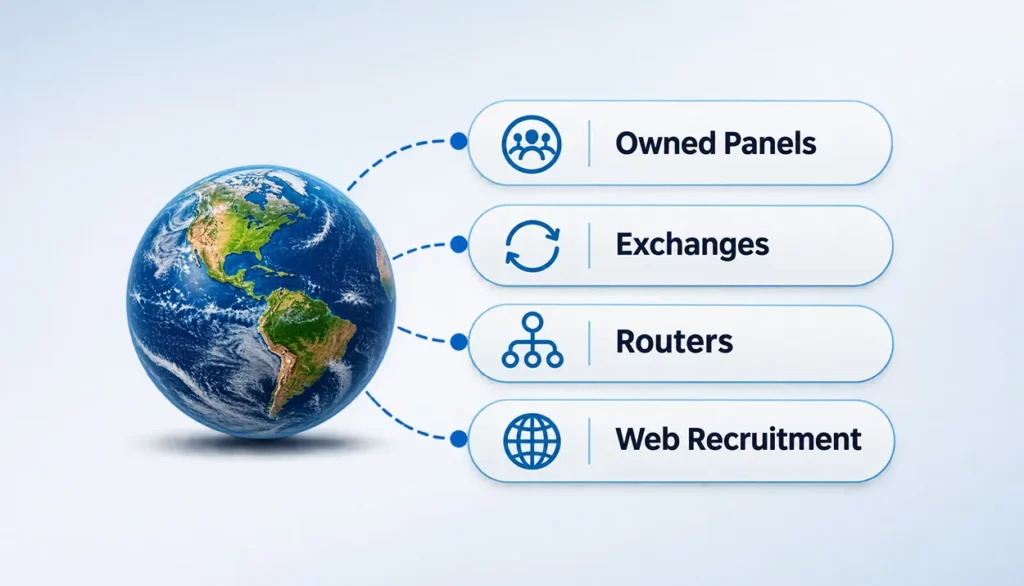
One of the less visible consequences of modern research infrastructure is that obtaining sample has become easier while understanding its provenance can become harder.
Participants may enter research through owned panels, exchanges, aggregators, routers, programmatic marketplaces, web recruitment, or combinations of several sources. That ecosystem creates enormous flexibility and speed. It also creates an important question for buyers:
Do we know who answered the research?
In August 2026, the Insights Association released a Sample Supply Transparency Framework specifically to improve visibility into participant sourcing, routing, validation, incentives, privacy protections, quality controls, and supplier oversight.
The timing is significant.
As research becomes more automated, provenance becomes more important, not less. Procurement teams understandably examine price, feasibility, and turnaround time. But a modern research specification should increasingly include another dimension: traceability.
- Where did the respondent come from?
- How was identity assessed?
- How many sources contributed?
- What quality controls were applied before, during and after participation?
- Were incentives appropriate?
- How was privacy managed?
Speed should not make those questions disappear. It should make the answers easier.
Trust is More than Fraud Detection
There is another danger in the quality conversation. We can reduce research trust to fraud prevention. Fraud detection matters enormously, but high-quality research requires more than proving that a human exists behind a response.
- A verified respondent can still be disengaged.
- A legitimate participant can still misunderstand a poorly constructed question.
- A real physician can still provide weak evidence if recruited into an irrelevant study.
- A genuine consumer can still rush through a survey that is unnecessarily long or confusing.
Research from Kantar illustrates the point. It’s testing found that asking about working status in a way that implies employment is desirable can lead to a 20 percent overclaim. In another test, giving people acceptable reasons for not exercising reduced false claims by 50 percent. Even genuine respondents can provide misleading data when questions are poorly framed.
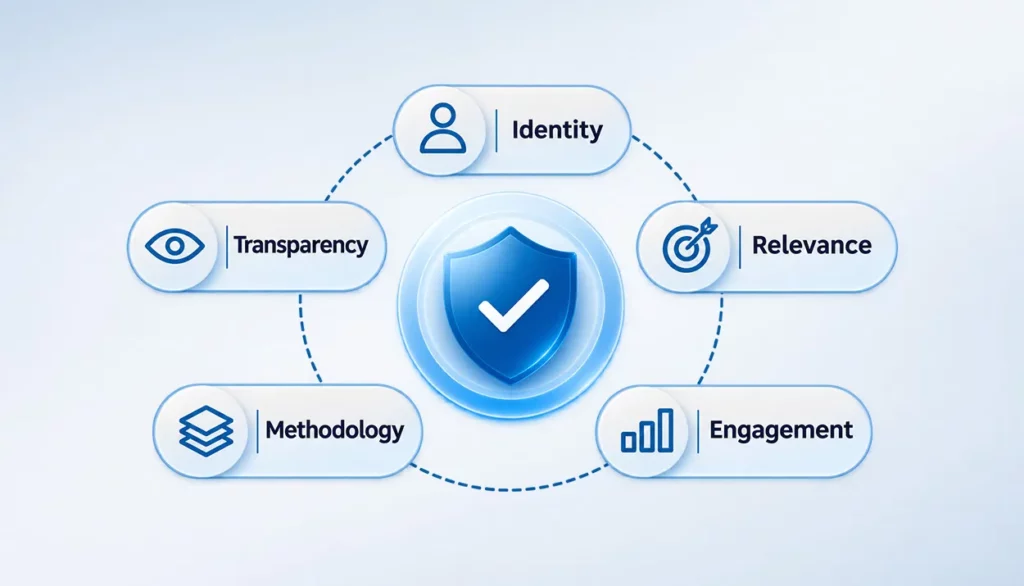
Trust therefore has several layers.
Identity. Relevance. Engagement. Methodology. Transparency. Interpretation.
Remove any one of them and a technically completed study can still produce weak evidence. That is why quality cannot simply be inspected at the end. It must be designed into the research process.
AI Makes this More Important, Not Less
AI will make research faster. It already is.
Survey creation, translation, open-end coding, quality detection, analysis, knowledge retrieval, synthesis, and reporting are all being accelerated. The latest GRIT analysis has documented rapid increase in AI use across research workflows, including a ninefold year over year increase in buyer side researchers using AI for report writing.
This creates enormous opportunity.
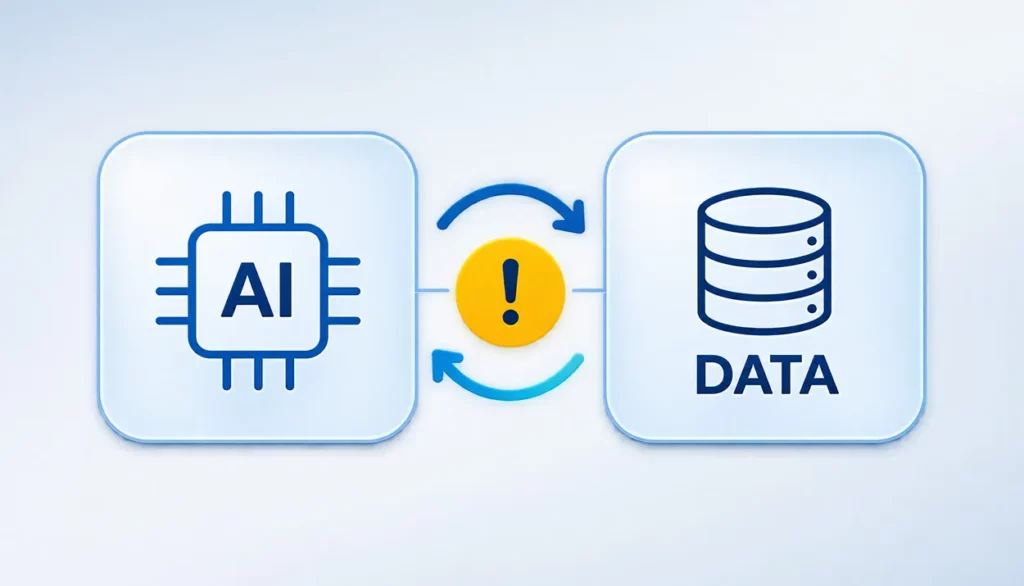
But AI also increases the leverage of the underlying evidence. If inferior quality information enters an automated research system, AI can summarise it faster, connect it more convincingly and distribute the resulting conclusion more widely. Automation does not correct weak evidence simply because the output looks intelligent. It can amplify it. This is why data integrity becomes more consequential in an AI enabled research environment.
ISO’s newly published ISO 20252:2026, the international standard for market, opinion and social research including insights and data analytics, reflects this changing environment. The revised standard covers the research lifecycle, while industry guidance around its release highlights strengthened provisions around AI and automation, sampling, panel management, and data quality.
Innovation and rigor are not opposing forces. Modern standards increasingly recognise that they need to evolve together.
The False Choice Between Speed and Quality
The industry sometimes frames this conversation incorrectly. One side argues that research must become dramatically faster. The other warns that quality takes time.
Both can be right, but the conclusion should not be compromise.
The objective should be to redesign research so that quality itself becomes faster. Identity validation should increasingly happen before participation rather than during weeks of retrospective cleaning.
- Fraud signals should operate in real time.
- Sampling provenance should be visible rather than reconstructed after fieldwork.
- Quality controls should be embedded across the respondent journey.
- AI should detect anomalies while research is happening.
- Data should arrive decision ready rather than requiring layers of manual repair.
This requires technology, better process design, and greater accountability across the research supply chain. But it also requires something more fundamental: accepting that quality is not the stage that slows research down.
Poorly designed quality systems do.
The industry should not be asking how much quality it can afford while moving faster. It should be asking how to engineer trust at the same speed as the research itself.
Specialised Audiences Raise the Stakes

This becomes particularly important in B2B and healthcare research.
The GDQ benchmarking data already shows B2B among the most challenging environments for data quality. Healthcare patient audiences also continue to create forecasting and quality challenges.
These are precisely the audiences where false positives can be most damaging. A consumer claiming to buy a particular beverage is one type of quality problem. Someone falsely presenting themselves as a procurement leader, oncologist, IT decision maker, or patient with a specific condition creates an entirely different level of research risk. The more specialised the respondent, the greater the commercial value of their opinion and often the greater the incentive for misrepresentation.
This changes the economics of quality.
For difficult audiences, respondent verification is not an operational detail. It is part of the research methodology. Research buyers should know not only whether a target can be reached quickly, but how confidently that target can be authenticated.
Procurement Has a Role in Protecting Trust

This is why the conversation cannot sit only with research agencies and sample providers. Procurement influences the research ecosystem through the metrics it rewards. If suppliers are evaluated overwhelmingly on cost, incidence assumptions and turnaround time, the market naturally optimises toward those measures. But a supplier delivering an interview faster or cheaper is not necessarily delivering the same product.
Research procurement increasingly needs to evaluate:
- Who supplied the audience?
- What validation occurred?
- What removal rates were experienced?
- What quality signals are available?
- What happens when multiple supply sources are blended?
- How are privacy and consent managed?
- How transparent is the supplier when something goes wrong?
Trust should become part of commercial evaluation rather than an assumption buried inside the contract.
The Real Measure of Research Speed
Modern organisations absolutely need faster insights. I would argue that the insights industry should become faster than it is today. Technology, automation, and AI give us the opportunity to remove enormous amounts of friction from research.
But we should be careful about what we optimise.
The fastest fieldwork is not necessarily the fastest route to a good decision. A questionable dataset that requires repeated cleaning, recontacting respondents, rebuilding samples, debating methodology or rerunning research creates delay.
Trust, by contrast, reduces friction downstream.
When leaders understand where evidence came from, how respondents were validated and how quality was protected, they spend less time debating whether the research is credible and more time deciding what to do with it.
That is the speed that matters. Speed is a service metric. Trust is a decision requirement. The future of research should not force organisations to choose between the two. It should deliver both. Because the competitive advantage is not producing an answer before everyone else. It is producing an answer quickly enough to matter, and credibly enough to act on.
——————————————-