



Over the past decade, the market research industry has driven panel costs down with impressive consistency. Faster turnarounds, larger samples, tighter budgets. The economics made sense on a spreadsheet. What they obscured was a quieter transaction: as prices fell, so did the scrutiny applied to who was actually answering the surveys.
Most research buyers did not know they were making that trade-off. But the market dynamics they created had that effect. And now, with generative AI making it trivially easy to produce synthetic survey responses that pass conventional quality checks, the bill is coming due.
The question facing every research leader today is whether they have the infrastructure to know if their survey data is fraudulent or not.
Threats Have Become More Sophisticated. The Defenses Have Not.

For most of the history of online research, fraud was a human-scale problem. Click farms, panel stuffing, and inattentive speeders. The industry built reasonable countermeasures: attention checks, red-herring questions, duplicate IP removal, speeder thresholds. Those tools worked reasonably well against human adversary cutting corners.
Generative AI changed the equation. A single operator with access to widely available AI tools can now produce hundreds of survey responses that are contextually coherent, demographically consistent, and behaviorally plausible. They fall within normal response time distributions. They pass consistency checks. They produce open-ended verbatim that reads like a real person wrote it.
The fraud problem is not just scaling. In certain dimensions, it is becoming harder to detect precisely because the outputs are getting better.
And the structural weakness in traditional quality control makes this worse: most of it is applied post-field. The data is collected first. Quality is assessed afterward. By the time a problem is detected, the study is done, the timeline is spent, and the pressure to accept an imperfect dataset rather than refund and re-field is significant.
What Is Actually Getting Through: A Closer Look at the Numbers
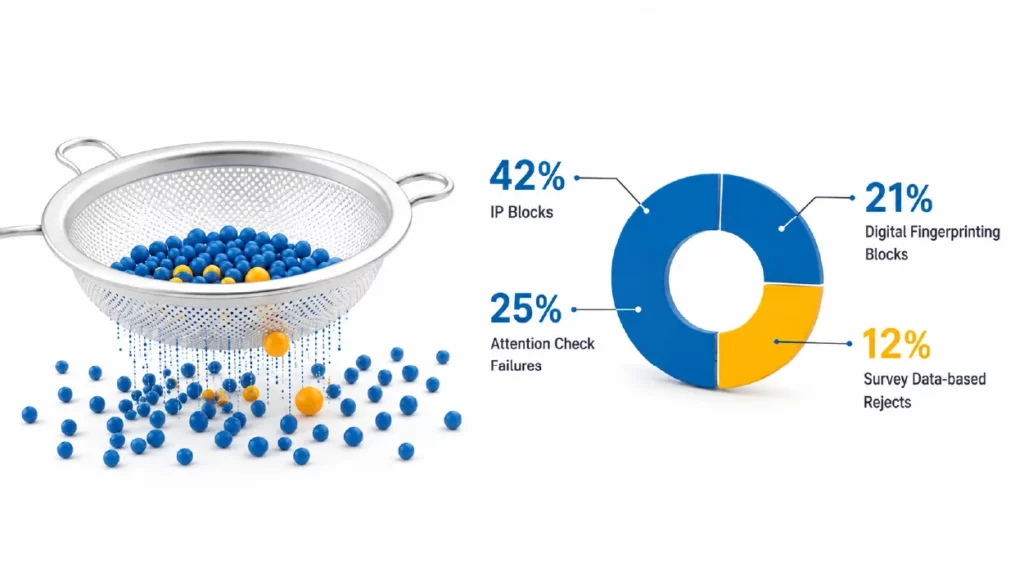
Borderless Access tracks quality failure patterns across all markets it serves. The internal data, drawn from a 12-month monitoring period, reveals something that should give every research buyer pause.
Across the quality failure categories observed, IP blocks accounted for the largest share of failures at 42 percent, driven by suspect IP addresses attempting to infiltrate panels. Digital fingerprinting blocks followed at 21 percent, catching duplicate responses based on browser settings, geolocation inconsistencies, and anonymous proxy use. Attention check failures represented 25 percent of quality rejects, while survey data-based rejects, where respondents simply failed to meet basic data hygiene standards, made up the remaining 12 percent.
Taken together, these figures point to one conclusion: in the absence of multi-layer, real-time quality infrastructure, a significant portion of what arrives in a dataset is not what it appears to be.
How Data Quality Failures Differs Across Geographies
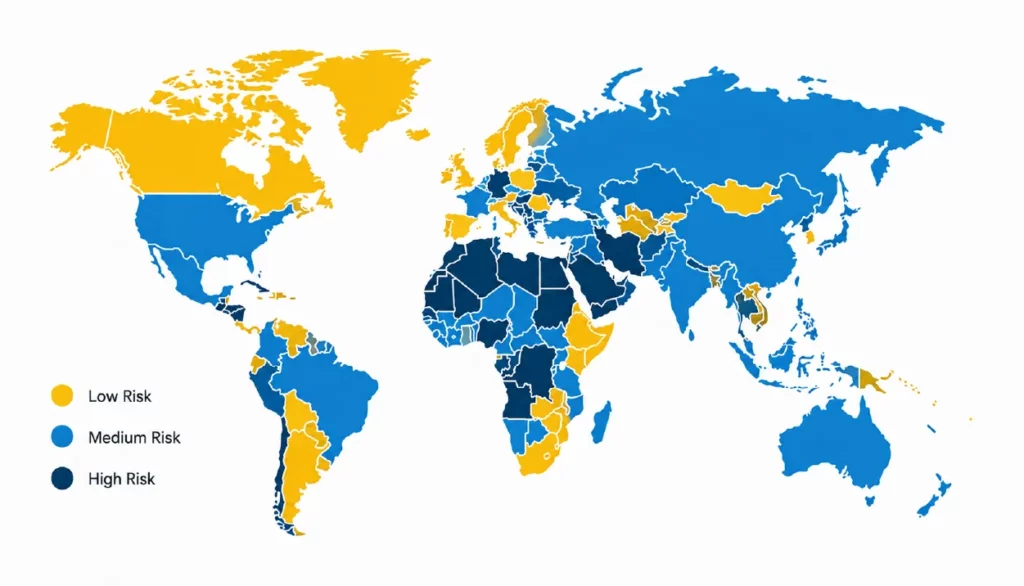
Here is something most quality conversations miss entirely: the fraud risk profile of a study is not uniform across markets. It varies substantially by country, and those variations are not random. They reflect differences in panel maturity, digital infrastructure, economic incentive structures, and the sophistication of local fraud networks.
The heatmap above, drawn from Borderless Access panel data across global markets, shows quality failure rates ranging from low to high across more than 50 countries. Markets classified as high-risk are not necessarily the ones that intuitively come to mind. Some developed markets show elevated fraud attempt rates. Some emerging markets show surprisingly low ones. The pattern reflects local dynamics that a one-size-fits-all quality approach is structurally incapable of addressing.
For a research leader running a 20-market global study, this has a direct operational implication. The quality control calibration that works in Germany does not necessarily work in Nigeria or Vietnam. A quality program that does not adapt to market-specific fraud patterns is not a global quality program.
Taking a Multi-Layered Approach to AI-Driven Fraud Detection
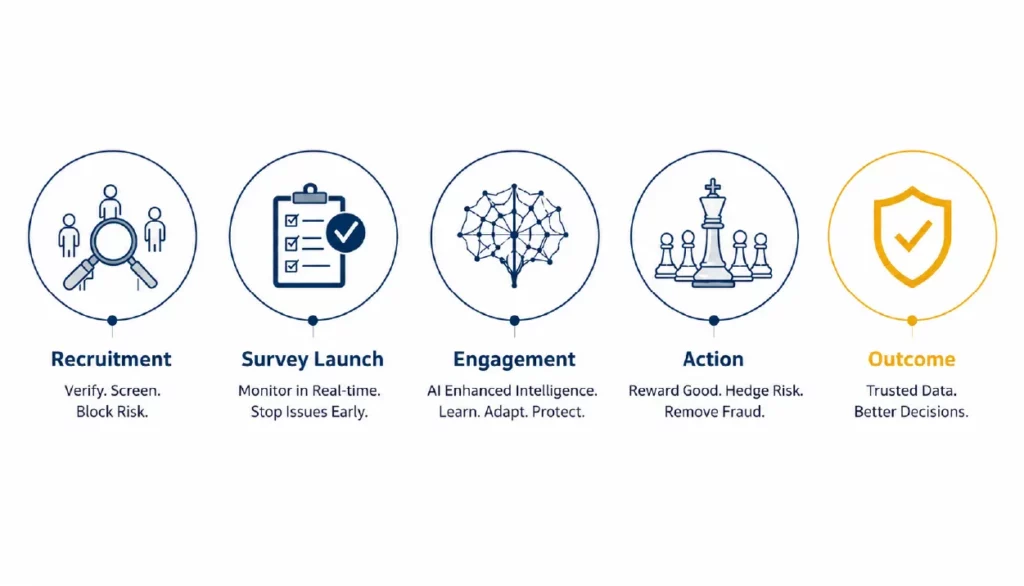
The architecture that defends against modern fraud is not a single check. It is a sequence of interventions across the full lifecycle of respondent participation. Across B2B, B2C, and healthcare research, Borderless Access treats data quality as the core of what makes our data trustworthy.
Our quality control framework, QMan™, is an AI-powered fraud detection framework that oversees the full lifecycle of respondent participation.
- At recruitment, the entry gate applies digital fingerprinting across 250-plus parameters, VPN blocking, geolocation verification, triple opt-in with OTP validation, reCAPTCHA, and for niche audiences including physicians and patients, mandatory authorisation documents such as medical licence copies, patient prescriptions, and employment authorisation documents. Approximately 40 percent of all recruitment traffic is rejected at this stage for failing to meet entry criteria.
- At survey launch, real-time monitoring kicks in. Server-to-server postback identifies survey skippers. Dynamically rotated attention-check pre-screeners are triggered based on the respondent’s persona profile. Duplicate IDs and IPs are auto-removed. Interview length is flagged in real time when it falls outside acceptable parameters.
- At engagement, supervised and unsupervised machine learning models evaluate each respondent’s behaviour continuously, assessing response rates, completion patterns, redemption behaviour, and time intervals between survey interactions. The output is a multi-level respondent ranking that drives corrective action: rewarding good actors, nudging suspect ones, evicting bad ones, and running re-engagement campaigns for fatigued respondents who still have value.
As a future-forward market research company, we go beyond the mechanics of verification, in how we understand our panelists, profiling them not just by demographics, but by attitudes, motivations, and behaviors. Taken together, these elements represent a shift from reactive to proactive quality management — from checking data after it has been collected to building the conditions for clean data before and during collection.
The Question Every Research Buyer Should Now Be Asking
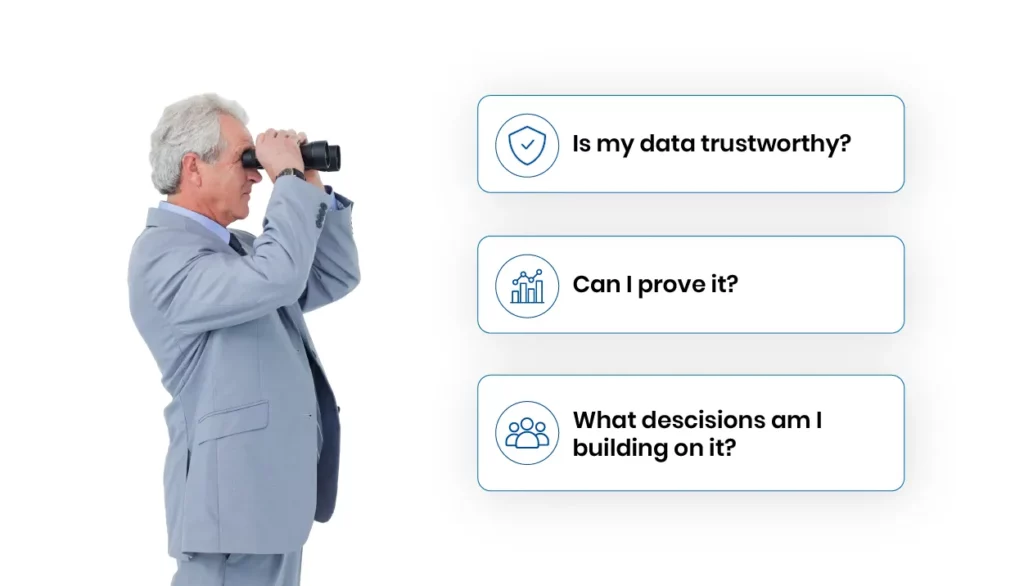
The industry conversation is moving. Research buyers who spent the last decade asking “how fast and how cheap?” are increasingly asking “how clean?” The suppliers who can answer that question credibly, with evidence rather than process descriptions, are the ones whose data is worth building decisions on.
The tools available to compromise data quality have advanced faster than the industry’s collective defenses. That gap is closeable. The organizations that close it first will hold an advantage that goes well beyond any single study.
To understand how our quality control framework can help you protect your research integrity and maintain the highest standards of data quality, speak to our experts.