


Key highlights from our co-presentation with Martens United Brands at Esomar 2026 that provides a fresh perspective on how we think about consumer behaviour research.
Let’s state something nobody says out loud in a debrief.
Segmentation studies in market research may look neat, distinct, and statistically strong, but that does not mean they will be useful to the business.
Too often, segmentation frameworks are created, presented, and then slowly forgotten because they are hard to activate in the real world. When that happens, the problem is usually blamed on execution, or even the client.
But what if we segmented the wrong thing to begin with?
That is the uncomfortable question we set out to answer. Drawn from a segmentation study that Borderless Access ran with Martens United Brands, the insight turned out to be a critical piece of methodological thinking in market research.
An Ordinary Study That Asked an Uncomfortable Question
The setup was familiar. Martens United Brands needed a proper understanding of consumers in a multi-category beverage segment in one of their key markets, sized well enough to build real commercial plans against. The methodology was sensible and sequenced correctly: online focus groups first to explore and understand the category, then an online survey to quantify it.
The qual before the quant was a deliberate choice; you cannot know what questions to ask until you have spent time inside the actual category. The survey needs to ask the right things, and the right things only become visible through conversation. That decision, unremarkable at the time, turned out to matter far more than anyone anticipated.
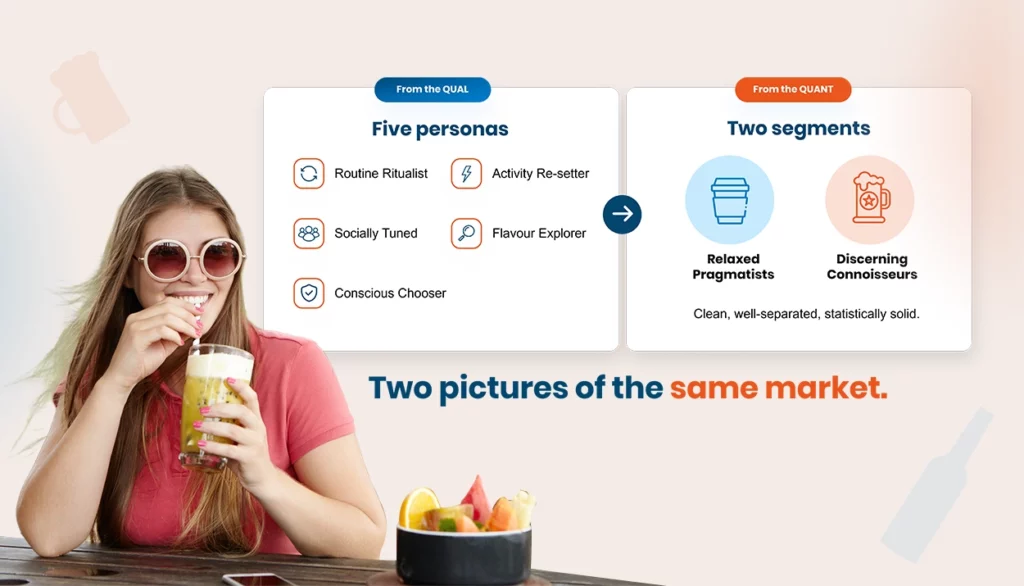
The qualitative phase produced five personas: Routine Ritualist, Activity Re-setter, Socially Tuned, Flavour Explorer, and Conscious Chooser. These personas captured observed behaviours and motivations, while the quant phase later created statistically defined segments. The two were designed to do different jobs—and that distinction became critical when they did not align perfectly.
The quant, on the other hand, produced two segments: Relaxed Pragmatists and Discerning Connoisseurs.
The team had a five-by-two situation with five personas, and two segments. The five personas were mapped against the two quant segments. Routine Ritualist and Activity Re-setter aligned with Relaxed Pragmatists, while Socially Tuned and Flavour Explorer aligned with Discerning Connoisseurs.
Four of the five fitted neatly; only the Conscious Chooser did not.
When the Mismatch Became the Finding
The Conscious Chooser emerged clearly in the qualitative work. These consumers wanted to feel confident about what they were choosing. Quality mattered. Trust mattered. The motivation was real and distinct enough to build messaging around.
The only problem was that the Conscious Chooser did not belong neatly to either quantitative segment. It appeared across both Relaxed Pragmatists and Discerning Connoisseurs.
Normally, that creates pressure to make the framework fit. You either force the persona into one segment, even when the evidence says otherwise, or leave it out altogether. In both cases, something important gets lost.
So instead of asking which method was wrong, the team asked a different question: what if the disagreement itself was telling us something?
That changed everything.
Quantitative segmentation is designed to identify differences between people. It groups consumers into relatively stable types based on how they differ from one another.
The qualitative work was revealing something else: differences within the same person across different situations. The person had not changed. The context had.
The two methods were not contradicting each other. They were measuring two different kinds of variation.
This finding gave the team a much more useful way to interpret personas:
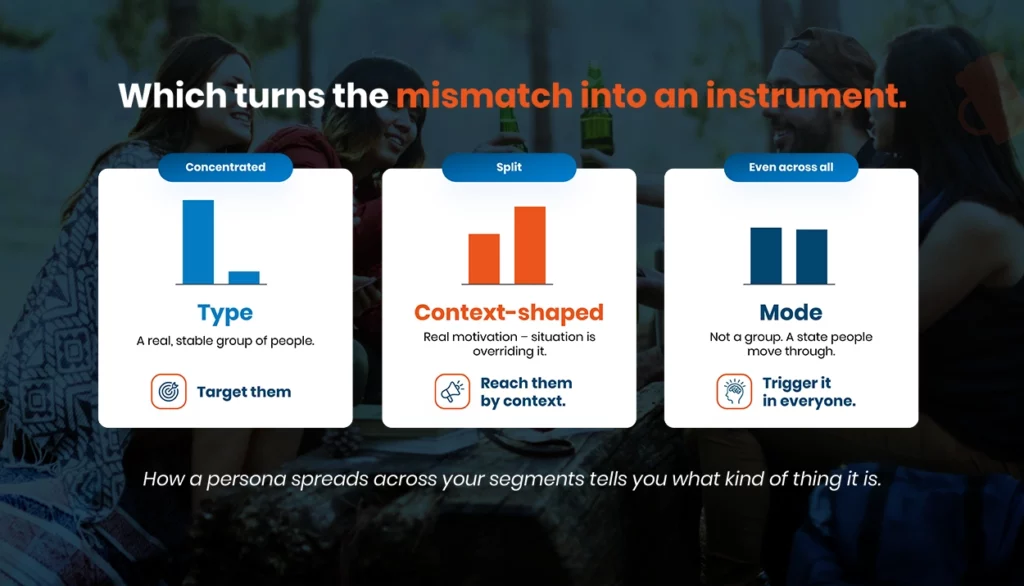
- When a persona sits mainly within one segment, it behaves like a type. It represents a relatively stable group of consumers with shared characteristics, making it something you can target directly.
- When a persona is split across two segments, the motivation is still real, but context is shaping how it appears. The same person may behave differently depending on when, where, or who they are with, so the opportunity is to reach them through the situation rather than identity alone.
- When a persona appears across the entire market, it is better understood as a mode. It is not a fixed group, but a state that different consumers can move into at the right moment. The question then shifts from who should we target to when and where is this mode most likely to be activated?
That was the Conscious Chooser. It was a motivational mode that could appear within either segment, triggered by the right occasion, message or stimulus.
Download our eBook to uncover the moments and motivations that could move consumers across segments and help you build more precise targeting, messaging, and activation strategies.
Stepping Beyond the Norms of Segmentation
This is where the thinking becomes practically useful, because the most elegant research insight is worth nothing if the business cannot act on it.
The Conscious Chooser sits across both as a layer. Not a third segment. Not an audience. A mode running through the entire market that can be triggered, in the right context, by the right stimulus.
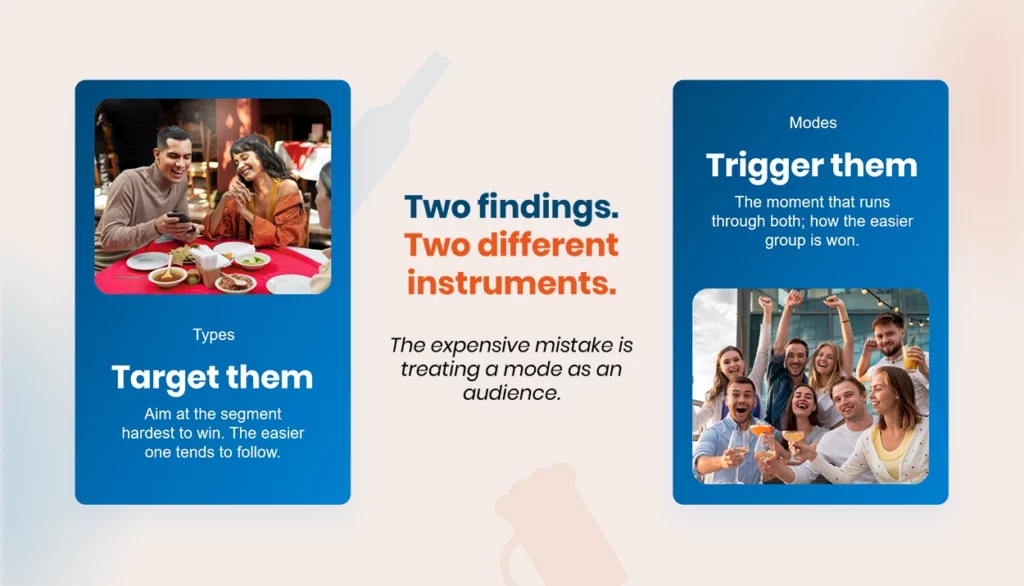
This distinction has direct commercial implications. The two segments are not equal in strategic value. One is harder to win — narrow, specific, and harder to please. The other is easier to win but also easier to lose; they will switch when something better appears. Rather than spreading investment across both equally, the team chose to aim at the harder segment, expecting that winning them would pull the easier segment along. And the Conscious Chooser mode is exactly what connects the two — a motivational state that, when activated at the right moment, moves both segments in the same direction simultaneously.
Target the types, trigger the mode. That became the sentence the team kept repeating to each other. The segmentation earns its place not just by dividing the market but by showing precisely where dividing was the wrong tool entirely.
When Exploration Meets Habit
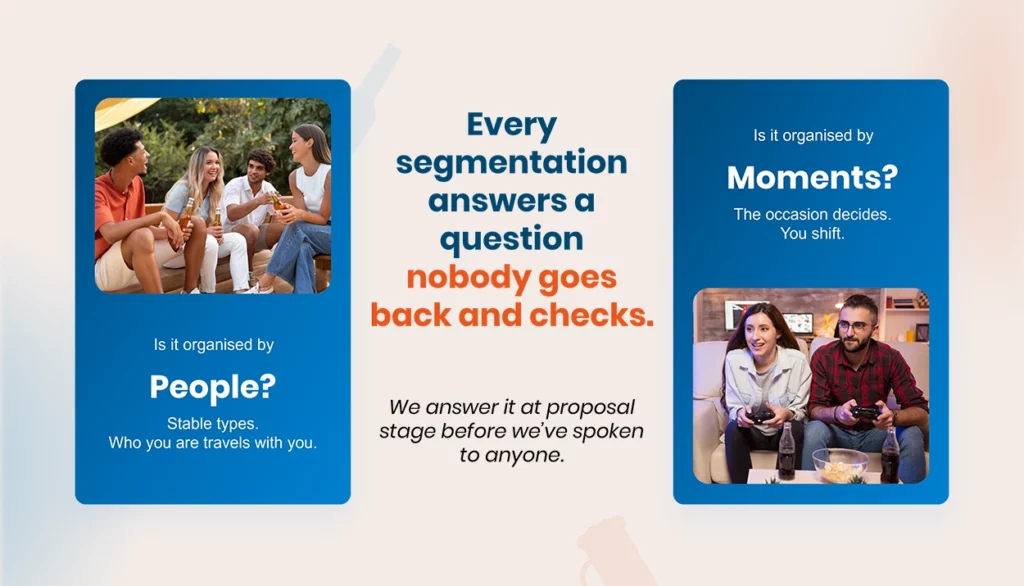
Consumers often say they want to try something new, but still choose the familiar option. Instead of treating this as a contradiction, the framework shows that both behaviours can be true at the same time.
The desire to explore is a mode — it appears in certain moments but is not always active. Habit, on the other hand, reflects the more stable type of behaviour that segmentation can capture.
The opportunity is not to decide which behaviour is more “real,” but to understand how they work together. Brands can target consumers based on their more stable behaviours, while activating the Conscious Chooser at the moments when they are most open to trying something different.
This creates a clearer path from segmentation to communications: target the type, trigger the mode.
The Takeaway That Requires No New Budget
What makes this framework genuinely useful for practitioners is that it does not require a new methodology, a new research design, or additional fieldwork. It requires a different reading protocol applied to work that most brand and research teams already have.
If your qualitative work ran before the quantitative study, as exploratory research almost always does, you already have an independent witness. A set of observations made before the segmentation existed, before the cluster solution was known, before anyone knew what boxes the data would produce. Those personas are not derived from the segments. They are independent of them.
Take those personas and map them onto the segments you have. Then map them to see how they spread. Concentrated in one segment? It is a type. Split across two? Context-shaped. Even across all of them? It is a mode. You need to read the shape and split the strategy accordingly.
The finding that does not fit is not the problem to be solved. It is often the most important thing in the model. Ours nearly got dropped. It turned out to be the thing that held the entire commercial strategy together.
Discover how our qualitative research reveals the emotions, cultural influences, and contextual motivations behind consumer behaviour.
Why This Matters More Now Than It Did Five Years Ago
There is a broader point worth making here, and it sits at the intersection of research methodology and the current state of AI-generated insights.
We can now generate more pictures of consumers faster than ever. AI has genuinely accelerated this. Synthetic personas, AI-generated segments, automated synthesis of qualitative data at scale, these are real productivity gains and most practitioners are using them.
But they change what is scarce. A picture built from your own data will tend to agree with your data. That agreement is the actual output. AI synthesis is built to find coherence, to organize, to resolve. It is not designed to produce disagreement, which teaches you something.
The useful question stops being how many pictures of consumers you have. It becomes which of these could have told me I was wrong? Those are the ones with real informational value. In the current environment, that is almost never going to be AI. It is going to be the method that was run independently, before the answer was known, with no access to the conclusions it would later appear to contradict.
The Next Time Qual and Quant Disagree
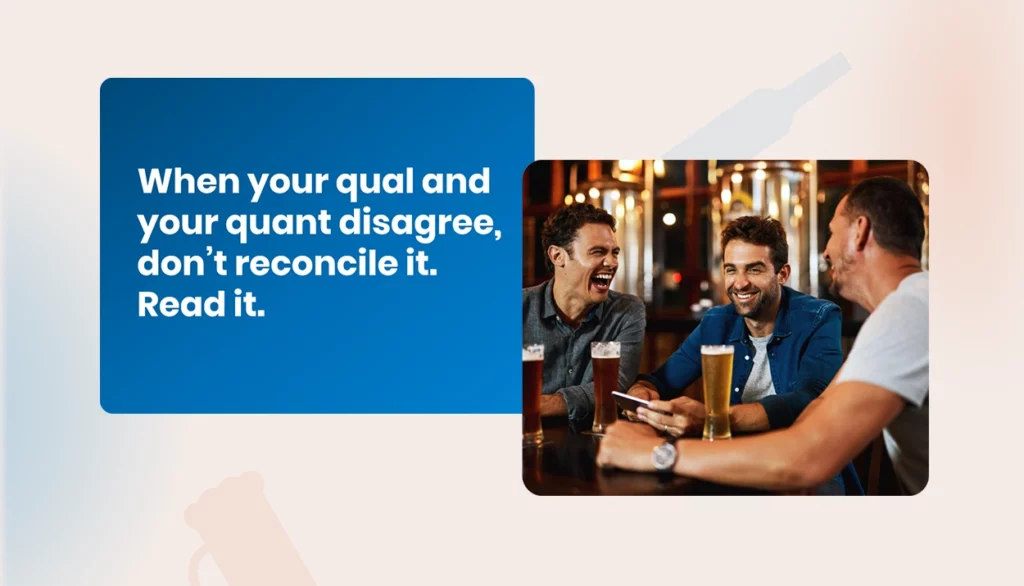
The next time a qualitative persona and a quantitative segment produce findings that do not map cleanly onto each other, resist the instinct to reconcile them. Resist the pressure to decide which method got it right.
Read the disagreement instead. It tells you whether the category is organized by people or by moments and what kind of instrument is needed to reach them.
At Borderless Access, this is the kind of thinking we bring to every segmentation engagement: not just the mechanics of running good research, but to make sure the most important findings in a study do not disappear into a folder.
Connect with our experts to build research that helps you decide who to target, what will move them, and when to act.