

The gap between what a consumer thinks and what they feel is where most product concept testing goes wrong.
Here is something that should make any brand strategist uncomfortable. According to a recently published report in the Journal of Consumer Psychology, consumers can give positive feedback to a concept that has no genuine impact on their purchase intent, and negative feedback to a concept that would have driven real behavioral change. The rating scale and the purchase decision are, more often than we admit, operating on different frequencies.
This is not a new observation. It has been quietly understood in research circles for years. What is new is that the tools to bridge this gap have finally arrived at commercial scale, and the brands moving fastest to adopt them are redefining what concept testing can actually deliver.
Overcoming the Structural Problem of Surveys
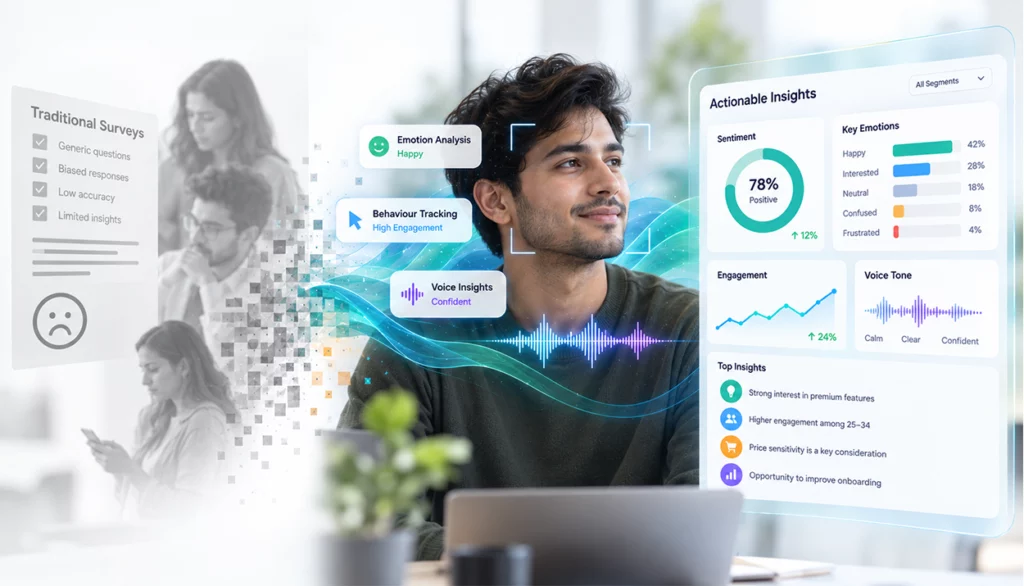
The standard concept test has served the industry well for decades. Show a consumer a concept, ask them to rate it, aggregate the scores, and make a call.
It is built on an assumption that has always been partially false: that consumers have conscious, articulable access to their own preferences, and that what they say in a structured survey setting reflects how they will behave at the moment of purchase.
Decades of behavioural science research work of researchers who famously argued that 95 percent of purchase decisions are made subconsciously, have established that this assumption is not just occasionally wrong. It is structurally incomplete.
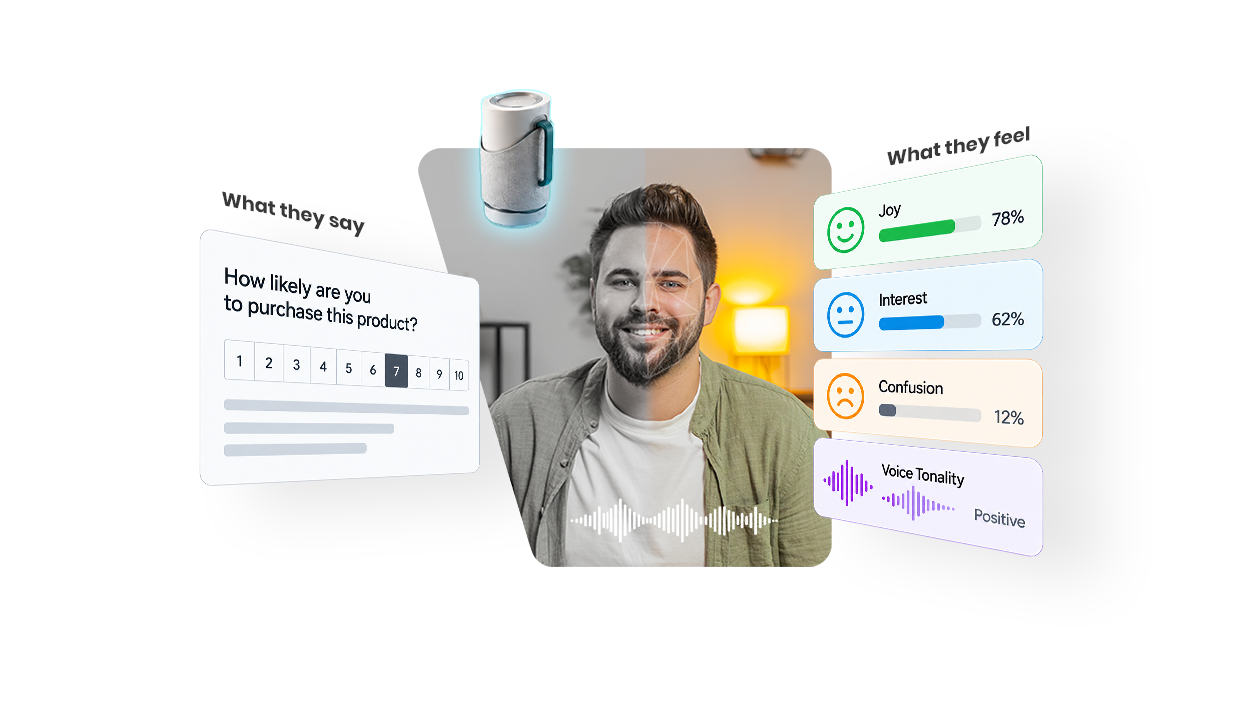
The consumer who rates a skincare concept 7 out of 10 on purchase intent is giving you their considered, conscious response to a structured question. They are not giving you access to the emotional reaction that happened in the first three seconds, the micro-expression of mild scepticism that crossed their face when they read the claim, or the subtle drop in vocal engagement when the brand name was mentioned. Those signals are where real predictive intelligence lives. And surveys, by design, cannot capture them.
What Does a Consumer Reveal Before They Say a Word?
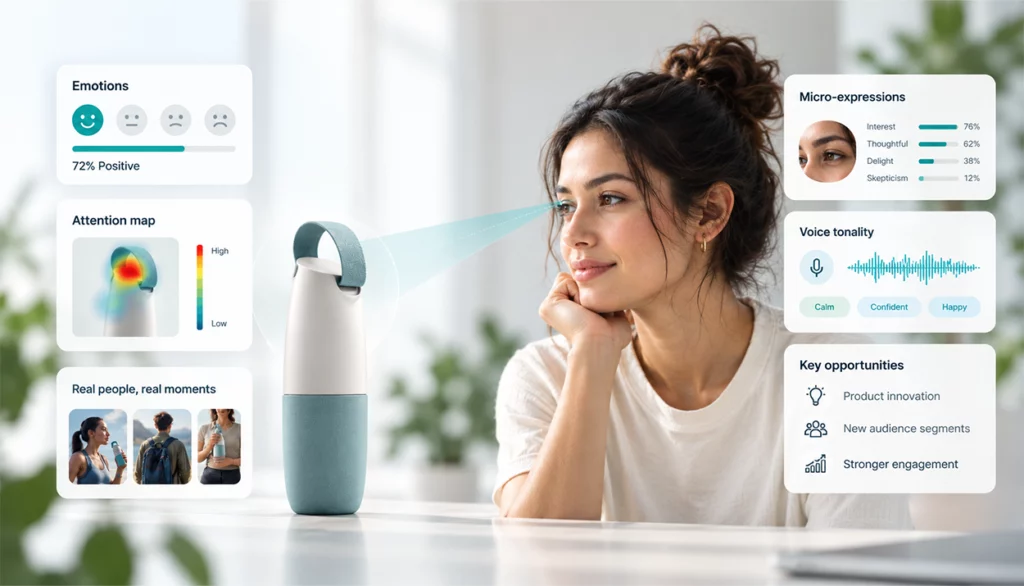
Facial coding is not a new science. Paul Ekman’s foundational research on universal facial expressions was published in the 1970s and has been refined continuously since. What is new is the ability to deploy it at research scale, in real time, across global consumer populations, using AI-powered analysis that can process thousands of micro-expressions per session with a precision no human observer could match.
When a consumer is exposed to a concept, their face responds before their rational mind has a chance to form a considered opinion. Genuine delight looks different from polite approval. Real surprise looks different from performed surprise. Confusion that signals genuine engagement looks different from confusion that signals rejection. These distinctions are invisible in a survey.
Voice tonality analysis adds another dimension. The pace at which someone speaks when describing their reaction to a concept. Voice carries information that the words themselves do not, and AI models trained on large datasets of human vocal patterns can extract that information reliably, across languages, accents, and dialects.
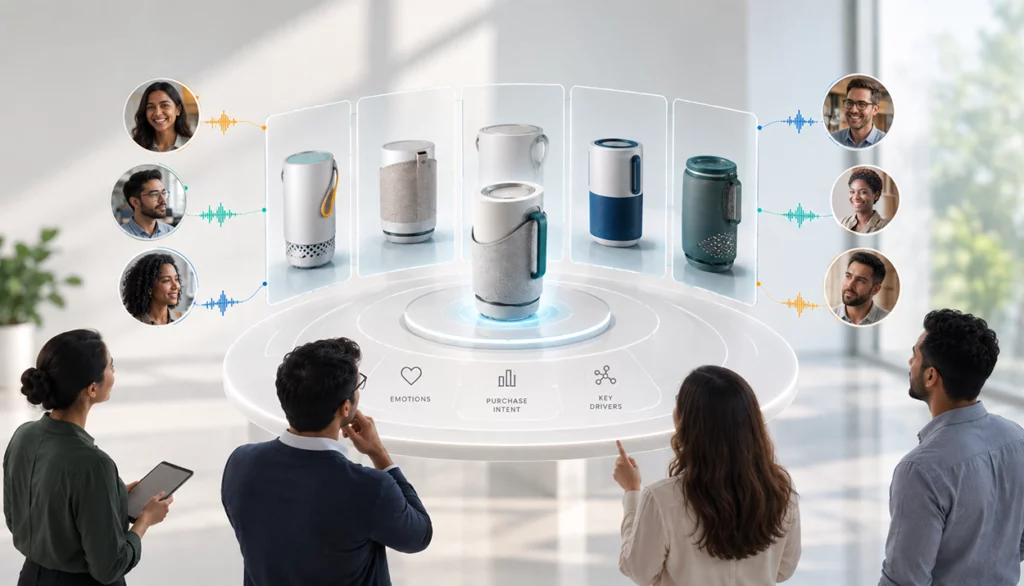
Together, facial coding and voice tonality analysis give researchers access to what might be called the pre-verbal consumer response, or the layer of reaction that exists before the consumer has translated their experience into language.
Why This Matters More Now Than It Did Five Years Ago
The context in which brands are operating has changed in ways that make emotional intelligence in concept testing more commercially urgent than ever before.
Consumer attention is compressed. On social platforms, the average time a consumer spends evaluating whether to engage with a piece of content is measured in fractions of a second. The emotional signal a concept sends in its first three seconds is increasingly the only signal that matters. If the research process used to evaluate that concept cannot measure what happens in those three seconds, it is measuring the wrong thing.
Generative AI has dramatically lowered the cost of producing creative variants. Brands that once produced three concept options now produce thirty. The bottleneck is no longer ideation but evaluation. Research tools that can process emotional response data at scale and speed are the ones that will keep pace with this new creative reality.
And consumer trust in brand communication is at a historic low. Edelman’s 2025 Trust Barometer reported that only 50 percent of consumers globally trust the brands they buy from regularly. In this environment, the gap between a concept that feels authentic and one that feels manufactured is not a stylistic distinction. It is a commercial one. Facial coding and voice tonality analysis can detect inauthenticity signals in consumer responses — the micro-expressions of scepticism, the flat vocal tone that accompanies disbelief — that surveys consistently miss.
By combining primary consumer research data with AI-captured category codes and emotional triggers that are currently driving engagement in a specific category and market, helps produce creatives better aligned with the cultural context of the target market.
Download the eBook to learn how our approach to concept testing research helped a QSR giant win over a new generation of diners in South Africa.
Putting It into Practice: What Effective Concept Testing Research Looks Like

The brands getting the most value from emotionally-intelligent concept testing share a few operational characteristics.
They integrate it early. Emotional testing applied to rough concepts and storyboards catches fundamental resonance issues before significant production investment has been made. The earlier in the development process the emotional intelligence is available, the more it can actually change the concept rather than just evaluate it.
Most concept testing tools were built to answer one question: does this work? InnoSight 2.0 by Borderless Access was built to answer a harder one: how do we make this win in this market, with this consumer, at this cultural moment?
The Three-Layer Intelligence Model
InnoSight 2.0 operates through the integration of three distinct intelligence sources. Each tells part of the story. Together, they produce something no conventional concept test can: a complete picture of how a concept is experienced emotionally, rationally, and culturally.
Primary Consumer Research with Emotional Intelligence
The foundation is structured primary research with verified, deeply profiled consumer panels across target markets. But unlike conventional concept testing, InnoSight 2.0 does not stop at rating scales and stated preferences. It integrates facial coding and voice tonality analysis directly into the research process.
As consumers engage with a concept, their facial expressions are captured and processed in real time across dozens of micro-expression variables — distinguishing genuine delight from polite approval, authentic surprise from performed engagement, real confusion from considered skepticism. Voice tonality analysis runs simultaneously, capturing the emotional warmth, hesitation, pace, and engagement level in how consumers verbally respond.
The result is a dual-layer data stream: what the consumer says, and what their face and voice reveal before the words are formed. In categories where purchase decisions are driven by aspiration, identity, and emotional resonance, that second layer is often the more predictive one.
AI-Captured Country and Category Codes
This is where InnoSight 2.0 goes significantly beyond emotional testing tools and conventional concept platforms. The platform draws on AI-captured intelligence from key digital platforms in each target market to understand what codes are actively driving engagement in the category right now. It includes live, market-specific intelligence on the visual language, claim structures, occasion associations, emotional triggers, and aesthetic cues that are currently resonating with consumers in each geography.
This matters because emotional response to a concept is always culturally mediated. The same claim that generates warmth in one market generates skepticism in another, not because the emotion being targeted is wrong, but because the cultural codes being used to access it are market-specific.
Country and category code intelligence makes this variation legible before launch. It answers the question that conventional concept testing almost never addresses directly: Is this concept speaking in the right cultural register for this specific market?
Human Expert Intelligence
AI can identify patterns across thousands of data points faster than any human team. It cannot tell you what those patterns mean for your brand strategy, or what the right creative response to them is. This is why InnoSight 2.0 pairs its automated intelligence with a layer of human expert interpretation.
Insights professionals who understand both the research methodology and the category context drive the analysis, the strategic interpretation, and the concrete recommendations. In complex, multi-market research engagements, this human layer is what transforms findings into a brief that a brand team or creative agency can actually act on.
The Questions Brands Can No Longer Afford to Ignore
In markets where the emotional layer of consumer decision-making is more commercially decisive than ever, and where the tools to access that layer are now available at research scale, relying on surveys alone is leaving the most predictive intelligence on the table.
The brands that will build the most durable consumer relationships over the next decade are those that understand not just what their consumers say about their concepts, but what their faces and voices reveal before the words are even formed.
That is not a research methodology. It is a competitive advantage.
Want to explore how our proprietary solution for concept testing is helping Fortune 500 companies launch their products with confidence? Talk to our experts to see it in action.