

Can AI ever truly understand how people feel?
The insights industry is moving faster than ever. AI tools now analyze millions of data points in seconds, automate customer research surveys, and generate dashboards almost instantly. Today, over 70% of market research companies rely on AI-driven workflows to accelerate insight delivery.
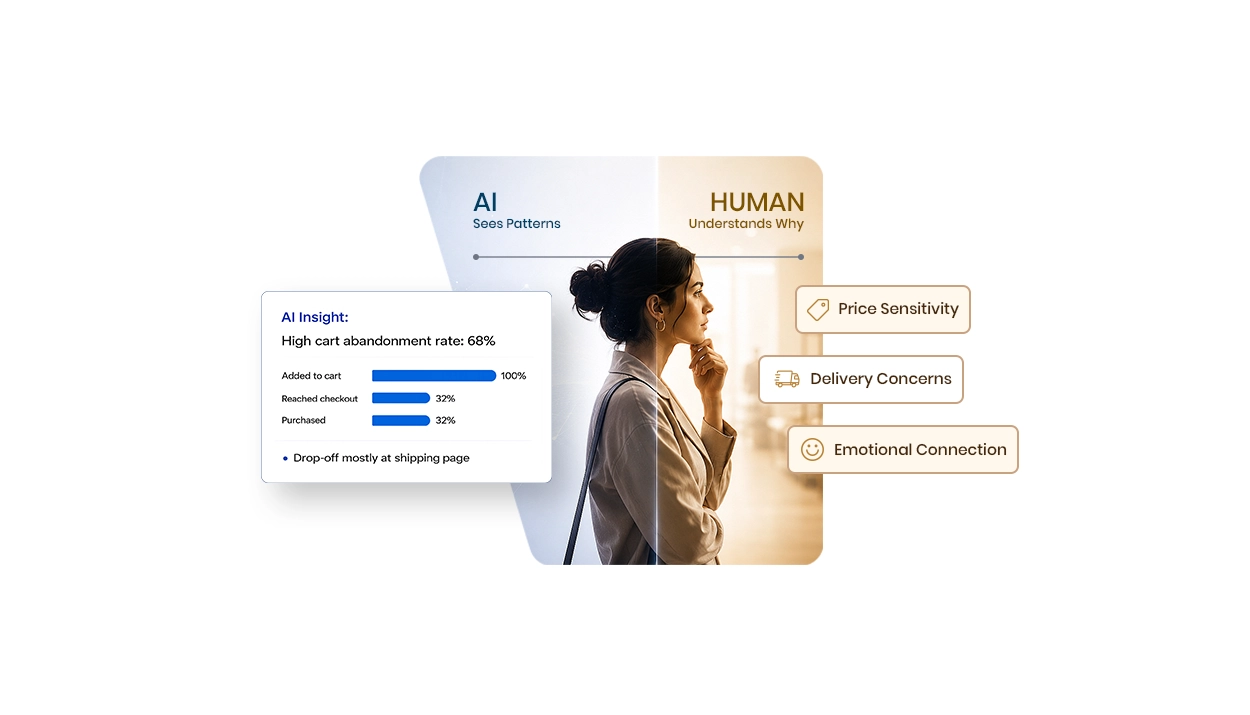
Yet something essential is still missing. Businesses can now track what customers do with incredible precision, but understanding why they do it remains far more complex.
That gap is where customer insights are being redefined. The future is not just about faster data; it is about a deeper understanding. And increasingly, that depth comes from emotional intelligence, which is the ability to interpret human behavior beyond what algorithms can see.
How AI Is Transforming the Insights Industry?
The pressure to deliver faster insights has transformed how research operates. What once took weeks now happens in near real time.
Automation has streamlined almost every stage of customer behavior research. From sampling to reporting, AI has reduced friction across workflows. Here is a detailed overview of how AI is reshaping the insights industry:
Faster Insights Through Automation and Real-Time Analysis
AI systems can process thousands of interactions simultaneously and generate real-time insights that allow businesses to act immediately. This real-time capability is particularly valuable in dynamic industries such as retail, healthcare and telecom, where customer expectations evolve rapidly.
From Sample-Based Research to Full-Scale Intelligence
The shift from traditional research to AI-driven intelligence has redefined how businesses gather customer insights. Earlier, customer behavior research depended heavily on surveys and small sample sizes, often capturing only a fraction of real customer experiences.
Today, AI enables organizations to analyze customer interactions across different channels, including calls, chats, emails, and social media.According to recent industry estimates, companies leveraging AI-powered conversation analytics report up to 3-5x more data coverage compared to traditional survey-based approaches.
Listening to the Voice of the Customer
AI is also transforming how businesses capture the voice of the customer. Instead of relying solely on structured customer research surveys, organizations can now analyze unstructured data at scale. This approach reveals unfiltered opinions, emotional tone& and hidden friction points that surveys often miss.
Study shows that over 80% of the world’s data is unstructured, and AI’s ability to decode this data is unlocking a new layer of customer behavior insights that were previously inaccessible.
Beyond Automation: Where AI Falls Short in Understanding Human Behavior?
AI can be remarkably effective in specific domains, but it operates within clear boundaries. And those boundaries become visible when we try to understand human complexity.
At its core, AI relies on what can be observed and learned from data such as recurring patterns, correlations and past behavior. However, human behavior is not that straightforward. People do not always act logically; they contradict themselves, they change their minds, they respond to emotions they may not even fully articulate.
This is where purely AI-drivencustomer insight research begins to fall short.
For example, a dataset might show high customer satisfaction scores. Yet the same customers may quietly switch to competitors due to subtle emotional disconnects, something not immediately visible in structured data.
The difference lies in interpretation. AI processes information, but it does not truly understand context in the way humans do. AI mostly struggles with:
- Cultural nuance across regions
- Emotional undertones in open-ended responses
- Contradictions between stated and actual behavior
According to ET Edge Insights, over 55% of AI-generated insights require human validation to become truly actionable. That statistic alone highlights an important reality that data without meaning has limited value.
Why Emotional Intelligence Is Now a Strategic Advantage?
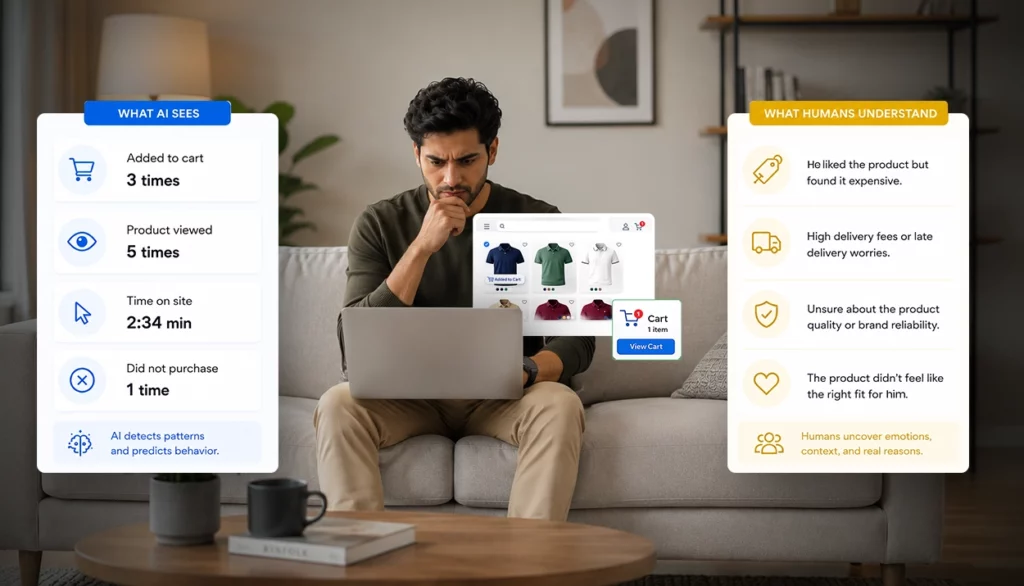
As AI continues to scale the speed and volume of customer insights, a new gap is becoming more visible. The gap between knowing what customers do and understanding why they do it. This is where emotional intelligence steps in as a critical differentiator.
Beyond Data to Human Understanding
Data can reveal patterns, but it rarely captures the full picture of human behavior. Customers do not make decisions based purely on logic. Emotions, context and personal experiences shape outcomes in ways that structured data alone cannot explain.
Research indicates that about 70% of buying decisions are influenced by emotional factors.
Two customers may follow the same journey but arrive there for entirely different reasons. Without emotional interpretation, these distinctions disappear. That is why businesses are shifting toward emotionally informed customer insight research to understand the deeper meaning behind actions.
Insights to Empathy-Driven Action
The true value of insights lies in what organizations do with them. Emotional intelligence ensures that decisions are rooted in empathy, not just analytics.
Research shows that companies leveraging emotionally informed customer behavior insights make customers 4x more likely to spend. This translates directly into measurable business impact, such as stronger relationships, improved customer lifetime value and more sustainable growth.
The Power of Hybrid Intelligence: AI and Human Insight Working Together
The future of insights is not about choosing between AI and human expertise. It is about combining both in a way that amplifies their strengths.
AI brings speed, scale and consistency. It can process vast datasets and identify patterns at a level no human can match. However, on its own, it lacks depth. On the other hand, human intelligence fills that gap. It interprets nuance, understands context and connects insights to real-world behavior.
When these two come together, the result is what many now call hybrid intelligence. In practice, this is how this approach looks:
- AI handling large-scale data collection and initial analysis
- Human experts interpreting emotional signals and contextual meaning
- Continuous feedback loops that refine insights over time
This combination creates a more complete picture of the customer. Organizations adopting this model report measurable improvements. With this model, insight accuracy improves, decision-making becomes more confident and strategies align more closely with actual customer needs.
How Borderless Access Is Leading the Human + AI Insights Revolution?
As the demand for deeper, more actionable insights grows, businesses are looking for partners who can bridge the gap between technology and human understanding. This is where Borderless Access is setting a new standard.
Rather than treating AI as a replacement for human expertise, Borderless Access integrates it as an enabler. Our approach ensures that speed and scale never come at the cost of depth.
Our proprietary solution, Deep Sense™, is designed to uncover the hidden layers behind consumer decisions.
Most consumer research captures what people say. The challenge is that consumer decisions are rarely driven by what people consciously articulate.
People often rationalize their choices after they make them. They describe decisions using logic when the real drivers are emotional, cultural, social, or deeply personal. This creates a gap between stated behavior and actual behavior—a gap where many important business opportunities remain hidden.
Deep Sense™ is Borderless Access’ proprietary qualitative intelligence framework designed to uncover those hidden layers of consumer decision-making. Rather than stopping at surface-level responses, it helps researchers decode the emotions, tensions, cultural influences, and subconscious motivations that shape behavior.
The framework explores consumer understanding across multiple levels:
Surface Response
What consumers say they do and why they believe they do it.
Rational Explanation
The logical justification consumers provide for their choices.
Emotional Driver
The feelings influencing behavior, often without conscious awareness.
Personal Context
Life experiences, memories, and situations shaping decision-making.
Core Human Truth
The deeper beliefs, values, and identity drivers that ultimately influence choice.
This approach allows brands to move beyond demographic descriptions and purchase behavior to uncover the deeper forces that drive preference, loyalty, and adoption.
For organizations seeking high-quality customer research services, this model delivers insights that are both fast and deeply human.
The Future of Customer Insights: Technology Meets Human Understanding
The role of insights is evolving. It is no longer just about reporting data; it is about shaping strategy. This evolution is being driven by one key realization: technology alone is not enough.
As AI becomes more widespread, its capabilities will become standardized. What will set organizations apart is how well they understand their customers on a psychological level. Emotional intelligence will play a crucial role in this shift. It will help businesses:
- Anticipate needs before they are expressed
- Build stronger emotional connections with customers
- Design experiences that feel intuitive and relevant
Looking ahead, the next frontier of customer insights will not just be defined by speed or scale, but by meaning, context and a deeper understanding of people.
Frequently Asked Questions
- Why is emotional intelligence important in customer behavior research?
Emotional intelligence helps researchers interpret feelings, context and hidden motivations behind customer decisions. It enables a more accurate understanding of customer decisions beyond surface-level data.
- How do customer research companies use AI today?
Most market research companies use AI for data collection, sentiment analysis, predictive modeling, and faster reporting. It improves efficiency and scalability.
- How can businesses improve their customer research strategy in 2026?
Businesses should adopt a hybrid approach. They must leverage AI for speed and scale while integrating human expertise to interpret emotional and contextual factors.