


According to ESOMAR’s Global Market Research Report, over 70% of research budgets globally are allocated to quantitative methods, the overwhelming majority of which are survey-based.
Yet, for most of its history, survey programming function, the critical bridge between a researcher’s questionnaire and a respondent’s experience, has been treated as a back-office operation.
In especially healthcare research, survey programming directly affects launch speed, respondent experience, qualification accuracy, data integrity, and sample performance. As healthcare research becomes more complex, spanning multiple markets, specialized audiences, and increasingly demanding timelines, traditional survey programming models are struggling to keep pace.
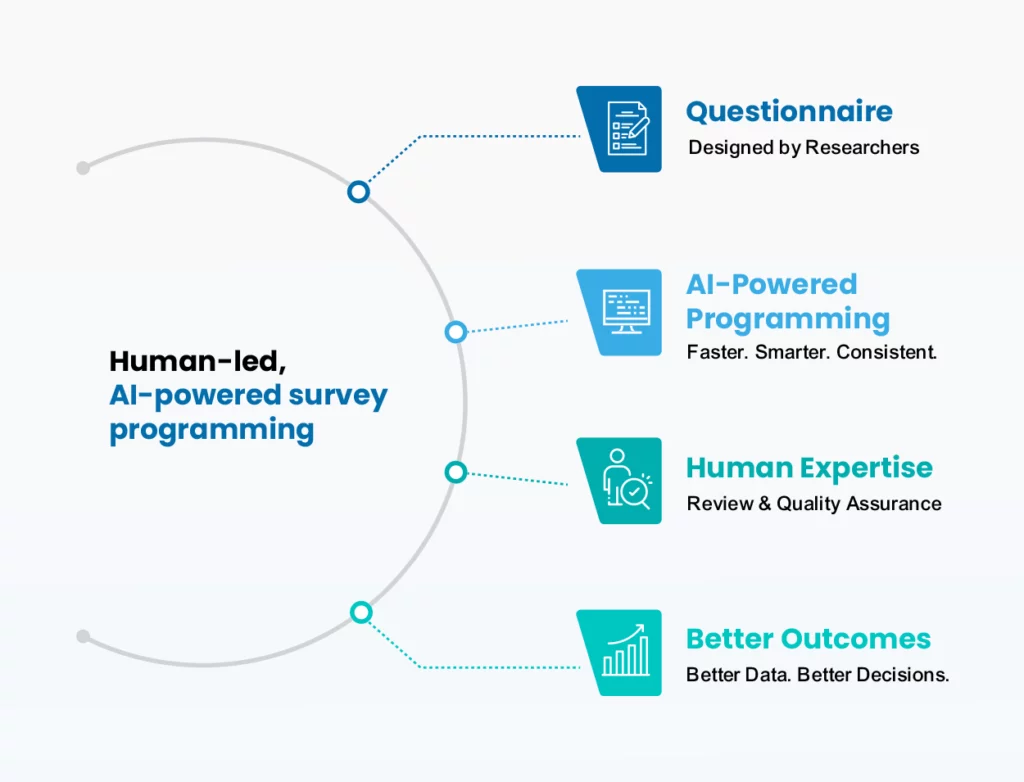
The answer certainly lies in combining AI-driven automation with experienced human programming oversight to create a faster, more reliable, and more scalable approach to survey execution.
What AI Changes in Healthcare Survey Programming and What it Does Not
Healthcare studies often involve highly specific respondent qualification criteria, regulatory compliance requirements, adverse event capture protocols, multi-country consistency, and sensitive patient or HCP data handling. In this environment, even small programming errors can compromise data quality, respondent eligibility, compliance standards, and ultimately the reliability of the research itself.
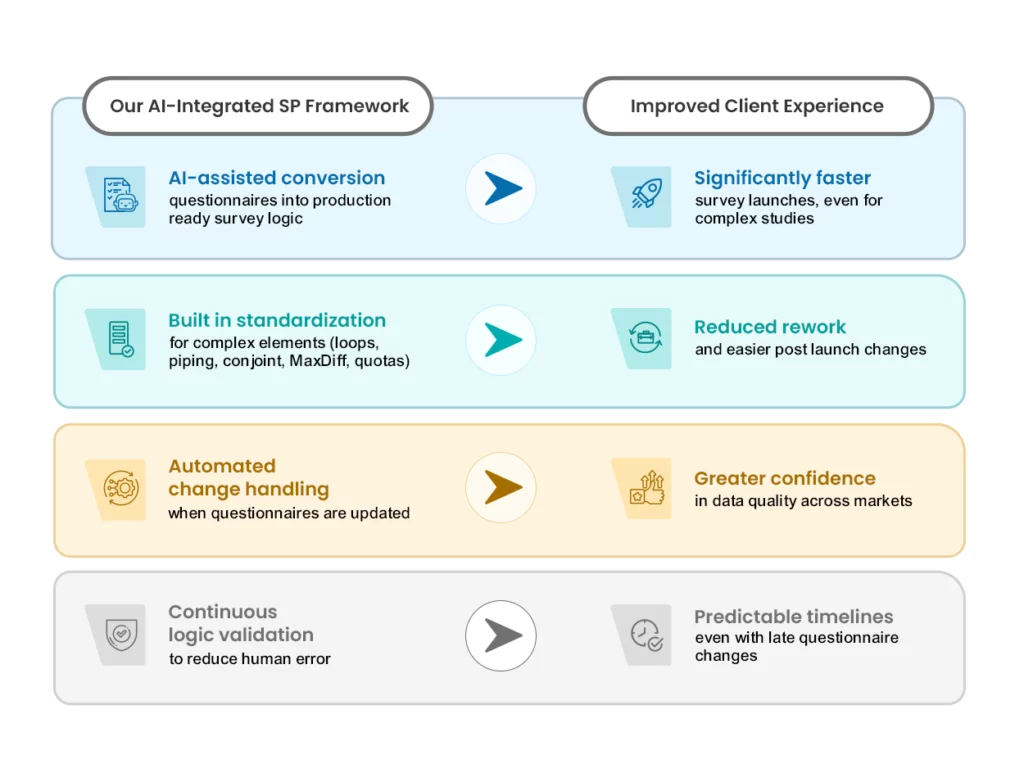
AI improves healthcare survey programming by automating the execution-heavy processes where delays, inconsistencies, and logic errors are most likely to occur. For MRAs and sample buyers commissioning these studies, the impact goes far beyond operational efficiency. Surveys launch faster, even when dealing with complex questionnaires, multiple markets, or highly targeted audiences. Data quality also becomes more consistent across markets and studies, reducing dependency on individual programming approaches and creating greater confidence in the results.
A machine, however, can validate whether the logic is syntactically correct. It cannot tell you whether the flow of a questionnaire will create respondent fatigue at a critical juncture, or whether the wording of a piped element will produce confusion in a specific market. Those remain human responsibilities.
Striking the Balance Between Human-Led and AI-Powered Survey Programming
With a structured AI-integrated survey programming workflow designed, Borderless Access supports healthcare research teams and sample buyers in bringing transparency, quality control, and adaptability at every stage of healthcare research.
The workflow includes six core stages:
1. Questionnaire intake and logic mapping. Every engagement begins with a structured review of research objectives, logical dependencies, and ambiguities that are flagged before any scripting starts.
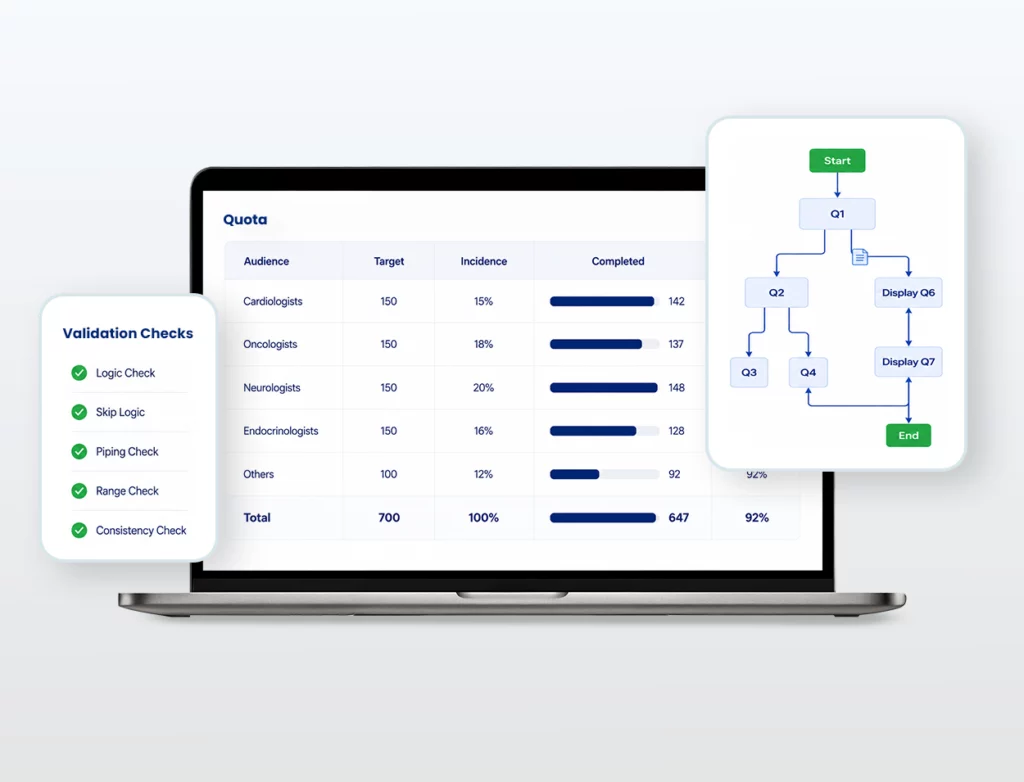
2. AI-driven scripting. Questionnaire logic is converted into production-ready code using AI-assisted tools that apply standardized rules to complex elements such as loops, piping, conjoint structures, and quota hierarchies. This enforces logic consistently and removes the variability that manual processes accumulate over a long build.
3. Automated logic validation. Integrity and logic checks run continuously during scripting, surfacing routing errors, quota conflicts, and piping faults before they can reach the soft launch environment.
4. Respondent experience review. This is the stage where human judgment is irreplaceable. Experienced programmers review the full instrument for methodological coherence, flow, screening language, condition-specific terminology, adverse event routing, and mobile rendering across devices. NLP models support this work by analyzing verbatim responses for relevance and aligning them with the intended questions.
5. Soft launch and change impact assessment. Late questionnaire changes arrive in nearly every healthcare study, often from regulatory or medical reviewers. Each one is run through a change impact assessment before it is implemented, so that nothing downstream breaks in the process.
6. Launch-readiness review. A final review confirms that quota configurations are correct, all logic paths have been validated, and the survey performs as intended across markets, languages, and device environments.
The workflow ensures the real value of AI is not just that it helps surveys launch faster but helps organizations make better decisions sooner.
Beyond improved survey quality, the workflow also delivers more output from the same resources. By automating validation, scripting, and reporting workflows, research teams can handle a larger volume of studies without increasing headcount or operational costs. The result is improved productivity, lower rework, better resource utilization, allowing organizations to do more with less while maintaining quality and speed.
How the Model Results in Measurable Business Impacts
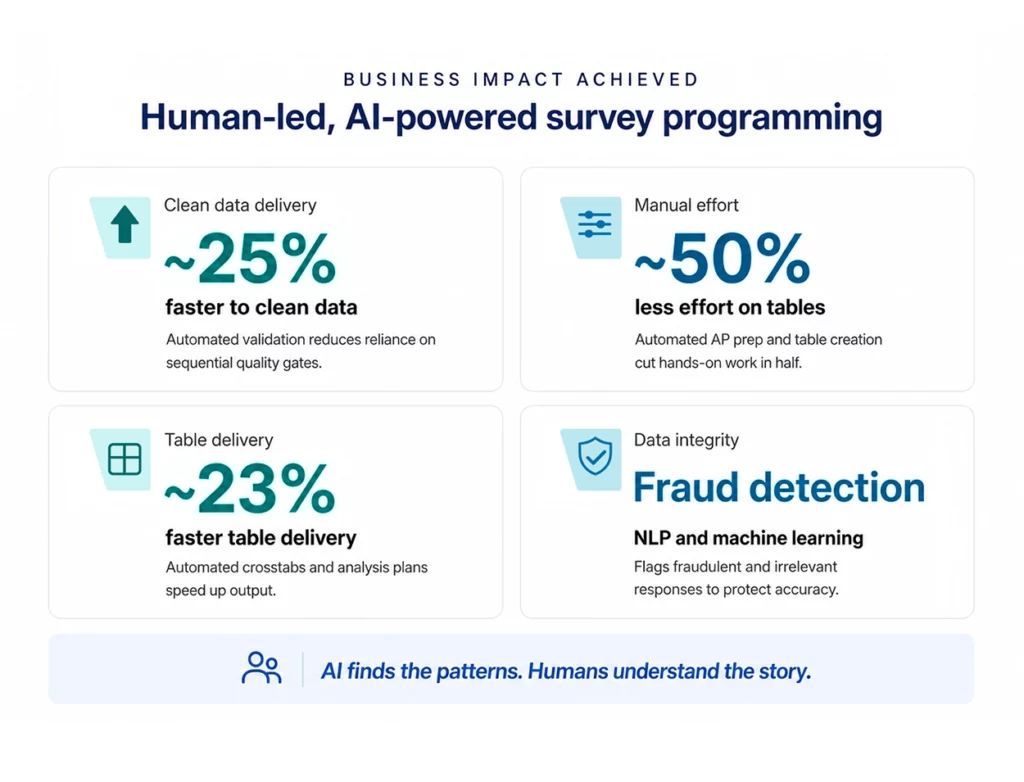
Embedding AI into the survey programming framework produces significant measurable gains for Borderless Access. Extending beyond internal operations, these gains directly affect how quickly research teams can move from questions to decisions.
- Automated validation reduces reliance on sequential quality gates, accelerating clean data delivery by around 25%.
- AI-driven scripting enforces questionnaire logic consistently, which drives a significant reduction in rework cycles and improves overall operational efficiency.
- NLP and machine learning models identify fraudulent or irrelevant responses, strengthening data accuracy and reliability in exactly the place where verified panels are most vulnerable.
- Automated analysis-plan preparation and table creation cut manual effort by roughly 50% and deliver tables about 23% faster.
The Structural Shift Underway
As healthcare research becomes more specialized and globally interconnected, the quality of insights will increasingly depend on the quality, precision, and scalability of the systems used to build the research itself.
The organizations that will define the next generation of healthcare research excellence are those that approach technology not as a replacement for human expertise, but as a force multiplier for it.
The survey is still the foundation of research. The quality of what it produces still depends entirely on the quality of how it is built.
To understand how our human-led, AI-powered programming framework can support your next research engagement, speak to our experts today.
FAQs
What is human-led, AI-powered survey programming?
Human-led, AI-powered survey programming combines the speed and automation of AI with the expertise of experienced survey programmers. AI helps automate complex scripting, logic validation, and repetitive tasks, while human experts ensure research quality, respondent experience, and methodological accuracy.
Why does survey programming matter in market research?
Survey programming directly impacts data quality, respondent experience, and research accuracy. Poor programming can lead to routing errors, incorrect quotas, incomplete data, and unreliable insights that affect business decisions.
Why is survey programming important in healthcare research?
Healthcare research involves strict qualification criteria, regulatory requirements, and highly specialized audiences like HCPs and patients. Accurate survey programming ensures the right respondents participate, compliant data is collected, and research findings remain reliable and medically valid.
How does AI improve survey programming?
AI improves survey programming by automating scripting, validating survey logic in real time, reducing manual errors, and accelerating study launches. It also helps manage complex healthcare studies and multi-market research more efficiently while maintaining consistency and accuracy