


How Gen X, Millennials, and Gen Z Are Redefining Work, Money, and Meaning and What Organizations and leaders Must Rethink Next
Introduction: Beyond Generations
For more than a decade, conversations about generations at work have relied heavily on shorthand narratives. Gen Z wants purpose. Millennials demand balance. Gen X values structure. These labels may sound familiar, but they oversimplify a far more complex reality.
When data replaces clichés, a different picture emerges, one that is less about generational conflict and more about context.
To better understand this shift, a multi country and cross-generational study was conducted among 12,000 working professionals across Gen X, Millennials, and Gen Z, spanning industries including technology, healthcare, manufacturing, retail, and BFSI. The objective was not to compare generations competitively, but to examine how personal values, life-stage realities, and lived experiences shape behavior at work.
What the data reveals is not a fractured workforce, but an evolving one, three generations connected by the same human needs for security, belonging, and purpose, expressed differently depending on circumstance and stage of life.
The modern workforce, therefore, is not divided by age. It is diversified by context.
For HR and leaders, this changes how we design engagement, careers, well-being, and trust.
PART I: Decoding Generations
What the Data Reveals About Today’s Workforce
1. Happiness Has not Changed – Only Its Equation Has
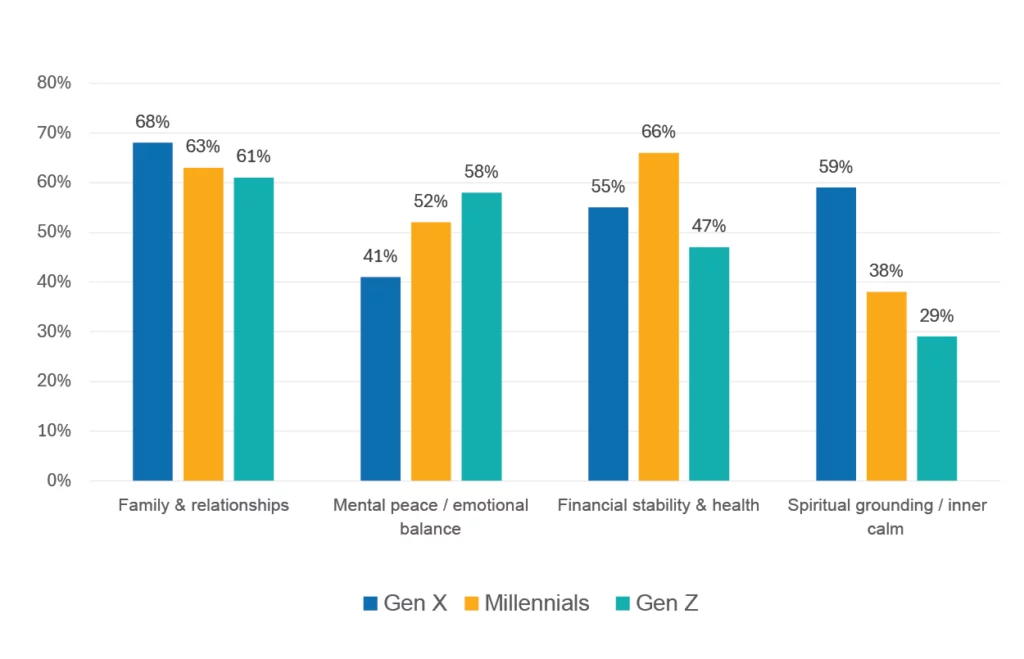
Across generations, one constant stands out clearly. When respondents were asked what most defines personal happiness, family and close relationships ranked first for all three cohorts cited by 68% of Gen X, 63% of Millennials, and 61% of Gen Z, ahead of career success or financial outcomes.
This shared anchor is important for organizations to recognize. It confirms that work is rarely the primary emotional center of life. Instead, employees draw stability from relationships outside the workplace, and that stability directly influences how they show up at work.
Where generations begin to diverge is in what follows that anchor.
Among Gen Z, happiness is strongly tied to mental peace and emotional balance, with 58% prioritizing mental well-being over material goals. This suggests that younger employees enter the workforce already attuned to psychological safety and emotional regulation, not as future aspirations, but as present-day expectations.
Millennials express a more blended equation. 66% identify financial stability and physical health as key contributors to happiness, reflecting a generation balancing career pressure with long-term personal sustainability. For them, happiness is about maintaining equilibrium – progress without exhaustion.
For Gen X, happiness takes on a more inward tone. 59% cite spiritual grounding and inner calm as dominant drivers, alongside physical well-being. This points to a generation that values steadiness, meaning, and reduced volatility after years of accumulation and responsibility.
Insight: Happiness has shifted from being an outcome of success to an operating condition for performance.
What this means for organizations:
well being is no longer optional or occasional- it must be built in to everyday work. Psychological balance increasingly functions as a performance enabler, and its definition varies by life stage. Uniform engagement strategies risk missing what different generations need to perform sustainably.
2. Purpose Has Shifted from Ladder to Compass

The study reveals a structural shift in how purpose is experienced at work – one that cuts across generations but manifests differently within each.
Among Gen Z, 68% associate purpose with learning and making an impact, valuing emotional congruence and skills development more than financial progression alone. Purpose, for them, is immediate and values-driven; it is something work must provide from the outset.
Millennials place purpose at the intersection of contribution and connection. 61% cite belonging, recognition, and meaningful contribution as central to their sense of purpose, often ranking these above traditional promotions. Horizontal growth, visibility, and voice matter as much as upward movement.
For Gen X, purpose becomes outward-looking. 57% find fulfilment in influence, mentorship, and legacy, linking meaning to the ability to shape outcomes and guide others rather than to personal advancement.
Across all three cohorts, one pattern is clear: titles alone no longer define purpose.
Insight: Purpose has moved away from hierarchy and toward alignment. It now acts as an internal compass rather than an external ladder.
Organizational implication:
Career frameworks that rely solely on linear progression risk disengaging talent. Purpose-driven ecosystems where learning, contribution, recognition, and mentorship coexists, are more likely to sustain engagement across generations.
3. Money and Fulfilment: Control Is the New Currency
Financial attitudes in the study reflect lived experience more than age.
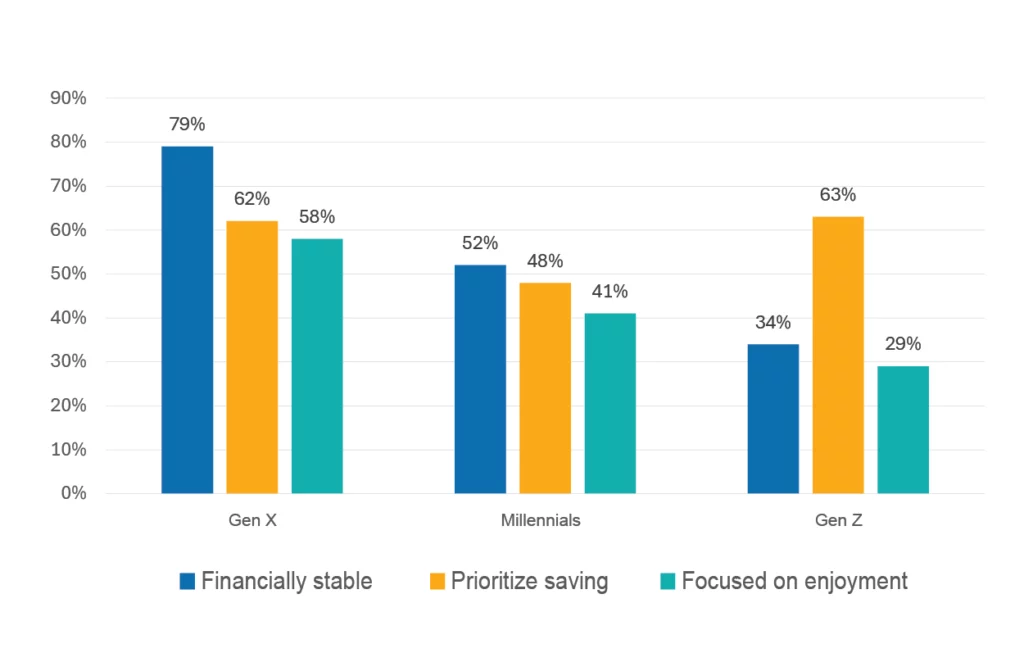
Among Gen X, 79% report feeling financially stable and focused on enjoying life. For Millennials, that number drops to 52%, reflecting a cohort still managing mortgages, dependents, and long-term planning. Notably, 63% of Gen Z already prioritize saving before spending, despite being early in their careers.
This pattern signals caution rather than comfort. Having grown up amid financial crises, digital transparency, and pandemic uncertainty, Gen Z exhibits what can be described as defensive creativity – a desire to secure independence early.
Across all generations, money is consistently framed not as status, but as autonomy and emotional security.
Insight: Financial well-being increasingly equals psychological saftey.
Organizational implication:
Compensation strategies must go beyond pay levels to include transparency, financial literacy, and flexibility. Benefits such as savings programs, predictable growth paths, and clear reward structures directly influence trust, risk-taking, and retention.
4. The Trust Economy: From Credit to Control
Attitudes toward credit further illustrate this shift toward autonomy.
The study finds that 54% of Gen Z and 48% of Millennials actively avoid credit dependence, compared to 32% of Gen X. At the same time, interest in income diversification is high across cohorts, with over 55% in each generation expressing interest in multiple income streams or side projects.
This reflects a broader redefinition of professional identity. Control over time, effort, and reward has overtaken consumption as a source of satisfaction.
Insight: Trust, not access is the new currency.
Organizational implication:
Rigid employment models are losing appeal. Organizations that allow flexibility, project-based engagement, or internal mobility are better positioned to retain energy rather than lose it to external opportunities.
5. Kindness and Social Responsibility: Same Value, Different Language
The data gathered from the study strongly challenges the notion that younger professionals are less socially responsible.
84% of Gen X participate in volunteering or skill-based community support.
57% of Gen Z prioritize environmental and ethical lifestyle choices.
46% of Millennials engage through structured giving and digital advocacy.
Insight: Altruism has not declined – it has diversified.
Organizational implication:
Corporate purpose must be expressed in multiple formats. Volunteering programs resonate strongly with senior employees, sustainability initiatives with younger cohorts, and digital advocacy with Millennials. CSR is no longer a top-down initiative; it is a participation model.
6. Awareness Is High – Capacity Is the Constraint
More than 70% across all generations actively follow global issues such as climate change, mental health, and inequality. Yet fewer than 25% report sustained personal action in support of these causes.
This gap reflects constraint, not indifference. Economic pressure, emotional load, and competing priorities limit capacity.
Insight: Modern employees are conscious but constrained.
Organizational implication:
Employers increasingly act as multipliers of employee intent. Embedding ethical choices into infrastructure – from sustainable operations to inclusive policies – enables participation without additional personal burden.
7. Relationships Are Becoming Smaller, Sharper, and Stronger
Social dynamics are shifting in measurable ways.
Gen Z favors small, emotionally safe circles. Millennials balance chosen families with professional networks. Gen X remains anchored in family ties. Travel and shared experiences lift mood for 74% of Gen X, 67% of Millennials, and 54% of Gen Z, but emotional energy is spent more selectively than before.
Insight: Connection has traded volume for depth.
Organizational implication:
Psychological safety and micro-communities of trust matter more than large-scale social initiatives. Collaboration thrives when people feel safe, not saturated.
8. Work Has Moved from Presence to Trust
Preferences around work models reflect trust behaviors rather than productivity differences.
Gen X builds trust through visibility and proximity.
Millennials through autonomy and ownership.
Gen Z through flexibility and alignment.
Insight: Trust has replaced time as the currency of professionalism.
Organizational implication:
Performance systems must focus on outcomes rather than attendance. Flexible work only works when linked clearly to purpose and accountability.
9. Well-Being Has Evolved from Relief to Resilience
There has been a preventive shift in how different generations of employees perceive well-being.
Gen X finds restoration in solitude and reflection. Millennials emphasize routine health practices. Gen Z protects mental bandwidth through boundaries and digital hygiene.
Insight: Wellness is no longer escape – it is fuel.
Organizational implication:
Well-being must be treated as workforce infrastructure, embedded into leadership norms and daily work rhythms rather than isolated programs.
10. Abundance Mirrors Experience, Not Age
When asked how they would use a financial windfall:
70% of Gen X prioritize saving,
50% of Millennials balance spending and investing,
40% of Gen Z favor experiences.
Insight: Abundance reveals life’s experiences more than desire.
Organizational implication:
How employees think about surplus mirrors how they manage constraint – informing decisions around risk, loyalty, and long-term commitment at work.
PART II: Translate
What Organizations Must Rethink
The study points to a clear conclusion: generations differ less in what they want and more in how they experience work. Designing for age alone is insufficient. Designing for context, capacity, and emotional reality is essential.
Organizations that succeed will:
- Redefine engagement around emotional needs, not generational labels
- Build purpose-driven ecosystems rather than isolated rewards
- Treat flexibility as a trust model, not a policy
- Embed well-being and values into everyday infrastructure
Conclusion: One Workforce, Many Realities
The multi-generational workforce is not a challenge to be managed – it is intelligence to be activated. Gen X contributes perspective and continuity. Millennials bring adaptability and connective energy. Gen Z adds conscience and curiosity. Organizations that understand these dynamics do more than accommodate diversity. They unlock collective capability.
Because the future of work will not be shaped by those who segment people by birth year, but by those who understand how experience shapes expectation.
Much of market and consumer research today looks outward at customers, categories, and competitors. This study deliberately looked inward. Because brands are not built by strategy alone. They are built by people inside organizations whose values, fears, priorities, and decisions shape outcomes long before consumers experience them.
Generation Connect is not intended to replace consumer research. It is intended to complement it by offering a deeper understanding of the people who design brands, make trade-offs, and define experiences.
For readers interested in how these internal human insights connect directly to brand performance and growth, we invite you to read our companion perspective:
“From People to Brands: Why Internal Insight Is the Missing Link in Growth Research.”
Regardless of what Generation Connect highlights, the intent is to understand different generations, bridge gaps, improve interpersonal skills, and achieve better outcomes by making the most of our demographic advantage. There is also an opportunity for each generation to learn from one another and grow together.