



When millions are at stake and attention spans are shrinking, advertising effectiveness stops being a marketing question and becomes a leadership concern. Brands today are navigating fragmented media environments, faster creative cycles, and are competing for seconds of attention, factors that have changed how advertising is developed and tested.
This is why many campaigns that look strong during development struggle to leave an impact once they go live. The problem is rarely a lack of creative ideas. More often, it stems from a structural gap in how advertising is evaluated before it reaches the market.
Most testing approaches are built to assess what people can easily explain after the fact, how clear the message was, what they remember, or whether they liked the ad. What they struggle to capture is the emotional response that unfolds while the ad is being watched, and whether that response is strong enough to hold attention, reinforce the brand, and influence behavior beyond the moment of exposure.
Over time, emotional resonance in advertising has proven to be a key indicator of a successful ad, as it shapes memory, strengthens brand associations, and determines whether an ad leaves a lasting impression. However, most advertising testing practices remain completely focused on rational validation rather than emotional impact. This often leads to the approval of advertisement that performs well in controlled environments yet struggles to connect or motivate action once it reaches real audience.
Why Advertising Testing Must Move Beyond Recall
For decades, advertising research has put great emphasis on clarity, recall, and persuasion as the yardsticks of success. These measures still have value, but they only tell a part of the story. In real world conditions, advertising doesn’t compete in isolation; it operates in environments shaped by emotion, distraction, habit, and split-second judgement.
Still, ad effectiveness research continues to rely on post-exposure questionnaires, in which consumers are asked to describe how they felt after seeing an advertisement or what they can recall about the ad. The limitation is not the method itself, but what it assumes: that people can accurately articulate emotional reactions after the fact, and that these explanations reliably predict real behavior. In practice, much of the emotional response to advertising happens instinctively and fades fast, attention shifts second by second, and brand cues are either absorbed or missed before viewers can consciously reflect on them.
At the executive level, this creates an invisible risk. Advertising may seem strong on the rational metrics brands approve of, but fails to connect with or hold the attention of the target market in a real-world commercial setting.
AdSight: Measuring the Emotional Effect With Precision
At Borderless Access, emotion-response-testing is operationalized though AdSight, allowing brands to assess emotional response before launching under conditions that more closely mirror real viewing behaviour. Rather than replacing traditional measures, it adds a critical layer: capturing how audiences engage with an advertisement as it unfolds, where attention strengthens or drops, and whether emotional moments are clearly connected to the brand.
Through this approach, leadership teams gain visibility into questions that recall-based testing alone cannot reliably answer:
- Is the advertising genuinely engaging viewers rather than just catching their attention?
- What is the progression or decline of the emotional response as the story unfolds?
- Is the message clearly and consistently linked to the brand?
- Does the creative move audiences toward consideration, preference, or purchase?
- Which specific moments boost or damage overall performance?
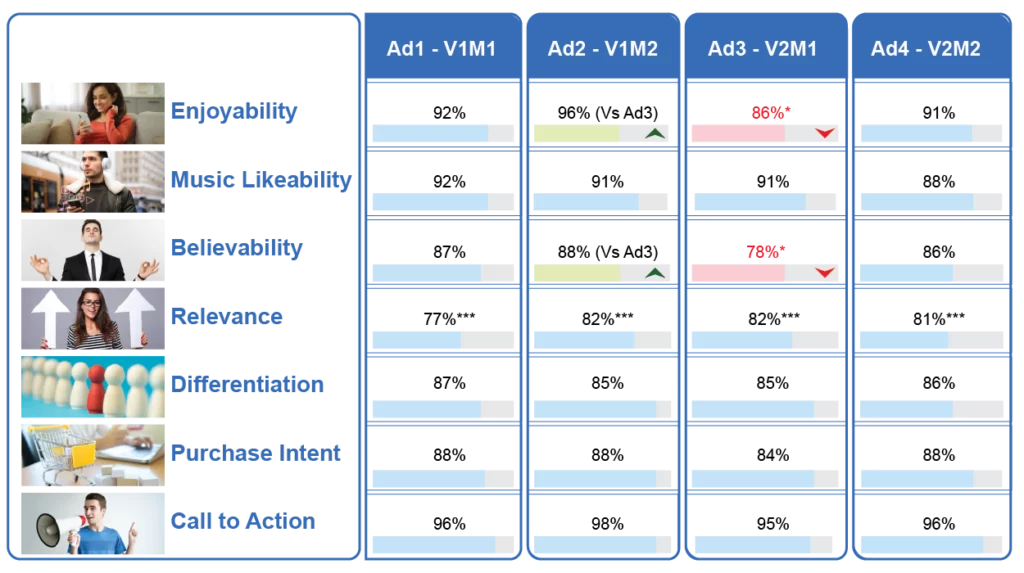
With the integration of survey responses and real-time emotional and attention data, which is gathered by eye-tracking, facial recognition, and positive versus negative emotion scores, AdSight points out trends such as sudden disengagement or high levels of emotional engagement that are not necessarily linked to the brand. This also makes it possible to have a more consistent assessment of the different formats, whether TV, digital, or social.
Emotion-Aware Testing as a Strategic Advantage
For Brands, the challenge is no longer whether advertising can be differentiated, but whether creative decisions can be made with confidence. When budgets are under scrutiny and creative pipelines are full, relying on assumption or intuition alone becomes a costly risk.
Brands that take emotional response seriously make fewer speculative creative bets and gain clearer understanding of why one execution should move forward over another. Over time, this discipline compounds. Media spend works harder, creative decisions become easier to defend internally, and growth is driven by consistency rather than chance.
By recognizing how audiences actually feel, not just what they recall, brands reduce creative risk, improve media efficiency, and build stronger long-term brand equity toward sustainable revenue growth.
FAQ
It has become an important aspect in advertising testing as emotion directly influences attention, memory, brand preference, and action. All these reasons make it a primary driver of advertising ROI.
Emotional measurement adds behavioral context to the practical/ rational metrics. It reduces the reliability of post-rationalized, biased responses and provides real and relevant data.
Yes, when the same emotional and attention-based metrics are applied with the same measurement framework. Scale comes from applying the same methodology across markets and formats, which enables a comparison of performance without having to restate results each time.
Yes. Early testing is where emotional insight is most useful. Looking at storyboards or early cuts helps teams spot weak moments before media plans are locked and changes become expensive.