



Ads have played a pivotal role in shaping the brand-consumer relationship for decades now. They create the foundation of those connections that fuel brand loyalty. But today’s consumes are only loyal to brands that feel authentic to them. They have become hypersensitive to inauthenticity.
In the last five years, brands have invested heavily in AI and automation to optimize ad performance, from dynamic creative optimization that automatically tests thousands of ad variations (headline, image, copy combinations) to machine learning algorithms that adjust targeting and bidding in real time across platforms like Facebook and Google.
Ironically, consumers now feel less understood than ever before. They are drowning in marketing messages, between hundreds of ads every single day, and their brains have learned to tune it all out.
AI can identify patterns and replicate them at scale. But emotions, context, brand loyalty? Those aren’t patterns, they are deeply human tendencies. So, smart brands are shifting. Instead of thousands of optimized ad variations, they’re testing for emotional resonance: Does this feel authentic? Does it connect? As the noise around advertising intensifies, brands must cut through it by building genuine emotional connections. they must first know and identify the emotional responses their ad communications actually elicit.
The Real Problem: Traditional Ad Testing Misses a Lot That Matters

For decades, brands have relied on the same testing playbook. They measure whether people understand their message, track recall, clicks, and comprehension scores. All rational metrics that seem to make sense on the surface. But here is where it breaks down; understanding your message isn’t the same as connecting with it.
Ad effectiveness research still largely relies on post-exposure questionnaires. Consumers are shown an ad and later asked how they felt, what they remember, or whether they liked it. It assumes that people can accurately reconstruct how they felt seconds earlier and also assumes that conscious explanations reflect subconscious reactions.
Behavioral science tells us otherwise.
Most emotional responses to advertising happen instinctively and disappear quickly. Attention shifts second by second. Brand cues are processed—or missed—before viewers are even aware of them. Studies in neuroscience and advertising effectiveness repeatedly show that emotion and attention drive impact far more than rational recall alone.
Yet traditional ad testing still overweights:
- Message recall
- Stated likeability
- Claimed purchase intent
The disconnect happens because conscious reporting cannot fully capture subconscious reaction.
Measuring Emotional Resonance at Scale

The real challenge with ad testing isn’t access to data, it’s interpretation. Brands can measure clicks and recall all day, but without understanding the emotional undercurrents driving those actions, they are working blind.
A campaign may score well on rational measures and win approval in pre-testing. But once launched into a real-world environment—crowded feeds, multi-screen viewing, distracted audiences—it fails to hold attention or build emotional memory structures. Media budgets are spent. Reach is achieved. But brand impact is diluted.
In today’s fragmented, scroll-heavy media landscape, effectiveness depends on:
- Micro-moments of attention
- Emotional intensity
- Implicit brand encoding
- Immediate instinctive response
If those elements are missed, no amount of rational approval can compensate.
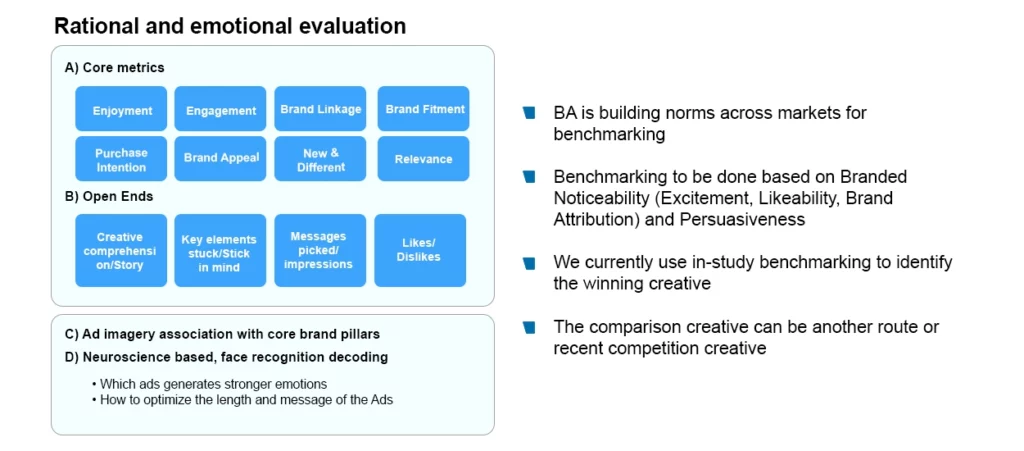
At Borderless Access, we help brands measure emotional responses to creative during ad testing. We go beyond surface-level metrics to understand not just whether people understand your message, but how they actually feel when they encounter it.
Our approach uses advanced techniques to capture genuine responses to ad creatives across all formats. Facial recognition decodes emotional states like happiness, anger, sadness, and fear through micro-expressions. These are reactions people can’t consciously control. Eye-tracking monitors exactly where attention lands and how long viewers engage with critical elements, revealing what truly captivates and what gets ignored.
Heat maps show where users interact most intensely on digital platforms, exposing patterns of emotional engagement. Voice analysis captures tone, pitch, and speech patterns that reveal authentic emotional responses. And real-time media campaign evaluation measures up to eight distinct emotions in video and audio content, creating a comprehensive emotional profile.
These technologies reveal what people actually feel, not what they say they feel in surveys. Someone might claim they liked an ad in a traditional test, but facial coding and eye movement data tell the complete emotional truth behind every frame, every word, every visual element.
This depth of emotional intelligence becomes your competitive advantage. You identify which creative elements genuinely resonate, which fall flat, and which might trigger unintended negative reactions. Before you invest in a full campaign launch, you understand exactly how your audience will respond emotionally and can optimize accordingly.
How Ad Testing Is Reshaping Creative Strategy
In a world where consumers expect brands to understand them, emotional connection has become a competitive advantage in advertising. Ad creative can be copied and messaging can be matched, but the emotional resonance that moves people to act is hard to replicate. It’s what separates a forgettable campaign from one that people actually remember, prefer, and choose over competitors.
At Borderless Access, we help brands measure emotional responses to creative during ad testing. Brands powered by emotional ad insights make creative decisions rooted in real audience responses, not assumptions. When you know exactly how your audience will emotionally respond before launch, you avoid costly missteps and maximize impact. The brands winning in 2026 aren’t chasing speed but ones building loyalty through deep emotional connections using their creative communications.