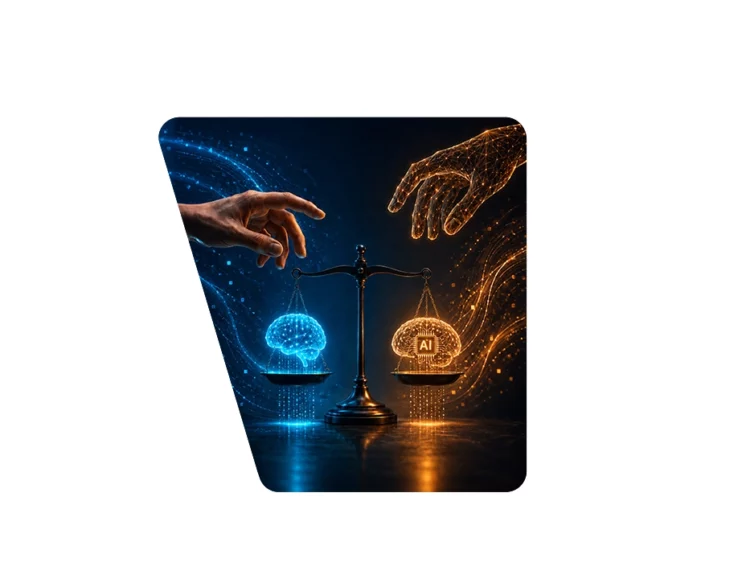



Artificial intelligence has crossed an important threshold in business. The question is no longer whether organisations will use AI in market research. The more consequential question is how much authority we are prepared to give it in understanding people and shaping decisions.
McKinsey’s 2025 State of AI research found that 88 percent of respondents said their organisations were using AI in at least one business function. Yet only 39 percent reported enterprise level EBIT impact, while two thirds said their organisations had not yet begun scaling AI across the enterprise.
That gap matters. Access to AI and value from AI are not the same thing.
For business leaders, brand owners, marketing leaders and insights leaders, there is another important distinction. AI can process information at extraordinary scale, identify patterns, connect signals, and accelerate analysis. But computational power does not automatically become consumer understanding.
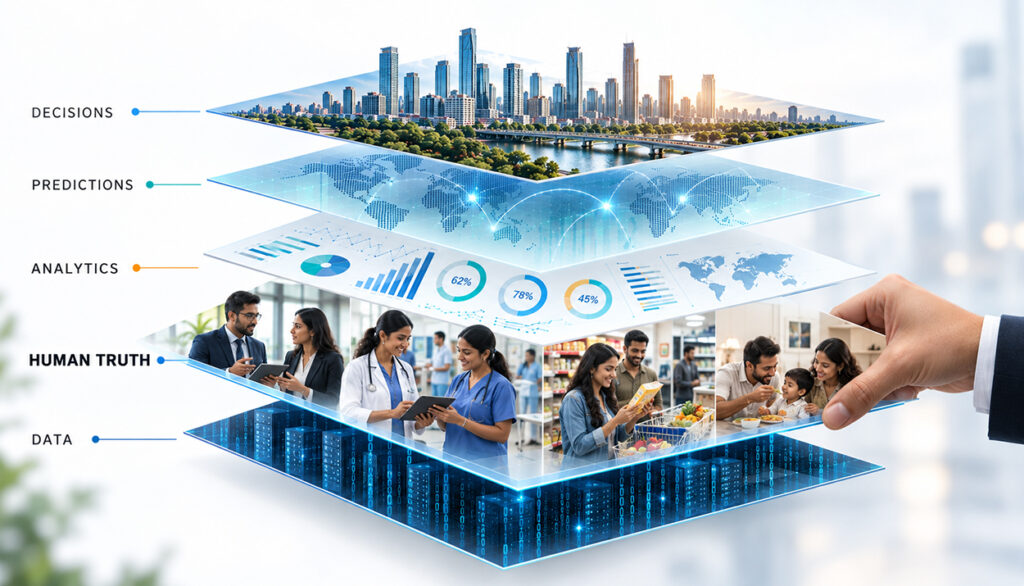
There is another layer that must remain connected to the decision. I call it human truth.
Human truth is the combination of lived experience, context, emotion, and contradiction that explains not only what people do, but why their behaviour can change.
Across markets and organisations of quite different sizes, I have seen the same mistake recur. Teams use technology to accelerate the answer before they have adequately defined the human question.
The Plausibility Problem
AI in market research is becoming remarkably good at producing coherent, useful, and increasingly sophisticated output creating enormous value. It also creates a new decision risk.
The greatest risk may not be that AI gives us an obviously bad answer. It may be that it gives us a plausible answer with enough confidence that we stop asking real people.
That matters because organisations already have enormous volumes of behavioural, transactional, social, customer, and research data. AI can connect those signals and generate convincing explanations for what is happening.
But explanation is not always understanding.
Imagine a loyal customer who suddenly stops buying a premium brand. Behavioural data can show when the purchase stopped. Analytics may identify which competitors gained share. AI can generate several reasons.
The actual reason may be less visible. Household finances may have changed. Premium consumption may now feel uncomfortable. The category may carry a diverse cultural meaning. Another family member may increasingly influence the purchase. Or the brand may simply have stopped feeling relevant.
These realities do not always sit snugly inside historical datasets. They emerge from people’s lives. The efficiency may belong to the organisation. The experience still belongs to the consumer.
Where Human Truth Becomes a Brand Issue
Kantar’s Media Reactions research provides a useful illustration. It reports that 75 percent of marketers feel positive about generative AI, compared with 56 percent of consumers. It also found that 57 percent of consumers are concerned about fake or misleading AI generated advertising. In Kantar’s LINK database, GenAI created ads averaged the 54th percentile for overall impact, compared with the 65th percentile for non-AI ads.
AI is opening substantial opportunities for creative development, localisation, experimentation, and productivity. The more important lesson is that organisational enthusiasm for a technology is different from consumer acceptance of its output. People can embrace AI and still expect humanity from brands. Consumer Research therefore still needs enough contact with people to understand what behaviour means.
Can AI Represent the Consumer?
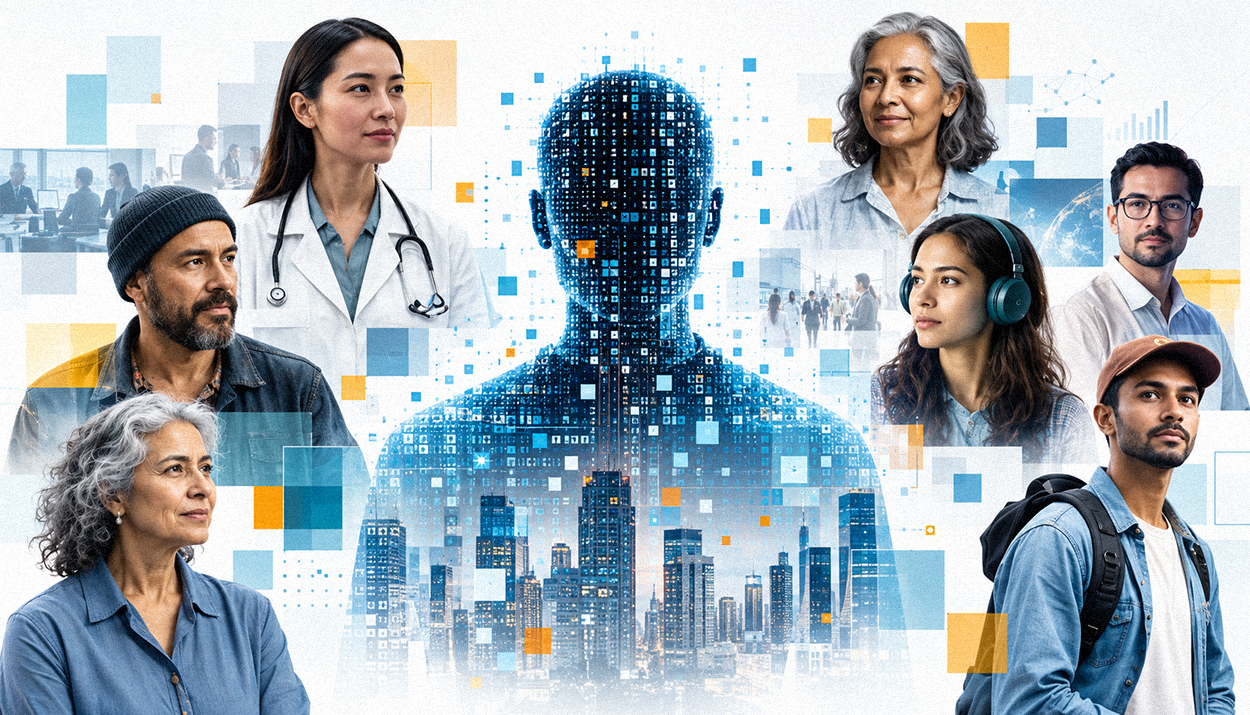
Synthetic approaches can be extremely useful for exploring hypotheses, pressure testing ideas and narrowing possibilities before deeper research. But simulation and observation are not automatically interchangeable.
The Nuremberg Institute for Market Decisions compared 500 real US consumers with 500 AI generated respondents across each of three research topics. It found that AI responses were more likely to favour mainstream brands and widely accepted positions, were more positive overall and showed less variation than the responses of real people.
A modelled representation of a person is not automatically equivalent to current evidence from that person. The distinction becomes even more important when the audience is difficult to generalise.
A broad consumer simulation may provide useful directional evidence in the right context. But the risk increases when decisions depend on senior business professionals, physicians, patients, caregivers, or people whose choices are shaped by highly specific professional, medical, cultural, or personal circumstances.
Professional responsibility, regulation, clinical experience, organisational dynamics, and lived circumstances can create contradictions that are difficult to infer from an average behavioural pattern.
The narrower and more specialised the audience, the more dangerous it becomes to confuse statistical plausibility with lived reality.
Human Evidence Must Also Earn Trust

There is an equally important counterargument in market research and insights. Human sourced data is not automatically synonymous with human truth. A real respondent who is incorrectly identified, disengaged, fraudulent, poorly qualified or answering without attention can distort a decision just as surely as a poorly designed model.
Preserving human truth therefore requires more than putting a questionnaire in front of a person. It requires appropriate verification, thoughtful sampling, rigorous quality controls, responsible incentives, privacy protection, informed consent, and transparent governance.
The Insights Association’s 2026 guidance makes a related distinction. It states that synthetic outputs should not be presented as equivalent to observed human responses without appropriate validation and calls for clear disclosure of whether evidence comes from human participants, synthetic participants, or a combination of both.
The choice is not between imperfect humans and perfect machines. Both require validation. The difference is that properly collected human evidence gives an organisation direct access to lived reality.
Why This Becomes a Business Risk
When an AI model represents yesterday’s patterns better than tomorrow’s emerging reality, the risk is not merely a research error.
It can become a product developed against the wrong need, a campaign built around a motivation consumers no longer hold, a market entry based on an overstated opportunity or a customer experience optimised for efficiency while quietly eroding trust.
Some of the most commercially valuable insights originate precisely in what aggregated models may smooth away: the minority opinion, the contradiction, the weak signal and the emerging need that has not yet become mainstream.
AI is extraordinarily good at recognising patterns. Growth, however, frequently begins by recognising when the pattern is about to change.
AI Is Raising the Standard for Human Research

The answer is not to slow AI adoption. It is to make human research better able to operate alongside it.
AI has changed expectations around speed. If analysis and synthesis can move from days to hours, human evidence cannot remain slow, fragmented or disconnected from the decision cycle. Audience access, fieldwork, verification, quality control, and insight delivery also must become faster and more fluid. The answer to faster artificial intelligence cannot be slower human intelligence. We need to make genuine human understanding faster too. This does not mean trading quality for speed. It means redesigning research so human understanding can keep pace with modern business. AI does not reduce the importance of genuine human evidence. It raises the standard that human research must meet.
Human evidence now needs to be faster, more verifiable, more specialised where required and more seamlessly integrated with technology.
Human Intelligence Amplified by AI
The most effective organisations I have seen do not ask AI to replace human understanding. They use AI to expand the speed and scale at which human understanding can be discovered, connected, and applied.
AI is increasingly exceptional at three things:
- Compressing information. Connecting signals. Accelerating analysis.
- Human intelligence contributes something different:
- Context. Contradiction. Consequence.
That distinction gives leaders a useful discipline.
When AI contributes to a market or consumer decision, we should understand what the recommendation is grounded in. Is it current human evidence, observed behaviour, historical information, or synthetic simulation?
- Where could human context materially change the interpretation?
- And who owns the consequence of the decision?
AI can contribute to a recommendation. Accountability still belongs to the organisation making the decision.
Human truth is not a brake on AI. It is a calibration layer.
Better Intelligence
For years, businesses have spoken about becoming more consumer centric. AI now gives us an opportunity to test how seriously we mean it.
As consumer understanding becomes easier to automate, there will be a temptation to remove the consumer from parts of the process because synthetic representations are faster, cheaper, and always available.
That would be a narrow interpretation of progress.
The purpose of AI should be to create more capacity for understanding people, not greater distance from them.
The strongest organisations will not choose between human intelligence in market research and AI. They will understand where each creates value, where each creates risk and how to combine both without losing sight of the people behind the data.
The objective is not more artificial intelligence or more human intelligence. It is better intelligence.
And better intelligence begins by keeping human truth connected to the decision.