


For decades, growth-focused research has been designed to look outward. We have studied consumers, categories, competitors, and markets with increasing sophistication by mapping journeys, tracking sentiment, segmenting behaviours, and predicting intent. This work has undeniably created immense value for brands.
Yet despite better tools, richer data, and more advanced analytics, many organizations struggle to translate insight into sustained growth. This gap is not anecdotal. Longstanding research across industries shows that nearly 70% of large change and transformation initiatives fail, not because the strategy is flawed, but because organizations struggle with alignment, ownership, and execution. The issue is rarely what companies know. It is what they can do.
The missing link is not more external data. It is a deeper understanding of the people who execute strategy.
Growth Has Become a Human Problem
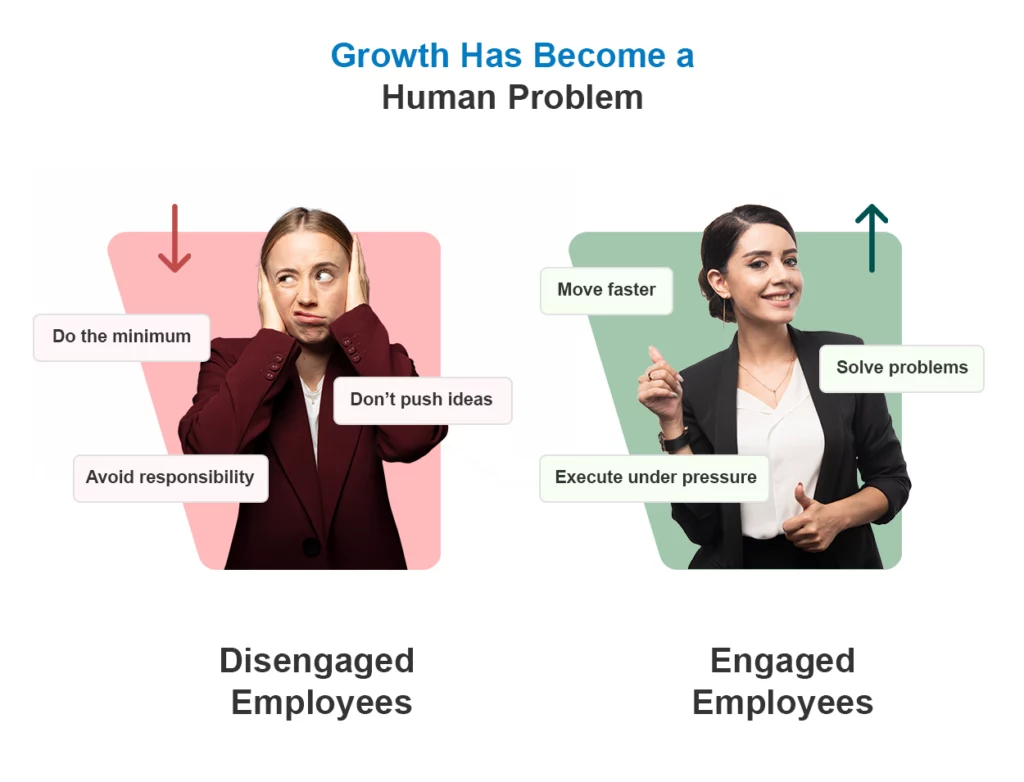
Most growth frameworks still assume that organizations behave like rational systems, that once insight is delivered, decisions align and execution follows. Organizations are human systems, shaped by trust, incentives, fatigue, risk tolerance, and belief.
Research data on global workplace reinforces this reality. Studies on workforce engagement show that only around one in four employees worldwide are actively engaged, with disengagement costing the global economy close to $9 trillion annually. More importantly, these studies consistently highlight leadership behavior and managerial context as primary drivers of engagement and discretionary effort.
This matters because engagement is not a cultural metric. It is a performance condition. Teams that feel aligned, trusted, and psychologically safe move faster, collaborate better, and sustain performance under pressure. Teams that do not, struggle to execute, regardless of how strong the strategy may be.
Growth today is therefore constrained less by opportunity and more by organizational health.
Organizational Health Is No Longer a “Soft” Advantage
Large-scale longitudinal studies on organizational effectiveness show a clear and consistent pattern: organizations with strong health defined by clarity of direction, trust in leadership, accountability, and shared purpose, outperform peers by two to three times in long-term value creation.
What differentiates these organizations is not superior ambition or intelligence. It is the conditions under which decisions are made. When people understand priorities, trust intent, and feel safe to act, execution accelerates. When those conditions are missing, even well-designed strategies stall.
This is why growth has become fragile in many enterprises. Strategy is abundant. Execution capacity is not.
Brands Are Human Outputs Before They Are Market Signals
Every brand experience begins internally.
Products are shaped by teams with particular risk appetites. Messaging is filtered through beliefs about what is safe to say. Customer experience is delivered by people operating under specific emotional, financial, and operational constraints.
Decades of customer experience research have demonstrated a direct link between employee experience and customer experience. Organizations with aligned internal cultures deliver more consistent and credible brand behavior. Those with internal friction leak inconsistency at every touchpoint.
Put simply: brands behave the way organizations feel.
When internal reality is misaligned, consumer insight alone cannot correct the outcome.
A Generational Shift Is Intensifying the Human Dimension of Growth
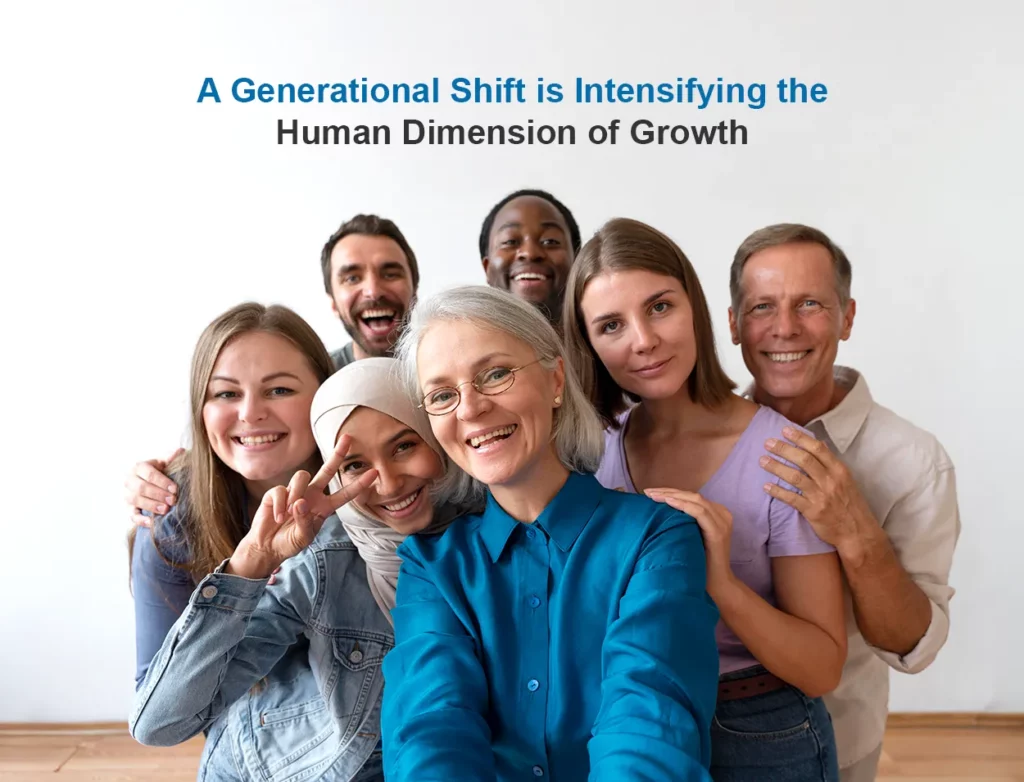
This internal dimension becomes even more critical when viewed through a generational lens.
The people shaping brands in 2026 and beyond will increasingly be Millennials and Gen Z, supported by Gen X leaders. Extensive global workforce studies show that these cohorts bring different baseline expectations into work such as expectations around autonomy, flexibility, trust, emotional safety, and financial stability.
At the same time, leadership systems have not evolved at the same pace. Research on the future of work repeatedly highlights a widening gap between how work is experienced and how it is managed.
These generational dynamics are not cultural noise. They directly influence:
how much risk teams are willing to absorb,
how quickly decisions are made,
how innovation pipelines move or stall,
and how authentically brands respond in moments of uncertainty.
This helps explain why many organizations struggle not with ideas, but with follow-through.
What We Learned by Looking Inward
At Borderless Access, this realization prompted us to examine growth from a different starting point.
Rather than beginning with consumers, we looked inward, at how different generations experience work, money, wellbeing, purpose, and responsibility. The intent was not to conduct an human resources study, but to better understand how internal human realities shape external business outcomes.
What emerged echoed what many leaders sense intuitively but rarely study systematically:
financial security influences risk-taking, emotional fatigue influences collaboration, trust influences speed, and purpose influences persistence.
Across generations, the same fundamental needs surfaced - security, belonging, meaning - expressed differently depending on life stage and context. These internal dynamics help explain why execution varies so widely even when strategy is clear.
Growth, we observed, is not resisted.
It is negotiated through human constraints.
From Outside-In Insight to Inside-Out Intelligence
Traditional growth research asks essential questions:
What do consumers want?
How do they perceive brands?
What drives choice and loyalty?
These questions remain critical. But they are no longer sufficient on their own.
The next evolution of insight must also ask:
Under what internal conditions are decisions made?
Where does trust enable or block execution?
How do emotional and financial realities shape risk appetite?
Why do organizations struggle to act on insights they already possess?
This is not a call to replace consumer research.
It is a call to complete it.
Connecting internal human insight with external market insight allows organizations to understand not just what should happen, but what realistically can.
What Organizations Must Do Now
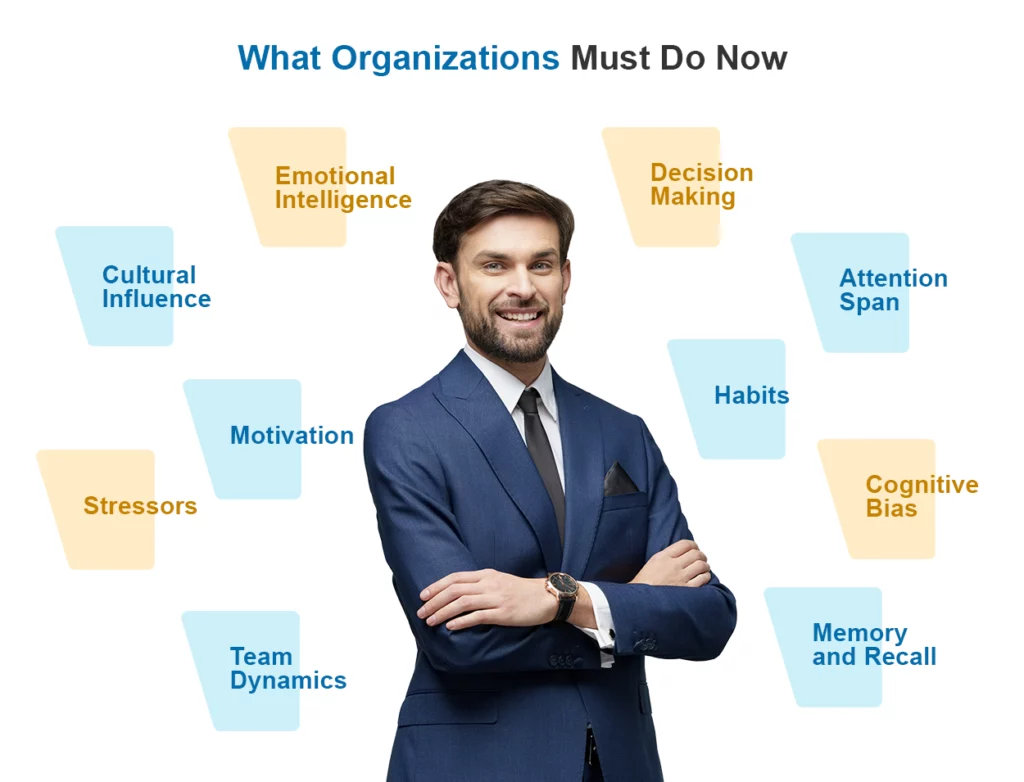
If people and internal systems increasingly determine growth outcomes, organizations must rethink how they diagnose and design for growth.
First, organizations must expand their definition of insight. Understanding markets without understanding the people executing strategy creates blind spots. Internal context, trust levels, decision friction, emotional load, financial pressure all must be treated as part of growth intelligence, not as background noise.
Second, organizations must shift from measuring activity to understanding conditions. Performance dashboards often track outputs but ignore the environments in which those outputs are produced. Insight that captures how decisions are made, not just what decisions are made, becomes critical.
Third, organizations must treat organizational health as infrastructure, not culture work. Trust, clarity, and psychological safety are not soft initiatives; they are prerequisites for speed, resilience, and innovation.
Finally, organizations must design for coherence, not control. As work becomes more distributed and generationally diverse, alignment will come less from hierarchy and more from shared understanding and belief.
These are not human resources interventions.
They are growth imperatives.
A New Responsibility for the Research Industry
If growth is increasingly shaped by human systems, the research industry must evolve accordingly.
This means moving beyond studying outcomes alone, toward illuminating decision environments, internal constraints, and the human conditions under which strategy is executed. The most valuable insights of the next decade will not only explain markets. They will explain organizational behavior under pressure.
A New-Year Reflection for Brands and Researchers
As organizations plan for future, many will invest in sharper strategies, better tools, and deeper consumer insight. These investments matter. But they will only deliver sustained returns if matched with an understanding of the people who bring those strategies to life.
Before asking consumers what they expect from your brand tomorrow,
ask whether you understand the people who will build it.
Because people do not just create brands and businesses.
They quietly determine their growth, their stagnation, or their decline.
Research Lens
This perspective is informed by global research on organizational health, employee engagement, execution effectiveness, and workforce transformation, including longitudinal studies published by Gallup, McKinsey, Harvard Business Review, MIT Sloan, Deloitte, PwC, and leading customer experience practitioners.