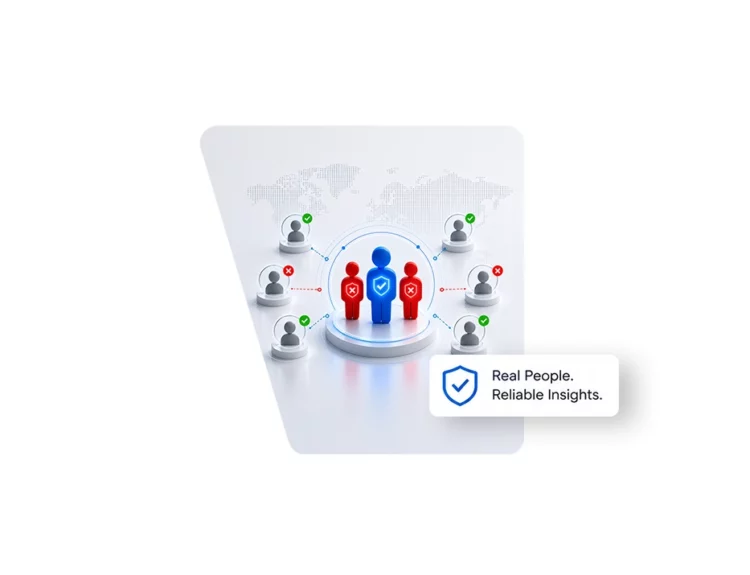



Why research buyers should look beyond AI-powered claims and ask how quality, validation, respondent authenticity, and decision confidence are governed.
AI has moved quickly from experimentation to everyday research operations. It now supports research design, data preparation, fieldwork monitoring, quality checks, reporting, and analytics workflows. For research buyers under pressure to deliver faster insights with leaner teams and tighter budgets, this shift is valuable. The promise is clear: less manual effort, faster execution, and greater operational scale.
But the rise of AI has also created a new kind of supplier ambiguity. Every provider now claims to be AI-powered, AI-enabled, AI-first, or AI-driven. The language sounds advanced, but it often hides the most important operational question: where exactly is AI being used, what does it improve, what does it not solve, and who remains accountable when research quality is at risk
That question matters because AI can accelerate research operations, but it cannot replace research judgment. It can detect patterns, flag anomalies, support feasibility planning, validate survey logic, and reduce manual workload. But it cannot independently determine whether a sample source is appropriate, whether a respondent is contextually credible, whether fieldwork trade-offs are acceptable, or whether a dataset is fit for a strategic decision.
The next era of research operations will not be defined by AI alone. It will be defined by human-governed AI: technology that improves speed and quality while human expertise protects methodology, respondent authenticity, ethics, context, and decision confidence.
The Industry Has Moved from AI Curiosity to AI Governance
The market research industry is no longer debating whether AI will matter. It already does. Greenbook’s 2026 GRIT Insights Practice Report describes a market where AI adoption is reshaping workflows, operating models, technology investment, governance challenges, and decision-making. MRS guidance also notes that AI and related technologies can be applied across research design, operations, data generation, data collection, measurement and analysis, reporting, and report writing.
This is not a marginal shift. AI is entering the core workflow of research.
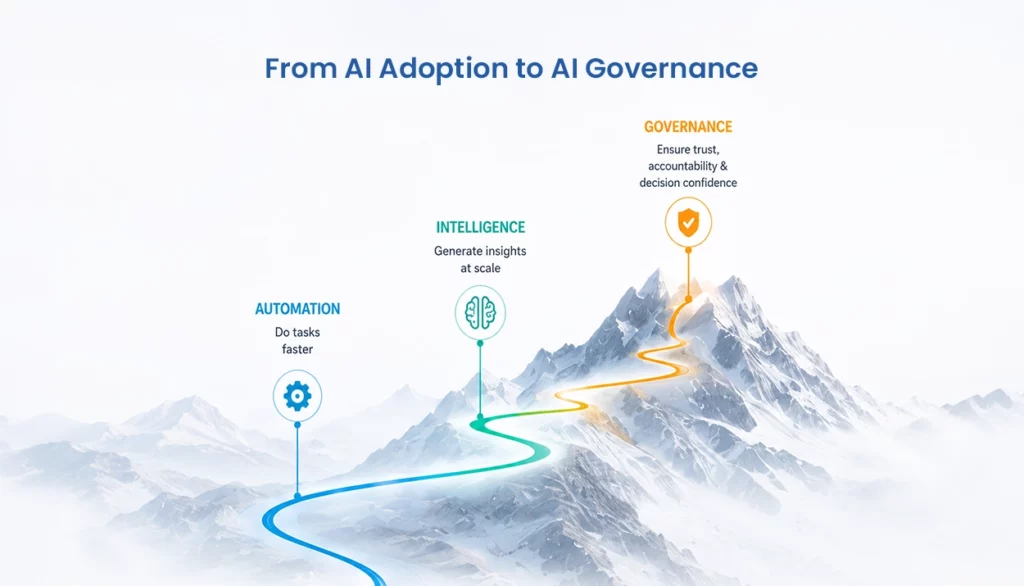
That is why governance now matters as much as adoption. ESOMAR’s 20 Questions to Help Buyers of AI-Based Services was developed to help buyers commission AI-based research services with greater transparency, trust, confidence, and respect for applicable intellectual property, privacy, and AI laws. Its very existence signals a new buyer expectation: research partners must be able to explain how AI is used, how outputs are validated, where human oversight exists, and how risks are managed.
The question for buyers is no longer, “Do you use AI?” It is, “Can you prove that AI is governed in a way that protects the research decision?
The Risk of Ungoverned AI
The problem with generic AI claims is that they make automation sound like assurance. It is not.
AI can make weak processes faster. It can scale errors. It can produce confident summaries from flawed data. It can miss contextual issues that experienced researchers would question. It can create false confidence when buyers assume that automation automatically means higher quality.
In research operations, ungoverned AI can create five serious risks:
- Over-trusting pattern detection: A response may look statistically acceptable to a model and still lack the required context for the study objective.
- Accelerating flawed source decisions: Speeding up fieldwork without adequate source review allows low-quality sample to move faster through the system.
- Over-summarizing nuance: Automating the analysis of open-ended responses can strip away vital context or amplify misleading patterns.
- Treating methodology as a workflow: Automation is treated as a substitute for methodological design, which inherently requires human judgment.
- Creating accountability gaps: Teams are left unable to explain exactly why a respondent was accepted, a source was used, or a dataset was finalized.
These risks matter because data quality is already under pressure. The Insights Association’s H1 2026 Global Data Quality Benchmarking Report draws on 1.8 million survey records across 13 countries to benchmark online research data quality. That scale reflects how central quality governance has become to the industry. Greenbook’s 2026 commentary also states that trusted panels and fraud detection remain essential in AI-driven research.
The message is straightforward: AI does not reduce the need for quality infrastructure. It raises the standard for it.
Where AI Can Strengthen Research Operations
Used responsibly, AI can significantly improve research operations. Its greatest value is not replacing human researchers. It is giving research teams better signals, faster.
During feasibility planning, machine learning models help identify incidence challenges, source-level performance patterns, and potential delivery risks long before fieldwork begins. When teams move to survey programming, automated logic validation reduces routing errors to ensure a seamless respondent experience. As fieldwork launches, AI actively monitors source shifts, response anomalies, speed patterns, straight lining, and suspicious open ends to flag necessary interventions. Finally, during data processing and analysis preparation, automation steps in to reduce manual effort by identifying inconsistencies, preparing tables, and accelerating routine validation.
Borderless Access capability material describes measurable research operations outcomes including 25% faster clean data delivery through automated validation, 50% less manual effort on analysis preparation and table creation, and 23% faster table delivery with fewer rework cycles.
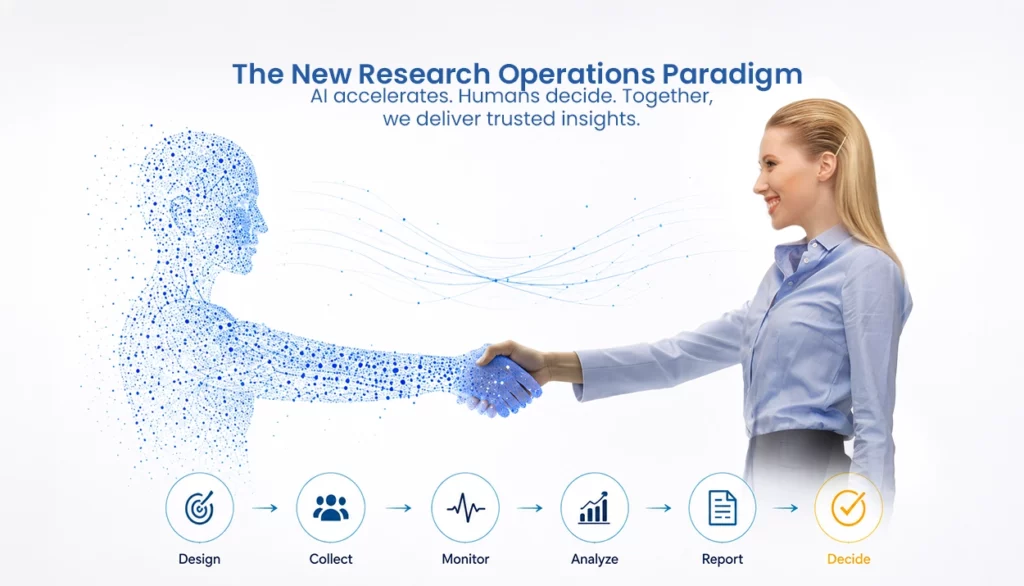
Those are meaningful outcomes. But they matter only when AI is placed inside a governed research operating model. Faster delivery is valuable when it preserves quality. Automation is useful when it strengthens consistency. AI-enabled monitoring is powerful when human teams know when to intervene.
Human Judgment Still Determines Whether Data Can Be Trusted
Research quality is contextual. A general population tracker, a B2B decision-maker study, a healthcare professional study, and a niche patient study do not carry the same level of risk. The same AI signal may require different interpretation depending on the audience, market, methodology, incidence rate, and business decision.
This is where human judgment remains essential.
Human researchers must decide whether the study design is fit for purpose. They must evaluate whether a feasibility assumption is too optimistic. They must interpret whether a quality flag is meaningful or misleading. They must decide when a source should be paused, when criteria should not be loosened, when fieldwork should be extended, and when data requires deeper review before delivery.
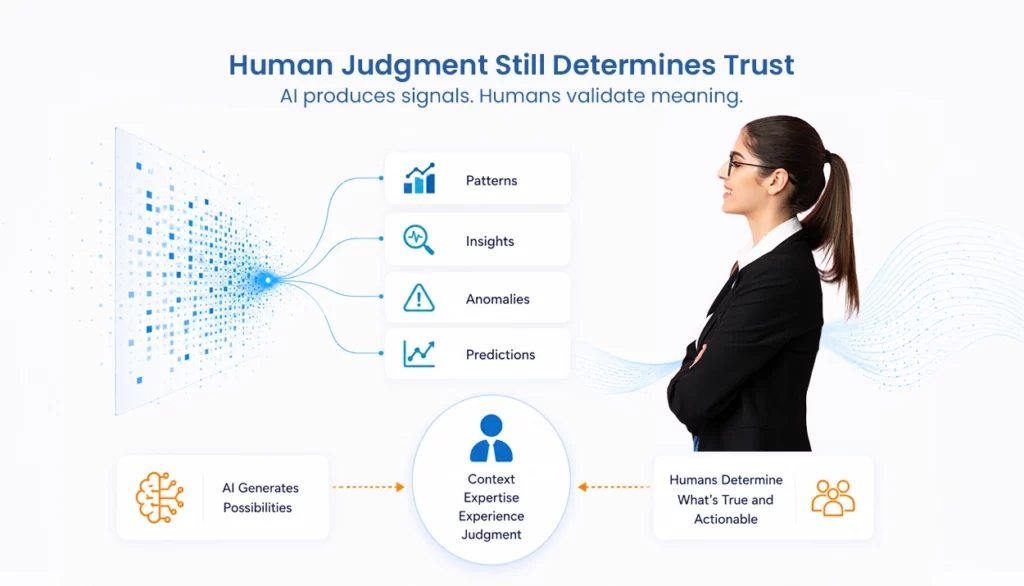
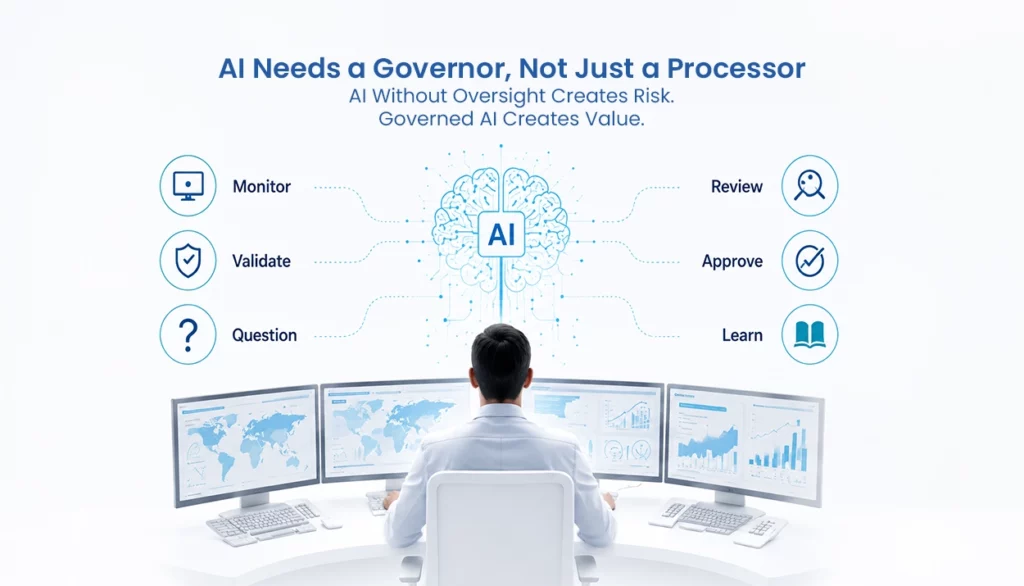
For complex studies, human oversight is not a formality. It is the mechanism that connects automation to accountability.
MRS guidance is explicit that AI use requires human oversight to support accuracy, safety, governance, decision-making, and maintenance. That principle is especially important in primary research because the output is not merely content. It is evidence used to support business decisions.
The Buyer’s Rubric: What To Ask Before Trusting AI-Enabled Research Operations
To move beyond generic AI claims, buyers should pressure-test how a research partner governs AI across the workflow.
| Buyer Question | Red Flag Answer | Stronger Answer |
| Where exactly is AI used in your research process? | “Our platform is AI-powered.” | “AI is used in defined workflow stages such as feasibility assessment, survey logic validation, targeting support, anomaly detection, fieldwork monitoring, and reporting assistance.” |
| What remains under human review? | “AI automates the process end to end.” | “Human teams govern methodology, validation thresholds, source decisions, exception handling, respondent experience, and final quality judgment.” |
| How does AI improve data quality? | “AI makes research faster.” | “AI helps surface suspicious patterns, source shifts, response-quality risks, routing issues, and anomalies that require human review.” |
| How do you prevent AI from creating new quality risks? | “Our models are accurate.” | “We use documented governance, escalation rules, human oversight, privacy controls, source monitoring, and post-field validation.” |
| Can you explain AI’s role without generic claims? | “We are AI-first.” | “We can show where AI is used, what it improves, what humans validate, and how outcomes are monitored.” |
This rubric helps buyers separate partners who use AI as a positioning claim from those who use it as a governed operating capability.
How Borderless Access Operationalizes Human-Governed AI
The strongest research operations model is not manual versus automated. It is human intelligence supported by AI efficiency.
At Borderless Access, AI and technology are positioned as enablers of better research operations, not replacements for research discipline. The operating idea is simple: AI should improve signals, speed, and consistency, while human teams govern methodology, respondent experience, source decisions, validation thresholds, compliance, and decision-readiness.
This approach is reflected across the Borderless Access research operations lifecycle, from survey programming and data collection to data processing, analysis, reporting, and visualization. Internal capability material describes a Human Led, AI Powered model in which AI handles scripting and logic enforcement, routing, quota and error validation, and NLP-led fraud screening, while human teams ensure market language context, compliance, and adverse-event routing where applicable.
QMan, the proprietary data quality framework from Borderless Access, strengthens this operating model by enforcing quality at three distinct stages:
- Pre-Survey Gating: Credential-based audience sourcing, condition verification, role and authority profiling, employer validation, digital fingerprinting, IP and location detection, and bot prevention.
- In-Survey Monitoring: Attention monitoring, real-time response monitoring, adaptive ML quality scoring, and AI-driven open-end validation and probing.
- Post-Survey Delivery: Completion authentication, technical metadata audits, outlier flagging, transparency reporting, and decision-ready output preparation.
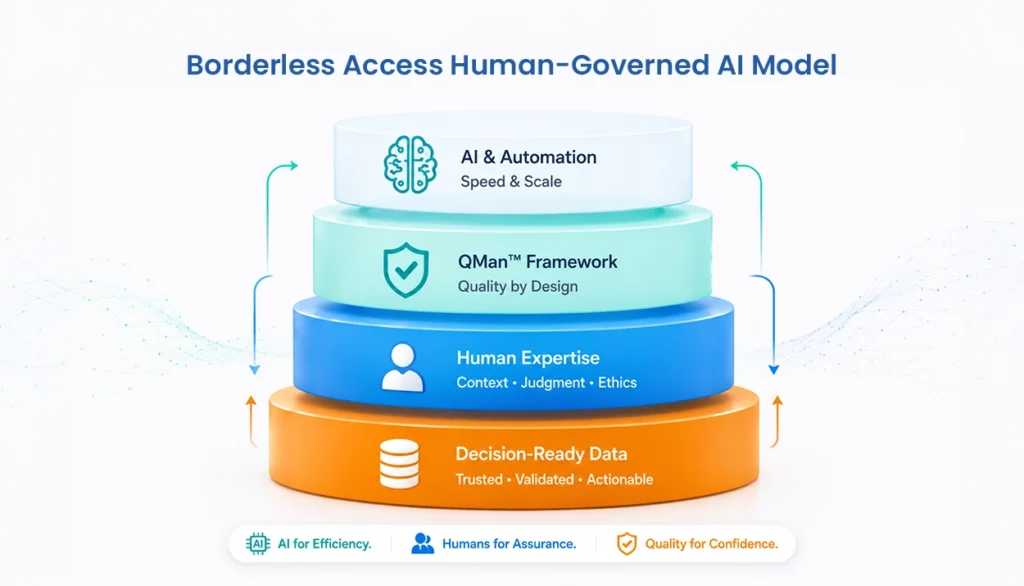
The stronger point is not that Borderless Access uses AI. Many companies do. The stronger point is that AI operates within a broader quality-governed ecosystem that includes QMan, feasibility intelligence, AI and tech-enabled research operations, validation frameworks, and human review. That is what protects the research decision.
The Future Belongs to Partners Who Can Govern AI, Not Just Use It
AI will continue to reshape market research. It will make some workflows faster, some processes smarter, and some quality signals easier to detect. But speed without governance is not enough. Automation without accountability is not enough. AI-generated efficiency without respondent authenticity, methodology, and validation is not enough.
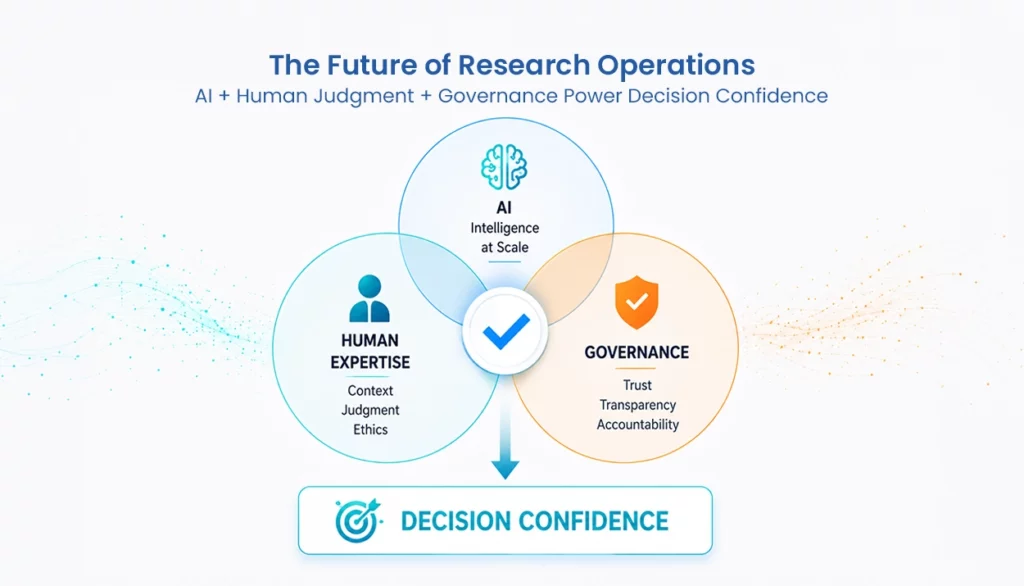
For research buyers, the next standard is clear. Do not ask only whether a partner uses AI. Ask how AI is governed. Ask where human judgment remains in control. Ask what quality signals are monitored. Ask how respondent authenticity is protected. Ask how feasibility, fieldwork, validation, and reporting are connected through a governed operating model.
The future of research operations is not AI replacing human intelligence. It is human judgment strengthened by AI and technology, governed through quality discipline, and focused on one outcome: decision-ready data that buyers can trust.
That is the standard Borderless Access believes research operations should meet: human-governed AI, real people, genuine opinions, verified responses, accurate data, and decision-ready insights.