



In high-stakes B2B and healthcare research, the real measure of audience access is not how many people a partner has in a database. It is whether the respondents are real, reachable, verified, and relevant to the decision being made.
Every audience access partner claims global reach. The language is familiar: millions of panelists, hard-to-reach respondents, specialist audiences, faster fieldwork, and broad market coverage. These claims may create confidence during supplier evaluation, but they often leave the most important question unanswered. How much of that reach is genuinely verified, qualified, and relevant to the research decision?
A job title can suggest authority without proving decision involvement. A healthcare profile can suggest relevance without confirming current practice context. A respondent can pass a screener but still lack the exposure, experience, or authenticity required for a high-stakes study.
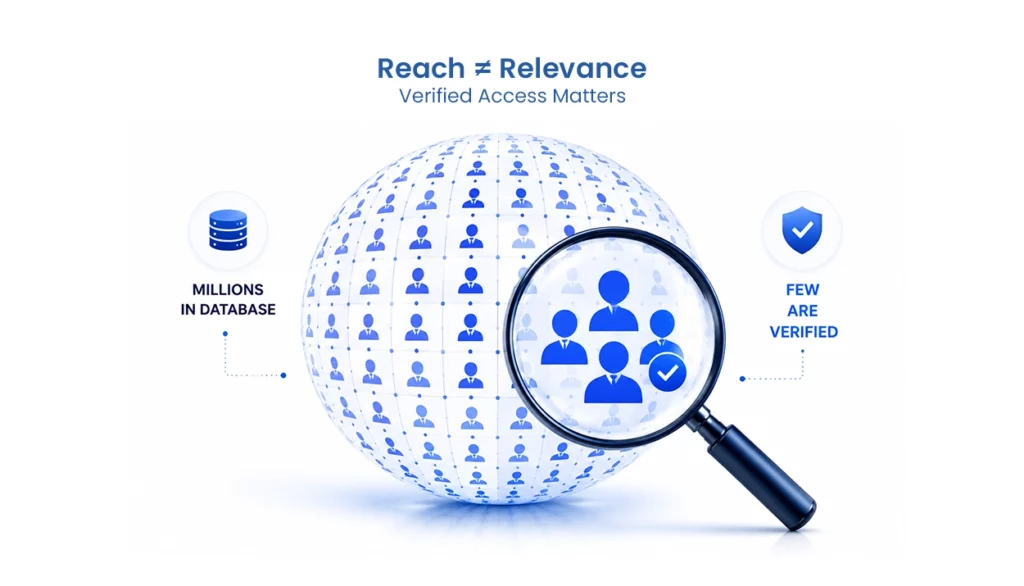
For insights leaders, procurement teams, research directors, agency sample teams, and panel managers, this changes the audience access conversation. The question is no longer simply whether an audience can be delivered. It is whether that audience can be delivered with enough confidence to support the decision the study is meant to inform.
The Market Has Moved from Reach Claims to Quality Proof
The industry has been signaling this shift for some time. ESOMAR’s 37 Questions guidance was created to help online sample buyers evaluate provider practices, sample sources, data quality, and the issues supplier answers should address. Greenbook’s recent GRIT commentary also points to a market where sample and data quality have moved into the top tier of unmet needs, especially as AI-generated responses and participant fraud deepen concerns around trust. Source references: ESOMAR 37 Questions; Greenbook GRIT commentary.
The risk is not theoretical. The Insights Association has reported that poor data quality undermines the industry’s ability to inform smart marketing and business decisions. Its data quality benchmarking work reports that 64% of respondents experienced a project delay or negative impact due to fraud, and 56% said fraud affected decision-making. Pew Research Center has also found that 3% to 7% of interviews in widely used online opt-in sources came from bogus cases, even after standard checks were applied.
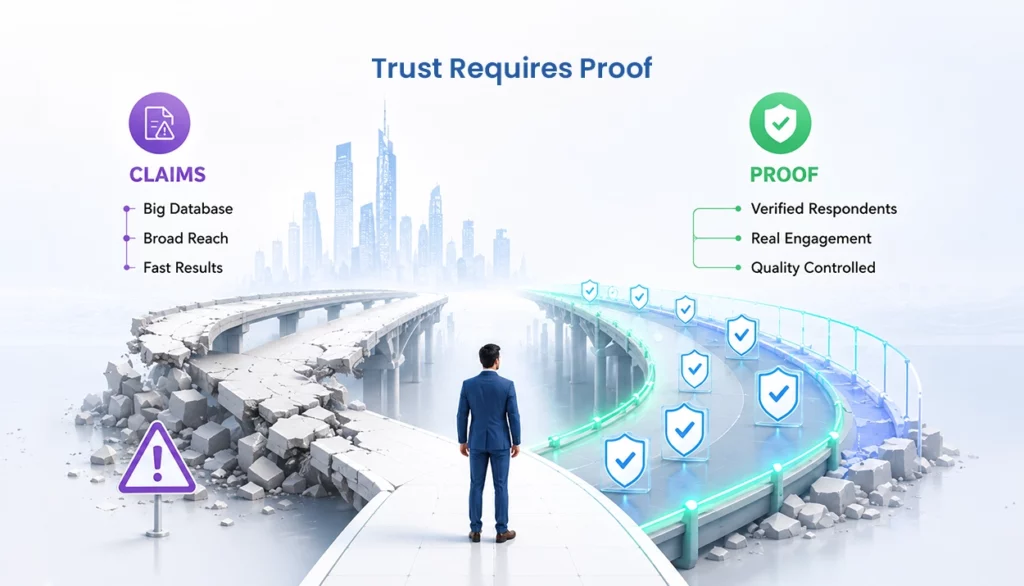
These proof points matter because they challenge a common assumption in online research. That assumption is that a completed interview is necessarily a usable interview. In difficult-audience studies, that assumption can be costly. A weak respondent base can inflate demand, misrepresent buying influence, and distort clinical or professional realities. This weakens confidence in decisions regarding product development, brand positioning and pricing, market access strategies, customer experience, and overall brand strategy.
The Feasibility Trap in Difficult-Audience Research
Many B2B and healthcare studies begin with a feasibility estimate that looks highly competitive. The audience appears reachable, the incidence assumption seems manageable, the timeline looks achievable, and the cost appears attractive. The challenge often becomes visible only after fieldwork begins.
When projects hit the field, several realities emerge:
- Incidence falls below expectation.
- Senior professionals are harder to engage.
- Healthcare profiles require deeper validation.
- B2B job titles do not always match decision authority.
- Regional markets perform unevenly.
As pressure rises, buyers are forced into difficult choices. They must extend timelines, increase incentives, add sources, loosen criteria, compromise quotas, or reframe expectations.
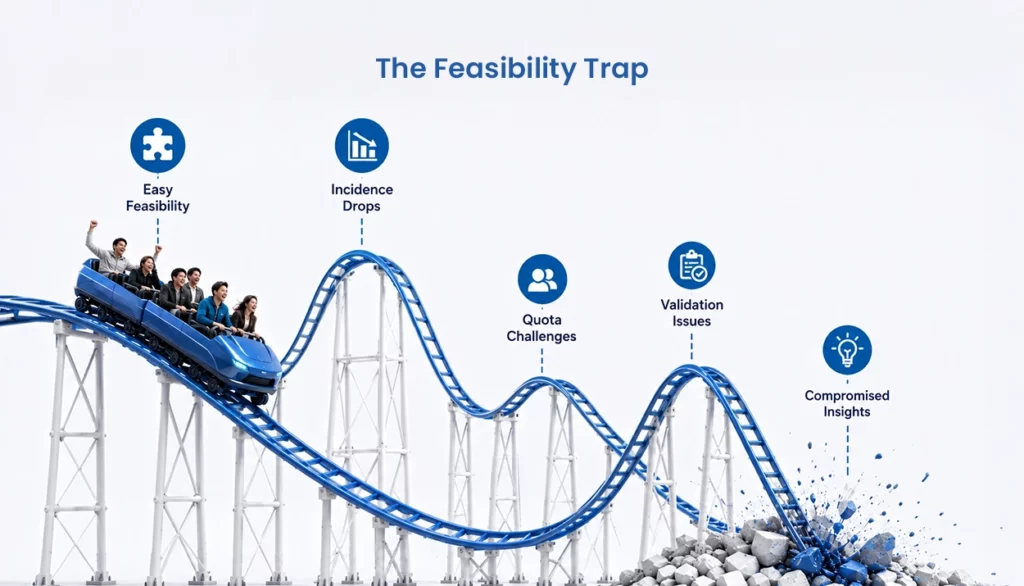
Each of these choices has a cost. Some affect budget and timeline. Others affect sample integrity. The most serious effect the confidence buyers can place in the final recommendation. This is why feasibility should be treated as a research discipline, not a sales promise. Strong feasibility does not simply ask whether completes can be delivered. It asks whether the right audience can be reached without weakening the data integrity behind the decision.
Why B2B Access Requires Deeper Validation
B2B research has become more complex because B2B decision-making has become more complex. Gartner has reported that 75% of B2B buyers prefer a rep-free sales experience, while also noting that fully self-service digital purchases are more likely to result in purchase regret. Forrester has also observed that B2B buying groups are becoming bigger, more networked, and increasingly led by digital natives. In its 2025 survey, 64% of manager-level-and-above business buyers were Millennials or Gen Z. Source references: Gartner B2B Buying Journey; Forrester B2B buyer research.
For research teams, this means a “B2B decision-maker” can rarely be treated as a simple audience label. Complex purchases require complex panels:
- Cloud infrastructure studies require IT leaders, security stakeholders, procurement influencers, finance evaluators, and operational users.
- Manufacturing automation studies require plant heads, technical evaluators, operations leaders, and budget owners.
- HR technology studies require HR leaders, employee experience teams, finance approvers, and users of the platform.
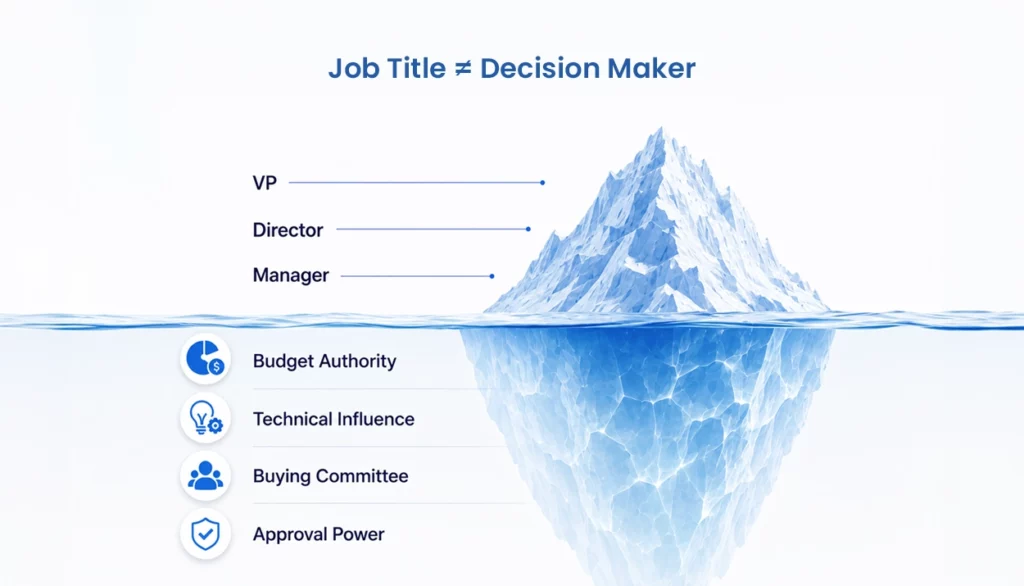
If these respondents are collapsed into one broad B2B category, the study may lose precision before fieldwork even begins. A credible B2B research panel must therefore be evaluated on more than database size and declared job titles. Buyers need confidence in role relevance, decision involvement, firmographic depth, source quality, and respondent validation.
Why Healthcare Access Carries an Even Higher Burden of Trust
Healthcare research requires an even higher standard because the respondent universe is more specialized, the time burden is greater, the topics are more sensitive, and the insights can influence decisions around product development, treatment understanding, patient support, market access, launch strategy, and healthcare communication.
The following groups cannot be treated as generic respondents:
- Physicians and specialists
- Allied healthcare professionals
- Patients and caregivers
- Payers and pharmacists
Their relevance depends heavily on specific clinical contexts, including specialty, therapeutic exposure, practice setting, patient volume, role in care delivery, and geography.
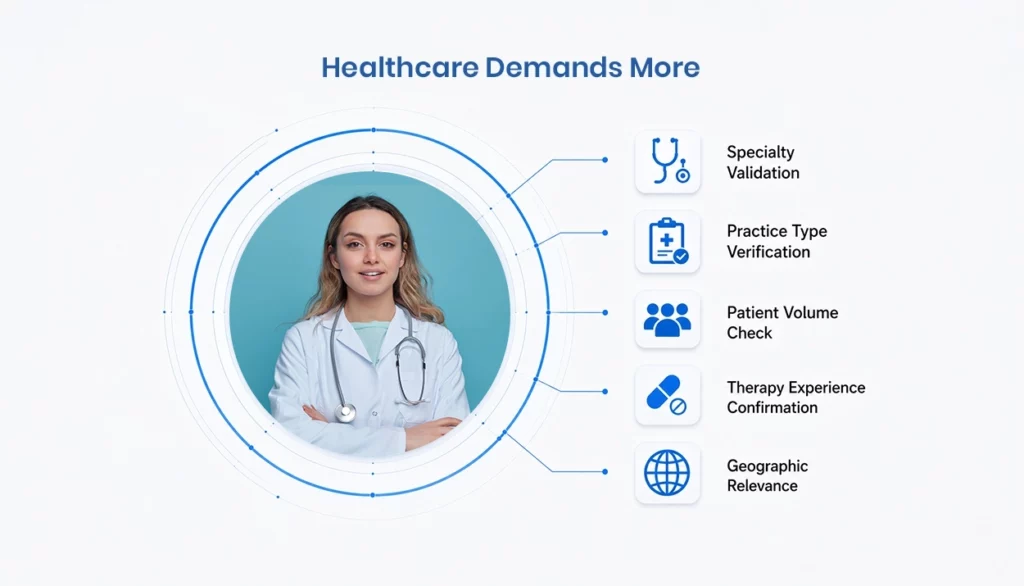
Focus on the difficulty of capturing medical professionals due to the nature of their work, status, and inconsistent engagement practices.
In healthcare research, access should not be evaluated only on speed, incidence, and cost. A physician panel or healthcare research panel has value only when the respondent’s professional relevance can be trusted.
Moving from Database Size to Verified Access
The next standard in B2B and healthcare audience access is verified access. Verified access means the respondent is not only present in a database, but must be:
- Real and active
- Reachable and relevant
- Properly profiled and validated
- Engaged and matched to the research objective
It also means that qualification is not left to the screener alone. It must be strictly governed across audience definition, feasibility assessment, source strategy, respondent validation, fieldwork monitoring, and post-field quality review.
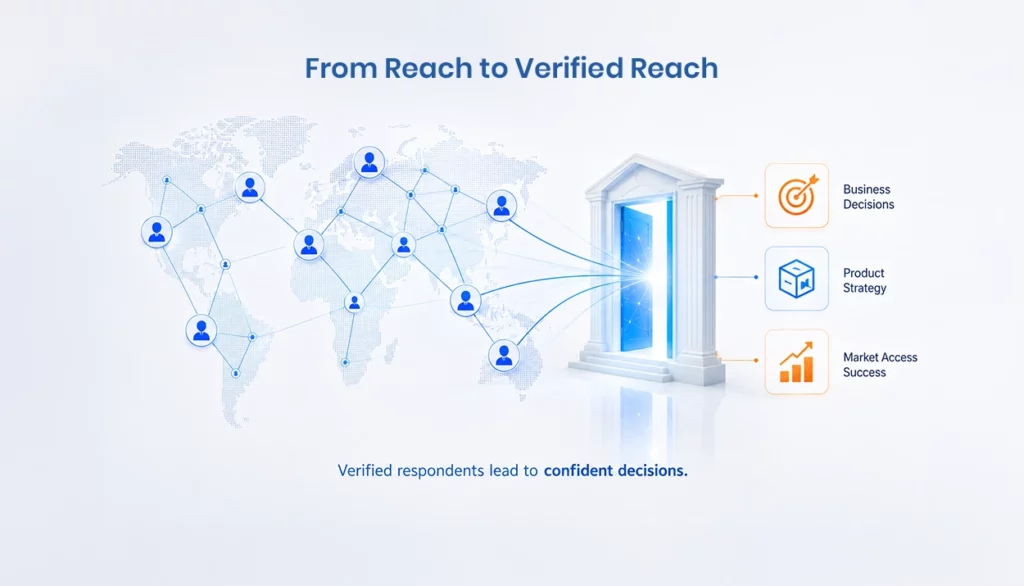
This changes how buyers should evaluate difficult-audience access. The question should not be, “How many people do you have?” It should be, “How do you know these are the right people, and how do you protect quality when the audience is difficult to reach?”
The Buyer’s Rubric: What To Ask Your Next Access Partner
To move beyond broad claims of global reach, buyers should pressure-test how an access partner governs quality before fieldwork begins.
| Buyer Question | Red Flag Answer | Stronger Answer |
| How do you define the audience beyond job title or specialty? | “We classify respondents based on declared profile data or screener responses.” | “We evaluate role relevance, decision involvement, professional context, firmographic or clinical fit, and study-specific requirements.” |
| What evidence supports your feasibility estimate? | “We have delivered similar audiences before.” | “We assess audience availability, incidence risk, market-level reach, source mix, expected drop-offs, and validation requirements.” |
| How do you validate professional identity or relevance? | “Respondents confirm their role during the screener.” | “Validation combines profile history, participation behavior, digital signals, duplication checks, and additional verification.” |
| How do you manage secondary or partner sources? | “We open partner networks when needed to complete quotas.” | “Any additional source is governed through common quality controls, transparent source management, and clear communication.” |
| What happens when incidence is lower than expected? | “We broaden the audience to complete fieldwork.” | “We diagnose the incidence issue, review source performance, discuss trade-offs, and protect the research objective.” |
This rubric helps buyers separate access partners who sell reach from those who govern it.
How Borderless Access Operationalizes Verified Access
Access should be proven, not just claimed. At Borderless Access, difficult-audience access is managed as a governed research process, not a database transaction. This is especially important in B2B and healthcare research, where the value of the insight depends on whether the respondent is not only reachable, but also real, relevant, verified, and engaged enough to provide meaningful input.
Borderless Access brings this approach to audience access through proprietary global panel ecosystems, specialized B2B and healthcare audience capabilities, feasibility intelligence, QMan-led data quality controls, AI and tech-enabled research operations, and human research expertise.
The company provides B2B audience access across roles such as IT, marketing, business, HR, and finance decision-makers. In healthcare and life sciences, Borderless Access publicly describes experience across more than 60 healthcare and life sciences clients, over 150 therapy areas, and over 80 markets. Source reference: Borderless Access public healthcare and life sciences capabilities.
The stronger point, however, is not scale alone. It is how scale is governed. Borderless Access’ proprietary data quality framework, QMan, is designed to strengthen respondent validation, survey integrity, fraud detection, and post-survey quality monitoring across the research lifecycle. It brings together multiple continuous controls, including:
- Digital fingerprinting and geo-validation
- Duplication prevention
- Length-of-interview monitoring
- Attention checks and smart sampling
- Machine learning-driven behavior prediction
- Engagement scoring
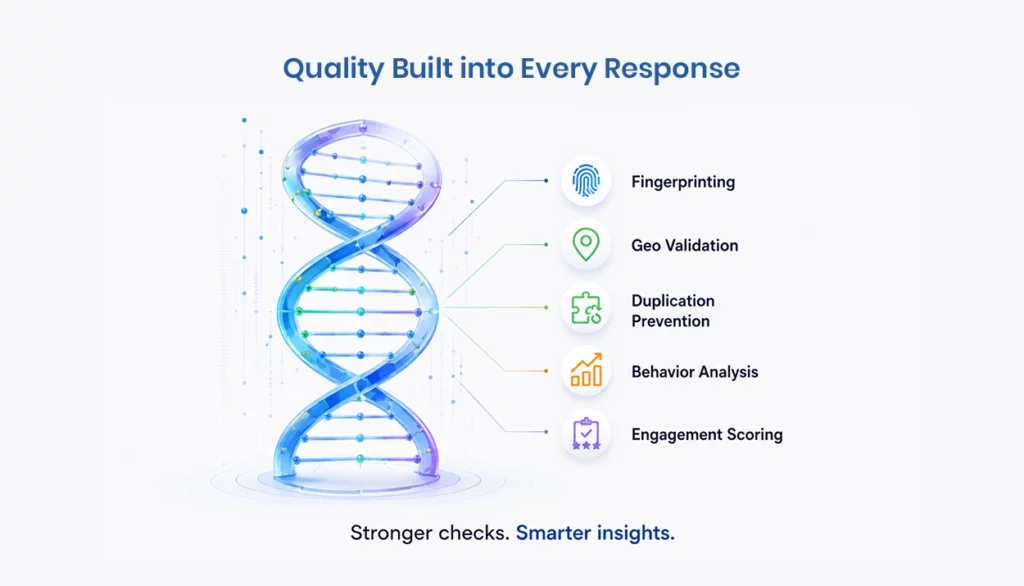
For difficult-audience studies, this matters because the central risk is not simply whether a respondent can be found. It is whether the respondent can be trusted for the decision being made. Verified access must protect the integrity of the research decision.
The Future Belongs to Partners Who Can Prove Access
Global reach will continue to matter. Speed will continue to matter. Cost efficiency will continue to matter. But in B2B and healthcare research, these factors cannot replace validation, feasibility intelligence, and quality governance.
The market does not need more suppliers claiming large databases. It needs research access partners who can prove verified reach. This means having the ability to define the audience precisely, validate that respondents are real and relevant, govern quality across sources and markets, and communicate feasibility honestly before fieldwork begins.
For research buyers planning B2B, healthcare, or niche audience studies across the USA, UK, Europe, or global markets, the better starting point is no longer asking if an audience can be delivered. It is asking if the audience can be delivered with enough confidence to support the decision being made.
That is the standard Borderless Access believes difficult-audience research should meet. Verified access to real people, genuine opinions, validated responses, and decision-ready data.