
Ask a pharma insights director the biggest challenge about healthcare research today, and the answer is rarely “finding respondents”. Healthcare panels can produce a physician sample in days. The harder problem is knowing whether that physician is who they claim to be, whether their specialty and prescribing pattern match the study’s requirements, and whether their answers will hold up once a launch decision, a pricing model or a regulatory submission depends on them.
Respondent access has become commoditized. Verification, therapy-area depth and operational quality have not. A large panel that recruits loosely and verifies occasionally can move just as fast as a smaller, tightly governed one, and still deliver data nobody should trust. For teams working across pharma, biotech, medical devices and diagnostics, the question worth asking isn’t whether a provider can find enough physicians, patients or allied healthcare professionals. It’s whether the infrastructure behind those respondents can support the decision waiting on the other side of the data.
A healthcare research panel operates as ongoing recruitment and qualification infrastructure, not a one-time source of respondents. That sounds close to a general consumer panel. It isn’t, and the difference matters more than most procurement conversations acknowledge.
General panels are built for breadth: reach as many people as possible, screen at the point of survey entry, move on. Healthcare panels have to solve a harder problem before a single survey goes live. A cardiologist has to be confirmed as a licensed, practicing cardiologist, not someone who answered a screener question correctly. A patient with a rare autoimmune condition has to be identified and profiled long before a study needs them, because that population is too small to find through open recruitment on a project timeline.
This is why specialization isn’t a marketing claim in healthcare panel research; it’s a structural requirement. Pharma, biotech, medical device and diagnostics organizations make decisions where the cost of an unverified or mismatched respondent isn’t a bad data point. It’s a wrong conclusion carried into a launch plan, a pricing model or a clinical development decision.
“Having respondents” and “having the right respondents” are not the same capability, and the gap between them is where most healthcare research risk lives.
A high-quality panel starts with identity and credential verification for healthcare professionals: confirming license status, specialty and active practice, rather than accepting self-reported claims at face value. For patients and caregivers, the equivalent is diagnosis and treatment-history verification, built without compromising privacy or consent. Allied healthcare professionals need their own verification path, since a pharmacist, nurse practitioner or medical technologist has different credentials to confirm than a physician does.
Verification is only the entry point. What makes a panel usable for real decisions is therapy-area profiling deep enough to separate a cardiologist who treats heart failure from one who treats arrhythmia, or a patient managing a stable chronic condition from one navigating an active rare-disease diagnosis. Segmentation this granular has to be maintained over time, not captured once at recruitment and left to go stale.
Longitudinal engagement is the piece organizations tend to underestimate. A panel that engages the same verified oncologists or diabetes patients across multiple studies, over multiple years, builds a depth of profiling and behavioral history that a one-time recruitment exercise cannot replicate. That’s the practical difference between a panel and a database of contacts: one gets more useful the longer an organization uses it, and the other starts degrading the moment it’s compiled.
Panels aren’t the only way to reach healthcare professionals and patients, and treating them as a universal replacement for other recruitment methods misreads what each approach is built for.
Method | Best Suited For | Strengths & Trade-offs | When to Use |
Healthcare research panels | Ongoing, specialized and tracking studies | Verified, profiled audiences at speed and scale; needs strong panel governance to sustain | Speed, specialization and repeat access all matter |
One-time recruitment | Generic, one-off studies | Fast and low-cost; no ongoing relationship, weak on niche audiences | Requirements are broad and one-time access is enough |
Physician networks | Research within one defined physician community | Strong engagement in a known group; limited scale, no competitive independence | Deep engagement with one physician group matters most |
Patient advocacy communities | Rare disease and condition-specific research | Trust and condition knowledge; risks over-representing the most engaged patients | Condition-specific insight is the priority |
Site-based recruitment | Clinical or care-setting research | Strong contextual verification; slow, costly, hard to scale internationally | Access through a clinical setting is essential |
The table above covers the trade-offs at a glance. The pattern across all alternatives is the same: each trades some combination of speed, scale or independence for the specific strength it offers, panels earn their place when a study needs several of those at once, not just one.

Healthcare panel provider aren’t a single respondent pool. They’re structured around the audiences, professional qualifications and therapy-area requirements a given study needs, and the most common structures are HCP panels, patient and caregiver panels, allied healthcare professional panels, and therapy-area-specific panels. Checking a box for every audience type isn’t the goal; going deep enough within each one to be useful for a specific research question is. Healthcare Professional panels cover physicians across specialties, from general practice to surgical and diagnostic specialties, along with nurses and pharmacists. Recruitment complexity rises sharply with specialization: a general practitioner is easy to verify and recruit at volume, while a subspecialist treating a narrow patient population requires deliberate, long-horizon panel building rather than on-demand sourcing.
Patient panels split into three distinct recruitment problems. Chronic-condition patients, managing diabetes or hypertension, exist in large numbers and can typically be reached at reasonable speed. Rare-disease patients are a different order of difficulty: low-incidence populations mean a provider either has years of accumulated, profiled reach or doesn’t have meaningful access at all. Caregivers add a third dimension, since their perspective on treatment burden, adherence and quality of life often diverges from the patient’s own account and needs to be captured separately, not inferred from it.
Allied healthcare professional panels, covering pharmacists, nurses, radiologists, lab technologists, therapists and hospital administrators, fill a gap that physician-only research leaves open. AHPs sit closer to day-to-day treatment delivery and operational friction: a pharmacist sees adherence problems a prescribing physician never observes, and a hospital administrator understands the formulary and procurement pressure that shapes what actually reaches a patient.
Therapy-area panels cut across all three respondent types. Oncology, cardiology, diabetes and metabolic disease, neurology and CNS, mental health and rare disease each carry their own recruitment complexity and research objective, from tracking treatment-sequencing decisions in oncology to understanding diagnosis delay in rare disease. The organizing question for a buyer isn’t which specialties a provider lists. It’s whether depth in the specific therapy area required exists before the study starts, not built reactively once it does.
This is the kind of breadth a provider’s numbers should reflect, not a large pool that theoretically contains the right people somewhere inside it. Borderless Access’s healthcare panel network spans more than 1.60 million physicians and HCPs, 2.19 million patients and 0.68 million allied healthcare professionals across 57 markets, profiled by specialty and therapy area rather than broad category. That is what turns a headline respondent count into something a study can actually use: the ability to reach a defined subspecialty, a specific rare condition or a named allied role, on request, rather than a general pool that includes them in theory.
The organizations getting the most value from panel infrastructure aren’t the ones running the most studies. They’re the ones returning to the same verified audiences across a product’s life, instead of rebuilding access from zero every time a new question comes up.
Before a therapy area is fully mapped, panels support the foundational work: sizing patient burden, tracing the diagnostic and treatment journey, and identifying where unmet need is real versus assumed. This is where verified physician and patient access turns a hypothesis about an opportunity into evidence a portfolio team can act on.
Panels contribute here in a supporting, not substitutive, role. Feasibility research, testing protocol design against physician and patient input before a trial launches, can surface burden, eligibility and adherence issues that are far cheaper to fix on paper than mid-trial. That’s distinct from clinical-trial patient recruitment itself, which operates under separate regulatory and ethical frameworks. Market research panels inform trial design; they don’t replace the recruitment infrastructure a trial requires.
Once a product approaches launch, the same verified physicians and patients who informed early research can evaluate positioning, message clarity and channel preference before spend commits. Pricing and market access research depends on perspectives from physicians, payers and other stakeholders who make or influence prescribing and access decisions.
After launch, the panel becomes a tracking instrument rather than a one-time recruitment tool. HCP adoption tracking, patient-reported treatment experience and competitive benchmarking all depend on returning to comparable, verified populations wave after wave. A brand tracking program that swaps its underlying sample between waves produces movement that looks like insight and is actually noise.
The value compounds. A panel used once is a procurement transaction. A panel used across a product’s life, from early landscape work through post-launch tracking, becomes something closer to a standing research capability than a vendor relationship.
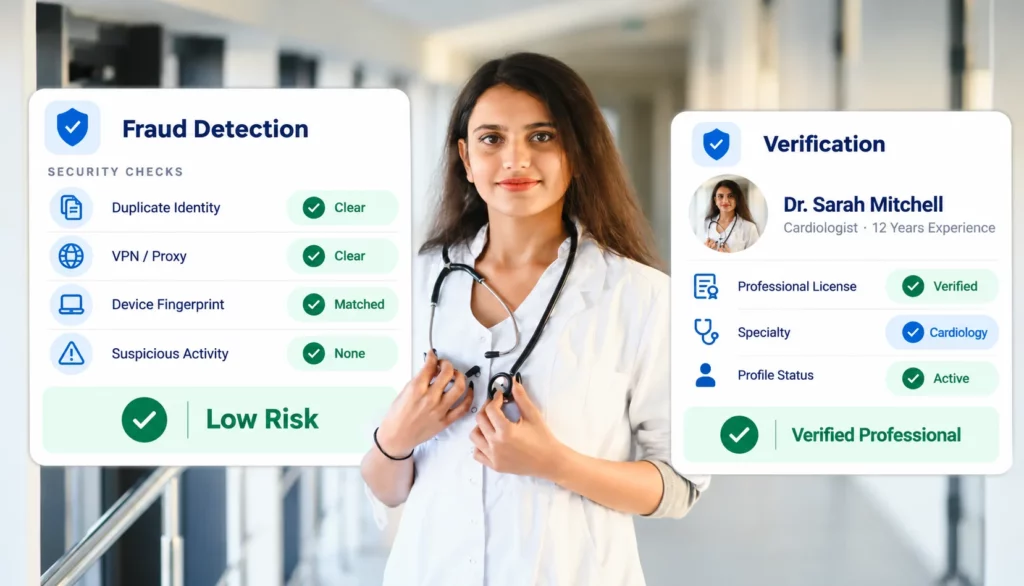
Panel size is the easiest number for a provider to advertise and the least reliable predictor of research quality. A million-respondent claim says nothing about how many of those respondents are still active, correctly profiled or willing to answer honestly under a paid incentive.
Real quality sits in the operating model behind the number. Identity verification for HCPs, patients and AHPs has to run at recruitment and be refreshed on an ongoing basis, because a license lapses, a specialty shifts and a patient’s diagnosis or treatment status changes. Intelligent sample matching, aligning respondents to a study’s specialty, therapy-area experience and demographic requirements, matters as much as verification itself; a correctly verified cardiologist is still the wrong respondent for a study that requires interventional cardiology experience.
Fraud prevention and continuous quality control have to operate throughout data collection, not as a cleanup step after fieldwork closes. Healthcare survey panels need to account for duplicate identities, professional survey-taking, bots, inconsistent responses, speeding and other behavioral signals that indicate compromised data. Controls such as digital fingerprinting, VPN and geolocation checks, duplicate detection, attention checks and behavioral monitoring work together to catch problematic respondents before their responses enter the final dataset. Representativeness and respondent diversity determine whether findings generalize past the specific people who happened to answer, and global coverage without accompanying regulatory compliance and local relevance can produce a dataset that looks complete and still misrepresents how a market behaves.
Quality, treated correctly, isn’t a final-stage check applied to a finished dataset. It’s an operating model built into every stage before, during and after fieldwork. The same survey design and quality-control questions that apply to market research broadly apply here with less room for error, since healthcare research panels remain only as strong as the survey design and fieldwork discipline built around them.
Download our Healthcare Panel Book to explore verified HCP, patient, and AHP audiences, specialized therapy-area expertise, and healthcare research capabilities across global markets.
Some problems in healthcare research don’t have an easy structural fix. Rare specialties and low-incidence patient populations mean the respondents a study needs may simply not exist in large numbers anywhere, so recruitment has to be built years ahead of demand rather than sourced on request. Maintaining data quality at scale gets harder as panels grow, not easier, because more respondents means more opportunity for fraud, duplication and disengagement to slip through.
Speed and verification pull against each other by default; cutting verification steps is the fastest way to compress a fielding timeline, and also the fastest way to compromise the data at the end of it. Multi-country studies add regulatory and consent requirements that vary by market, and longitudinal engagement requires sustained relationship management that a one-off recruitment push never has to solve.
These are exactly the pressures that have pushed serious providers to build AI into panel operations rather than treat it as an add-on.
AI’s contribution to healthcare panel research is a shift in where quality checks happen: earlier, continuously and at a scale human review alone can’t sustain.
Applied well, AI supports survey programming and logic validation before fieldwork opens, catching bias and structural errors that would otherwise surface only after data starts coming in. It powers intelligent sample matching, aligning verified respondents to a study’s specialty, therapy-area and demographic requirements faster than manual screening allows. During fieldwork, automated fraud detection and behavioral-anomaly monitoring flag duplicate identities, speeding and inconsistent response patterns in real time, rather than after the dataset is closed. On the back end, automated data validation and AI-assisted reporting shorten the distance between fieldwork closing and insight reaching a decision-maker.
AI-assisted execution across Borderless Access’s healthcare panel operations has been associated with up to 30% faster survey deployment and data delivery, a 94% response quality rate, and up to a 50% reduction in manual operational effort, across 57 markets. These figures are tied specifically to that AI-powered healthcare workflow, not a blanket claim about every panel study or every research vendor, and are worth reading as evidence of what a well-built AI layer can do rather than a guarantee any given study will replicate them.
None of this replaces research judgment. AI can flag an anomalous response pattern; it can’t decide whether a finding is commercially meaningful, or whether a therapy-area nuance in the data reflects something real about physician behavior versus an artifact of question design. The organizations getting the most from AI-enabled panel operations pair it with experienced research leadership rather than substitute one for the other.
Most healthcare panel provider evaluations stop at “how many physicians do you have in this specialty?” That question gets a number. It doesn’t get an answer to whether the number is real, current or usable for the study at hand.
A more useful set of questions goes deeper. Instead of asking whether respondents are verified, ask what verification means operationally: when it happens, how often credential and identity information is refreshed, and what triggers removal when a respondent’s behavior falls outside quality thresholds. Instead of asking about therapy-area coverage, ask for evidence of depth in the specific therapy area a study needs, not a broad specialty list that happens to include it.
Ask how a provider sources respondents, since recruitment channel shapes everything downstream: a panel built through controlled, verified recruitment behaves differently from one assembled by aggregating third-party sources. Ask about panel refresh practices, because a panel that recruited well three years ago and hasn’t actively renewed since is quietly decaying even if the headline size hasn’t changed. Ask what fraud controls run during fieldwork, not only at registration, and what AI-enabled quality infrastructure sits behind the panel doing that work continuously.
Together, these are what panel transparency actually means in practice: a provider willing to name its recruitment sources, disclose its refresh cadence, explain how inactive respondents get removed, and describe its fraud and quality controls in specific terms rather than as proprietary.
Geographic coverage and regulatory compliance deserve direct questions too: which markets does the provider operate in with local teams rather than subcontractors, and what data-governance frameworks apply across those markets. Finally, ask about scalability: whether the provider can support a study from early landscape research through post-launch tracking, or whether the relationship resets with every new project.
The providers worth working with answer these questions with specifics. The ones worth avoiding answer with adjectives.
Respondent access was the primary constraint a decade ago. Increasingly, it isn’t. The constraint now is trust: whether the verification, therapy-area depth and quality infrastructure behind a panel can support a decision that carries real commercial or clinical weight.
That’s the question worth resolving before the next study goes out for pricing, not after the data comes back and something doesn’t add up.
Looking for quality healthcare panels for critical research decisions? Connect with our experts for verified HCP, AHP and patient audiences, specialized therapy-area expertise, and rigorous quality controls.
What Are Healthcare Panels?
A healthcare research panel is a pre-recruited, continuously verified group of physicians, patients, caregivers and allied healthcare professionals available for ongoing market research. Verification, therapy-area profiling and continuous quality monitoring distinguish it from a general consumer panel, since healthcare decisions carry a higher cost when respondent data turns out to be unreliable.
How Are HCPs Verified in a Healthcare Panel?
Verification typically combines license and credential checks against specialty records, controlled or invitation-based recruitment, and ongoing behavioral monitoring rather than a single registration-stage check. Providers with strong panel governance re-verify credentials periodically and remove or flag respondents whose activity falls outside expected quality thresholds.
How Are Patients Recruited for Healthcare Research?
Patient recruitment for panel-based research relies on layered profiling built up over time, condition, treatment history and demographic attributes, combined with consent and privacy safeguards appropriate to health data. For rare or low-incidence conditions, this profiling has to exist before a study begins, since open recruitment on a project timeline rarely reaches these populations. A provider either has that reach already built and kept up to date, or it doesn’t have real access to these patients at all.
What Are Allied Healthcare Professionals (AHPs)?
Allied healthcare professionals are clinical and technical staff outside medicine, nursing and dentistry, including pharmacists, radiologists, lab technologists, therapists, nutritionists and hospital administrators. In research, AHPs often surface operational and adherence realities that physician-only studies can miss, from formulary friction to workflow barriers.
Why Does Therapy-Area Expertise Matter in Healthcare Research?
Therapy-area expertise determines whether a panel can distinguish a physician treating heart failure from one treating arrhythmia, or a patient with a stable chronic condition from one navigating an active rare-disease diagnosis. Without that depth, a study can reach technically qualified respondents who still don’t match what the research question requires.
How Does AI Improve Healthcare Panel Recruitment and Quality?
AI supports intelligent sample matching, ongoing quality monitoring and automated fraud detection throughout fieldwork, rather than as a single pre- or post-study check. Borderless Access reports up to 30% faster survey deployment and a 94% response quality rate within its own operations, figures specific to its research framework rather than an industry standard.
What Should Organizations Look For in a Healthcare Panel Provider?
Look past headline panel size to verification methodology, therapy-area depth, panel transparency around recruitment sources and refresh practices, fraud controls, AI-enabled quality infrastructure and genuine geographic coverage with local regulatory compliance. The strongest indicator is whether a provider can support a study from early research through post-launch tracking using the same verified audience, rather than starting from zero each time.
How Long Does It Take to Field a Healthcare Research Study?
Timelines vary by specialty rarity, therapy-area complexity and geographic scope, a general practitioner sample fields faster than a rare-disease patient sample across multiple markets. Providers with pre-profiled, verified audiences typically field faster than those recruiting from scratch, since the qualification work is already done before a study launches.
How Much Does Healthcare Panel Research Cost, and What Drives the Price?
Cost depends primarily on respondent rarity, incidence rate and required sample size, not panel size alone. A common chronic-condition patient sample costs less to reach than a narrow subspecialty or low-incidence rare-disease population, since the latter requires deeper, longer-maintained profiling to locate at all.
What Should MedTech and Medical Device Companies Look For in a Healthcare Panel?
Beyond standard HCP and patient verification, MedTech research needs profiling on procedure experience, device usage and role in clinical or purchasing decisions, not just specialty. A panel that can’t distinguish a surgeon who has used a specific device class from one who hasn’t isn’t qualified for device-specific research, regardless of overall panel size.
© 2026 Borderless Access Pvt Ltd. All Rights Reserved.