
Consumer research done well is not just about reaching a lot of people. It is about reaching the right composition of people, verified to be genuine, engaged enough to give real answers, and specific enough that the findings mean something more useful than a population-wide average.
This guide covers what consumer research actually involves, how to define an audience with real precision, what separates reliable consumer data from data that just looks reliable, and where the discipline is headed as both consumer behaviour and research technology continue to shift.

Consumer research is the systematic study of how individuals think, feel, and behave as buyers and users of products, services, and brands. It covers everything from large-scale quantitative tracking of category attitudes to deep qualitative exploration of why a specific purchase decision was made, and everything in between.
What makes it distinct from other forms of market research is the audience itself: individual consumers making personal decisions, often influenced by factors that have little to do with rational product evaluation, habit, identity, social context, emotion, convenience, and constraint.
Good consumer research treats that complexity as the subject of study, not as noise to be averaged away. A finding that “62% of consumers prefer Option A” is only useful if you also understand which consumers, in which contexts, and whybec, ause the remaining 38% are not a rounding error. They are very often a distinct group with their own coherent logic.
Consumer research is sometimes treated as a confirmation exercise: a way to validate a decision that has effectively already been made internally. Framed this way, the research is designed to produce supportive findings rather than accurate ones, and the questions are written to lead toward an expected answer.
This produces data, but not insight. Genuine consumer research has to be willing to return findings that contradict the brief’s starting assumption. The value of the discipline is precisely its capacity to surface what internal teams could not have known from the inside.
Every consumer research brief defines a target audience, and the quality of that definition determines almost everything downstream, recruitment, questionnaire relevance, and ultimately whether the findings can be acted on.
The trouble is that broad demographic descriptors age range, gender, income bracket, urban or rural, describe a population, not an audience. Two 32-year-old urban professionals earning a similar income can have entirely different relationships with a category: one researches extensively before any purchase, the other buys on impulse and rarely returns to a brand once dissatisfied. A sample built only on demographics will blend both into a single average that represents neither.
Useful consumer audience definitions tend to go further, incorporating:
Category behaviour, not just category membership, frequency of purchase, brand switching patterns, channel preference, and price sensitivity within the specific category being studied, not assumed from general spending habits.
Life stage and circumstance, which often predicts behaviour far better than age alone, a new parent, someone recently relocated, or someone managing a chronic health condition behaves differently from demographic peers without those circumstances.
Attitudinal and psychographic markers, which capture orientation toward a category, early adopters versus cautious followers, value-driven versus premium-driven, brand-loyal versus deal-driven, that demographic data alone cannot surface.
Specific ownership or usage, for studies that genuinely require respondents who already use a particular product type, service, or platform, rather than people who plausibly might.
A sample defined with this level of resolution costs more to recruit than a generic demographic pull. It is also the difference between research that explains a specific commercial question and research that produces an interesting but unusable population snapshot.
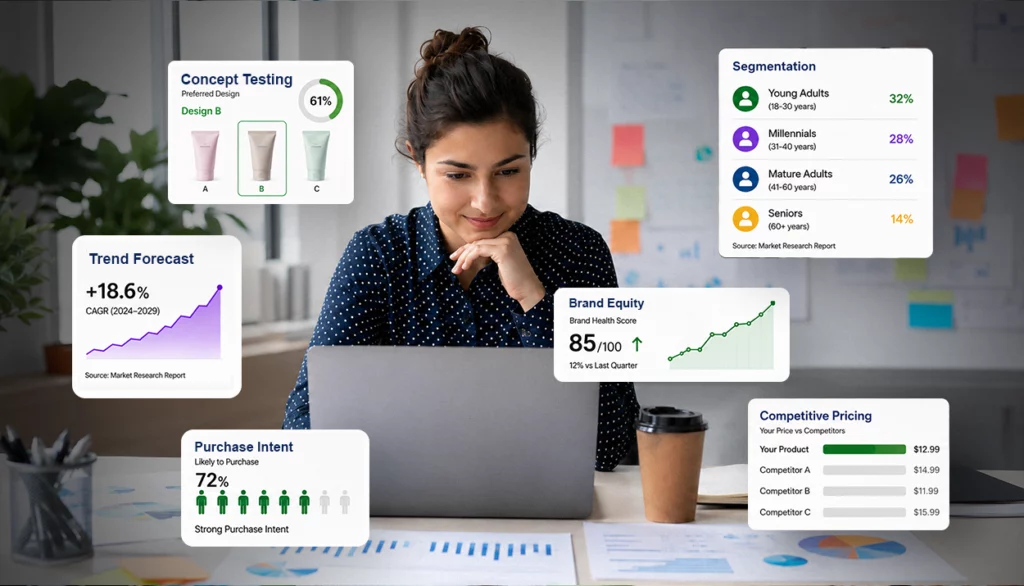
Beyond stated preference, consumer research uncovers the functional and emotional factors that actually determine choice within a category and where those factors diverge from what consumers say drives their decisions versus what their behaviour actually reveals.
Exposing defined consumer audiences to test new product ideas, packaging, or propositions and measuring appeal, differentiation, and purchase intent provides evidence for investment decisions before development costs are committed.
Ongoing measurement of awareness, consideration, and preference among target consumer segments shows whether brand investment is translating into commercial position, and flags shifts early enough to respond to them.
Understanding how consumers move from initial awareness through consideration to purchase and what information, triggers, and obstacles shape that path, informs where and how brands should invest in reaching consumers at each stage.
Identifying groups of consumers who are internally similar and meaningfully different from each other in needs, attitudes, or behaviour rather than just demographics, gives brand and product teams a foundation for differentiated strategy rather than a one-size-fits-all approach.
Understanding what consumers are willing to pay, how price interacts with perceived value, and where price sensitivity varies by segment supports pricing decisions that are grounded in actual consumer trade-offs rather than internal assumption.
Testing how consumers respond to messaging and creative, what they understand, what they remember, and what it makes them feel, before and after a campaign closes the loop between communication investment and actual impact.
Structured surveys remain the primary tool for measuring consumer attitudes, behaviours, and preferences at a scale large enough to generalise confidently to a broader population. They are the right choice when the research question is fundamentally about size and distribution: how many consumers feel this way, how does that vary by segment, and how has it changed over time.
Best suited to: brand tracking, usage and attitude studies, concept and product testing, pricing research, and any study requiring statistically reliable comparison across consumer segments or markets.
One-to-one interviews and group discussions explore the reasoning, emotion, and context behind consumer behaviour in a depth that structured qualitative surveys cannot reach. They are particularly valuable when a research question is fundamentally about meaning rather than measurement — why a behaviour exists, not just how common it is.
Best suited to: early-stage concept exploration, understanding purchase decision journeys, uncovering unmet needs, and exploring category language and emotional drivers ahead of communication development.
Longitudinal communities engage a defined group of consumers over an extended period, days or weeks through structured tasks, discussions, and reflection prompts. This format captures how opinions develop and shift over time, and allows iterative research designs where later tasks build on what emerged earlier in the study.
Best suited to: iterative concept development, tracking attitude shifts around an emerging trend, and studies that benefit from depth across multiple touchpoints rather than a single moment of feedback.
Observing consumers in their natural environment at home, while shopping, during product use captures behaviour as it actually occurs, which frequently diverges from how people describe their own behaviour after the fact. This method is particularly valuable for understanding routine, habit, and the role of physical and social context in shaping decisions.
Best suited to: shopper behaviour research, in-home product usage studies, and any research question where environment and habit are central to the behaviour being studied.
The most consequential consumer research questions are rarely answered by a single method alone. A common and effective sequence pairs qualitative exploration to understand the landscape of consumer attitudes and the language consumers actually use with quantitative measurement that establishes how widely those attitudes and behaviours extend across the broader population.
Best suited to: major strategic decisions where both depth of understanding and statistical confidence are required before committing resources.
Precision in audience definition creates its own challenge: the more specifically a study defines who it needs to talk to, the smaller and harder to find that audience becomes. Consumer research increasingly needs to solve for both ends of this tension simultaneously genuine precision in targeting, and genuine scale in reach.
This is particularly visible in three recurring research scenarios.
Multi-market studies need consistent audience definitions applied across very different consumer populations, in markets where panel depth and digital infrastructure vary considerably. A study that performs well in markets with mature online panels can struggle to deliver comparable sample quality in markets where online research is newer or less penetrated, unless the panel infrastructure has genuinely been built out in those markets rather than assembled through ad hoc local partners for each project.
Niche and hard-to-reach segments people defined by a specific condition, ownership, interest, or behaviour rather than broad demographics, require panels that have already profiled respondents against those specific attributes. Recruiting a custom sample of, for example, pet owners who also use a specific category of financial product, fresh for each individual study, is slow and frequently under-delivers on sample size and quality.
High-value or affluent segments, which represent a small fraction of the general population but a disproportionate share of category value in many sectors, require panels with the depth to identify and reach this group specifically, rather than hoping enough of them surface incidentally within a general population sample.
Solving for scale and precision together is fundamentally a panel infrastructure question. It requires a sufficiently large base of profiled, verified respondents, spread across enough markets, that virtually any reasonably defined audience can be reached without compromising on either the size or the specificity of the sample.
Some of the most valuable business decisions depend on understanding highly specific consumer groups, not the general population. Whether it’s frequent travelers, OTT viewers, smartphone users, gamers, pet owners, financial product holders, healthcare patients, or high-net-worth individuals, these audiences often hold the insights that drive product innovation, marketing effectiveness, and growth strategies.
The challenge is that niche audiences can be difficult, expensive, and time-consuming to find through traditional screening methods. Reaching them efficiently requires a panel that is already deeply profiled across demographic, behavioral, lifestyle, and category-specific attributes.
This is where Borderless Access creates a distinct advantage.
Our global consumer panel is continuously profiled across hundreds of data points, enabling researchers to identify and engage highly targeted audience segments with speed and confidence. Rather than relying on broad recruitment and extensive screening, brands can access pre-profiled consumers based on attributes such as shopping behavior, travel frequency, device ownership, media consumption habits, health conditions, financial product usage, family structure, automotive ownership, gaming preferences, and much more.
This depth of profiling not only improves targeting accuracy but also accelerates project timelines and enhances data quality by ensuring the right consumers are reached from the outset.
Equally important is our ability to deliver these audiences at a global scale. Borderless Access combines strong panel presence in mature research markets such as India, Brazil, and Mexico with continued investment in emerging and hard-to-reach regions across Africa, the Middle East, and Eastern Europe. This allows brands to conduct consistent, high-quality research across both established and developing markets without compromising on audience precision.
The result is a research ecosystem that moves beyond broad consumer sampling to deliver highly targeted, globally scalable audience access, helping brands connect with the consumers who matter most to their business decisions.
Explore how Borderless Access helped one of the world’s largest beverage companies access rapid, high-quality insights for faster decision-making at regional and global scale. View the Case Study
The quality of any research study depends on the quality of the people participating in it. A verified consumer panel is made up of real, authenticated individuals whose identities and participation are continuously validated to ensure the insights they provide are genuine, reliable, and representative.
This has become increasingly important as online research faces growing challenges from bots, duplicate accounts, fraudulent respondents, and disengaged participants. While these respondents may appear legitimate at first glance, they can significantly compromise data quality, leading to inaccurate insights and poor business decisions.
At Borderless Access, panel quality is not treated as a one-time verification exercise. It is managed through a multi-layered quality framework designed to validate respondent authenticity throughout the entire research lifecycle.
Our approach includes:
By combining rigorous verification processes with ongoing quality monitoring, we ensure that only authentic and engaged respondents contribute to our research programs.
The result is a consumer panel built on trust and reliability, with a 91% respondent acceptance rate, significantly lower levels of repetitive survey fraud, and fraud detection capabilities that identify bot-driven activity at nearly twice the rate of conventional screening methods. For brands, this translates into cleaner data, greater confidence in findings, and insights that are genuinely reflective of real consumer opinions and behaviors.
Download our Panel Book to discover our global B2B, B2C, and healthcare audience capabilities across markets worldwide.
Consumer expectations are evolving faster than ever, and traditional research methods are under increasing pressure to keep pace. AI is helping researchers respond to this challenge by improving everything from audience targeting and data quality to survey engagement and insight generation.
One of the most significant impacts of AI is operational efficiency. AI-powered tools can automate survey programming, validate complex survey logic, identify low-quality responses, detect fraud in real time, and accelerate data cleaning and analysis. Tasks that once required days of manual effort can now be completed in hours, allowing research teams to focus more on interpretation and strategic recommendations.
AI is also transforming how researchers analyze large volumes of unstructured data. Advanced text analytics can process thousands of open-ended responses simultaneously, identifying recurring themes, sentiment patterns, emerging trends, and consumer emotions at a scale that was previously difficult to achieve.
Beyond operational improvements, AI is fundamentally changing how consumers experience research.
Traditional surveys often follow a rigid, one-size-fits-all structure. Respondents are presented with the same questions in the same order regardless of their answers, leading to survey fatigue, disengagement, and superficial responses.
At Borderless Access, our Conversational AI capabilities are designed to make surveys more natural, adaptive, and engaging. Rather than simply collecting answers, Conversational AI creates dynamic interactions that respond to participant input in real time.
This approach enables:
For example, if a consumer says a product feels “too expensive,” Conversational AI can immediately probe further to understand whether the concern relates to value perception, competitive alternatives, affordability, or product expectations. This helps researchers move beyond surface-level responses and uncover the deeper drivers of consumer behavior.
Consumer research has historically traded off speed against rigour. Faster studies meant smaller samples, simpler questionnaires, or less thorough quality checking. That trade-off is being actively dismantled by the application of AI to the operational mechanics of research, while leaving the judgement calls that determine research quality firmly in human hands.
In practice, this divides cleanly into what AI is well suited to handle and what still requires human expertise. AI-assisted tools support survey scripting and logic validation, helping ensure that complex routing and quota structures function correctly before a study goes live, work that is repetitive, rule-based, and exactly where manual processes are prone to error. Machine learning models support respondent quality screening during fieldwork, identifying patterns associated with fraud or disengagement faster and more consistently than manual review alone could manage at scale. Automated data cleaning algorithms remove outliers and inconsistencies from raw datasets, reducing the manual processing time required before analysis can begin.
Human expertise remains central at the points that determine whether research actually answers the right question: defining study objectives, designing a questionnaire that captures what the research brief actually needs, and interpreting what the data means for a specific commercial decision. AI extracts patterns from data efficiently; it takes a researcher who understands the category, the client’s competitive context, and the decision at hand to translate those patterns into a recommendation that is actually useful.
The combined effect of this division of labour is measurable: roughly a quarter faster delivery of clean, validated data through automated checks, around half the manual effort previously required for analysis preparation and table building, and meaningfully faster delivery of final data tables with fewer rounds of rework. None of this comes at the expense of the human judgement that determines whether a study was designed and interpreted well in the first place, it comes from removing the operational friction that used to consume time better spent on that judgement.
Ready to unlock deeper consumer insights? Connect with our experts to discover how our global consumer panels, AI-powered research capabilities, and human-led expertise can help you make smarter, faster, and more confident decisions.
What is consumer research?
Consumer research is the process of understanding how people think, feel, and behave as consumers. It helps businesses make informed decisions about products, pricing, branding, customer experience, and marketing strategies.
Why is consumer research important?
Consumer research reduces uncertainty by providing evidence-based insights into customer needs, preferences, motivations, and purchasing behaviors, helping businesses make smarter decisions and minimize risk.
What are the main types of consumer research?
The most common types include quantitative surveys, qualitative interviews and focus groups, online communities, ethnographic research, and mixed-method studies that combine multiple approaches.
How do you recruit the right consumers for research?
The most effective approach is using pre-profiled consumer panels that allow researchers to target participants based on demographics, behaviors, attitudes, interests, and category usage rather than relying solely on broad screening criteria.
What is a consumer research panel?
A consumer research panel is a group of pre-recruited and profiled individuals who agree to participate in research studies. Panels enable faster access to relevant audiences and improve research efficiency for deeper consumer behavior insights.
What are verified consumer panels?
Verified consumer panels consist of authenticated respondents whose identities and participation are continuously monitored to prevent fraud, duplicate accounts, bots, and low-quality responses.
How can businesses reach niche consumer audiences?
Niche audiences can be reached through deeply profiled consumer panels that identify respondents based on specific behaviors, interests, ownership patterns, life stages, health conditions, or category usage.
How does AI improve consumer research?
AI helps automate survey programming, respondent quality checks, fraud detection, data cleaning, text analytics, and reporting, allowing researchers to deliver faster and more reliable insights.
How does AI improve consumer research?
Consumer research focuses on understanding individual consumers—their behaviors, motivations, preferences, and decision-making. Market research is broader, covering consumers, competitors, industries, and market trends.
© 2026 Borderless Access Pvt Ltd. All Rights Reserved.