
For years, many business leaders have viewed B2B market research as a straightforward exercise in surveying professionals and reporting results.
A survey goes out to a panel. A few hundred responses have come back. The data gets cleaned, cross-tabulated, and built into a deck. The deck gets presented and everyone nods at the findings; someone raises a concern about whether the sample was really the right audience, and the report is filed somewhere it is rarely opened again. But that’s far from the reality.
Effective B2B , however, depends on reaching the right decision-makers, asking the right questions, and ensuring data quality at every stage.
This article explores the key characteristics of a successful B2B market research company and how organizations can turn research investments into actionable business outcomes.
B2B market research is the systematic collection and analysis of data about business markets, buyers, competitors, and industry dynamics specifically to inform decisions made by organizations that sell to other organizations.
It answers questions that commercial instinct and internal data cannot: how do buyers in a target segment actually make purchasing decisions? What do they value that competitors are not delivering? Where is the market heading, and what does that mean for product strategy? How is your brand perceived by the buyers you most need to reach?
The output is not a dataset. It is the understanding required to make better decisions about where to compete, how to position, what to build, and how to sell.
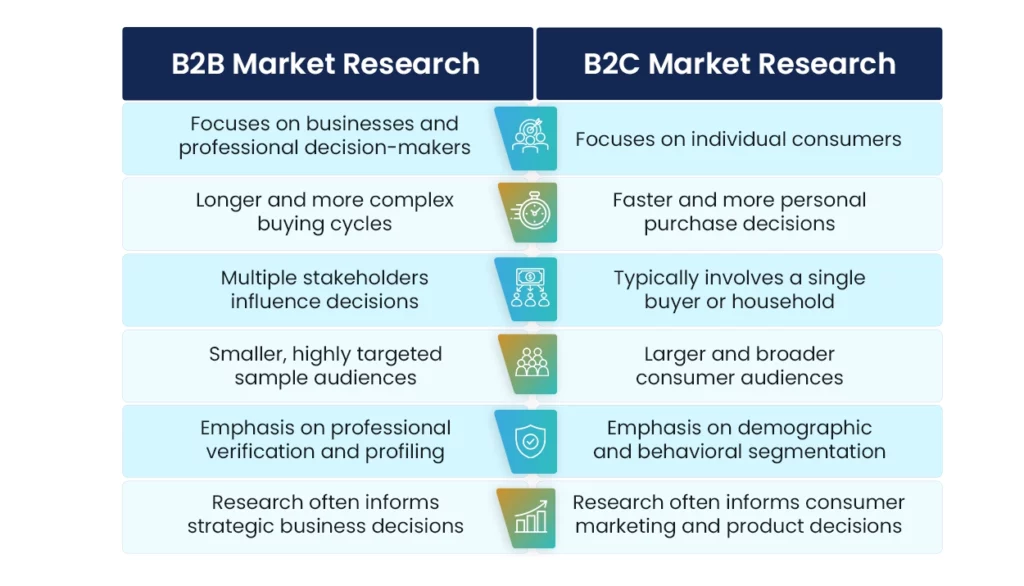
At first glance, B2B and B2C market research may seem similar. Both aim to understand audiences, uncover opportunities, and support better decision-making. However, the people being studied, the buying journey, and the research challenges are fundamentally different.
In B2C research, the focus is on individual consumers making personal purchase decisions. These decisions are often driven by factors such as convenience, price, emotions, brand perception, and lifestyle preferences. B2C audiences are generally larger and easier to reach, allowing researchers to gather feedback from broad population groups.
B2B research, on the other hand, focuses on professionals and business decision-makers. Purchasing decisions are typically more complex, involve multiple stakeholders, longer evaluation cycles, larger budgets, and greater business risk. A technology purchase, for example, may require input from IT teams, procurement managers, finance leaders, and executive decision-makers before a final decision is made.
This difference significantly impacts how research is conducted. While B2C studies often prioritize scale and consumer sentiment, B2B research places greater emphasis on audience verification, professional profiling, and understanding decision-making dynamics within organizations.
It is not a survey deployed to whoever is available and willing to respond. The quality of B2B research is determined almost entirely by who answers, not just how many answer. A sample of the wrong professionals, however large, produces findings that cannot be trusted.
It is also not a one-size-fits-all method. B2B market research encompasses quantitative surveys, qualitative in-depth interviews, expert panels, online communities, and secondary intelligence work. Choosing the right approach for the right question is a core part of what makes research useful rather than just completed.
The audience is defined not by who someone is, but by what they do professionally, their role, their decision-making authority, their industry, and the size and type of organisation they work in. A “procurement manager” in a 20-person logistics firm is a fundamentally different research subject from a “procurement manager” in a 5,000-person pharmaceutical company, even though they carry the same job title.
Getting that distinction wrong produces data that looks credible but reflects the wrong population. As B2B samples are smaller than consumer samples to begin with, there is lesser room to absorb that kind of sampling error.
Then there is access. Senior business professionals are time-constrained and in many industries, over-surveyed. The most relevant ones require a panel built specifically for professional audiences, with verification processes that go beyond asking someone to tick a box confirming their job title.
Professionals in a formal research context sometimes answer how they think they should, particularly on topics involving technology adoption, budget authority, or strategic priorities. Research that does not account for that gap produces findings skewed toward stated intent rather than actual opinions.
These three problems, profile, access, and response authenticity, are where most B2B research programs quietly lose their validity before the first question is asked.
When it is designed and executed properly, B2B market research informs decisions across the full commercial lifecycle.
Every significant commercial decision, entering a new market, launching a new product, expanding into an adjacent segment, rests on some estimate of the opportunity. B2B research provides the primary data that makes that estimate credible: how large is the addressable market, what share is currently served, what is the realistic penetration given competitive dynamics, and what would buyers actually pay?
Market sizing built on secondary data and analyst estimates is a starting point. Research that puts those estimates in front of the actual buyers who would make the purchase decision is what makes them defensible.
Which value propositions resonate with IT decision-makers versus CFOs? What language does a manufacturing buyer use to describe a problem that your marketing team is describing in entirely different terms? Where in the purchase journey does a particular type of content actually influence behavior?
B2B communication research closes the gap between what organizations say about themselves and what buyers hear and identifies the specific messages, formats, and channels that work for specific buyer profiles at specific stages of the decision process.
Surveys deployed to a defined sample of verified business professionals are the workhorse of a B2B market research company. They are effective for measuring the size and distribution of attitudes, awareness, preferences, and behaviors across segments and for producing data that can be defined by role, industry, geography, and company size.
The defining variable is sample quality. A survey instrument that is well-designed but deployed against a poorly verified panel will produce numbers that are statistically confident but substantively wrong. In B2B research, sample quality is not a secondary consideration. It is the primary one.
When to use: Market sizing, demand estimation, competitive benchmarking, awareness and consideration tracking, feature prioritization, and multi-market comparison studies.
One-to-one conversations with verified business professionals, typically 45 to 90 minutes, conducted by a specialist moderator, are the primary qualitative method in B2B customer research. They are designed to explore the reasoning, context, and process behind professional decisions at a level of depth that surveys cannot reach.
IDIs are particularly valuable for understanding complex, multi-stakeholder buying processes: how a procurement manager and a technical evaluator think about the same decision differently, what informal criteria shape vendor selection that never appear in an RFP, and why a deal that looked certain fell apart at a particular stage.
When to use: Buyer journey mapping, multi-stakeholder decision dynamics, product development research, and any study where the reasoning behind behaviour matters as much as the behaviour itself.
Group discussions with business professionals surface how peers talk about shared challenges, how category of language is used in practice, and where professional consensus and disagreement exist. Expert panels assembled from senior practitioners in a specific domain are particularly useful for strategic foresight and market landscape work.
When to use: Category exploration, messaging development, strategic planning research, and understanding shared professional norms around vendor selection or technology adoption.
Longitudinal research communities bring together a cohort of business professionals over days or weeks. Participants respond to prompts, complete tasks, and discuss topics with each other over time. The format is well suited to iterative product or concept development, where feedback needs to come across multiple rounds rather than being captured in a single session.
When to use: Multi-stage innovation research, extended co-creation projects, and studies that require professionals to reflect on their experience over time rather than react to a one-time stimulus.
In B2B market research, job titles alone rarely tell the full story. The same title can represent very different responsibilities, authority levels, and purchasing influence across industries and organizations. That’s why effective B2B research requires a deeper understanding of who respondents are, what decisions they influence, and the context in which they operate.
The Borderless Access B2B panel spans more than 2.75 million verified professionals across 40 economies. The panel is profiled across multiple dimensions including decision-making authority, industry, company size, seniority, and functional role to help brands reach the exact professionals they need. Whether targeting final decision-makers, key influencers, C-suite executives, IT leaders, or mid-market buyers, researchers can build highly precise audiences based on verified professional attributes rather than self-reported credentials.
This multi-layered profiling approach helps improve audience accuracy, strengthen data quality, and deliver insights that better reflect real-world business decision-making. The result is research that goes beyond reaching professionals, it reaches the right professionals, enabling organizations to make more confident, informed, and actionable business decisions. The company is affiliated with ESOMAR and operates under ESOMAR guidelines on respondent treatment, data handling, and ethical research practices.
Asking someone whether they are a decision-maker is not verification. People who want to qualify for a survey will say they are decision-makers. What verification actually requires happens at the panel level before any study begins through the recruitment process, the authentication steps, and the ongoing monitoring of response quality over time.
The Borderless Access B2B panel is built around a layered verification architecture designed specifically for this problem.
Profiling tells you who a panelist is supposed to be. Verification is what establishes that they actually are.
The Borderless Access verification process operates across five stages. Each stage catches a different type of quality failure. Together, they address the three core risks in B2B panel quality: fraudulent or misrepresented identity, disengaged or inconsistent respondents, and the gradual degradation of panel quality over time.
All B2B panelists are recruited through Borderless Access’s dedicated app and website, a controlled environment designed specifically for professional audience recruitment. This creates a different entry point from general consumer panels, where B2B profiles are assembled by filtering for self-reported professional characteristics in a population recruited for unrelated purposes.
Recruitment through a dedicated platform means that people joining the panel are doing so because they have been specifically invited or have sought out professional research participation, not because they are heavy survey-takers looking for incentives. That starting point filters a different kind of respondent before any formal verification begins.
Every applicant goes through a double opt-in process before being admitted to the panel. This is a direct confirmation requirement, the applicant must actively confirm their registration through a secondary channel, typically email, that conforms to ESOMAR guidelines on panel recruitment.
Double opt-in serves two functions. It establishes that the person who applied is the same person who controls the contact details provided. And it filters out the passive or accidental registrations that inflate panel numbers without adding genuine research participants.
Following the double opt-in, panelists are authenticated via mobile using a one-time password at registration and again at incentive disbursement. This triple opt-in step ties panel membership to a verified, active mobile identity, a layer of authentication that significantly raises the cost and complexity of fraudulent registration.
The incentive disbursement check is particularly important. It means that the verification is not just a one-time hurdle at entry but is repeated at the moment the panellist receives a tangible benefit from their participation, creating a continuous link between verified identity and active engagement.
This is the step that most B2B panels skip. For the Borderless Access B2B panel, social media verification is mandatory for all recruits, not optional, not recommended, but required as a condition of panel membership.
The reason it matters is specific to the B2B context. Consumer identity is difficult to verify but relatively tolerant of approximation. Professional identity, the specific role, organization, and authority level that B2B research depends on, is verifiable through professional social networks in a way that consumer demographics are not. Cross-referencing panel profile data against an active professional social media presence creates a check that self-reported credentials alone cannot provide.
The friction this adds to recruitment is real. Some potential panelists will not complete this step. That is the point. The panel is smaller as a result and more accurate as a result.
Verification at entry is necessary but not sufficient. Panel quality degrades over time when respondents become disengaged, begin rushing through surveys for incentives, or change roles in ways that make their profile data stale.
At Borderless Access, panelists are monitored continuously. Predictive algorithms and ML-powered behavior analysis flag inconsistent response patterns and remove respondents who fall below quality thresholds. The result is a panel that maintains its integrity over time rather than one that passes a quality check at entry and degrades from there.
For research buyers, the findings they get what verified professionals in the relevant roles think and feel, not what a broadly recruited sample of respondents reported.
Watch our exclusive webinar to learn how we are helping industry leaders tackle panel fraud, improve respondent engagement, and build robust quality frameworks that deliver more reliable insights.

As B2B markets become increasingly complex, the future of research will belong to organizations that combine AI-driven efficiency with human judgment, enabling faster, higher-quality insights that support better business decisions.
One of the biggest shifts is in professional audience verification and recruitment. functional responsibility.
As B2B buying committees become more complex and niche, researchers need to identify decision-makers based on factors such as authority, industry, company size, and functional responsibility.
AI-powered profiling, behavioral analysis, and verification systems are helping research providers improve audience accuracy and reduce the risk of misrepresented respondents, a growing concern in an era of survey fraud and synthetic identities.
AI is also transforming how data quality is managed. Machine learning algorithms can now detect suspicious response patterns, identify disengaged participants, flag inconsistencies, and surface fraudulent activity in real time. This is becoming increasingly important as research buyers place greater emphasis on respondent authenticity and reliable decision-making data.
Beyond fieldwork, AI is accelerating survey programming, open-end coding, text analytics, and reporting. Tasks that once required days of manual effort can now be completed in hours, allowing research teams to focus on interpretation rather than administration. At the same time, advances in generative AI are helping researchers analyze large volumes of qualitative feedback, identify emerging themes, and uncover patterns across complex datasets.
However, the most successful organizations are not treating AI as a replacement for human expertise. B2B purchase decisions remain highly contextual, involving multiple stakeholders, long buying cycles, and industry-specific nuances. While AI can identify patterns at scale, human researchers are still essential for understanding the motivations, organizational dynamics, and strategic implications behind those patterns.
The research questions vary by function, but the underlying need is the same: to replace internal assumption with external evidence before making decisions that are hard to reverse.
Strategy and corporate development teams use it to evaluate market opportunities, size addressable segments, assess competitive dynamics, and build the evidence base for entry or expansion decisions.
Product and solutions teams use it to understand buyer’s needs before committing a direction, test concepts against the actual evaluation criteria buyers apply, and diagnose why adoption has not met expectations.
Marketing teams use it to define positioning that resonates with specific buyer profiles, develop messaging grounded in how buyers actually describe their problems, and optimize channel and content investment by role and stage.
Sales enablement teams use it to understand how target buyers evaluate vendors, what decision criteria apply at each stage of the purchase process, and what objections are most likely in specific segments.
Eager to know how Borderless Access can help you reach verified decision-makers and act on insights that create measurable business impact? Speak to our experts today
What is B2B market research?
B2B market research helps organizations understand business buyers, market opportunities, competitors, and purchasing behaviors to make informed business decisions.
Why is B2B market research important?
It helps businesses reduce uncertainty, identify growth opportunities, improve products and services, and develop strategies that better align with customer needs.
How is B2B research different from B2C research?
B2B research focuses on professionals and business decision-makers, while B2C research focuses on individual consumers. B2B buying decisions are often more complex and involve multiple stakeholders.
How long does a B2B market research project take?
Most projects can be completed within 3–8 weeks, depending on the methodology, audience complexity, and number of markets involved.
What industries use B2B market research?
B2B research is widely used across technology, manufacturing, healthcare, financial services, telecommunications, professional services, and many other sectors.
How do you ensure B2B data quality?
Data quality is maintained through respondent verification, quality checks, fraud detection measures, and continuous monitoring throughout the research process.
© 2026 Borderless Access Pvt Ltd. All Rights Reserved.