
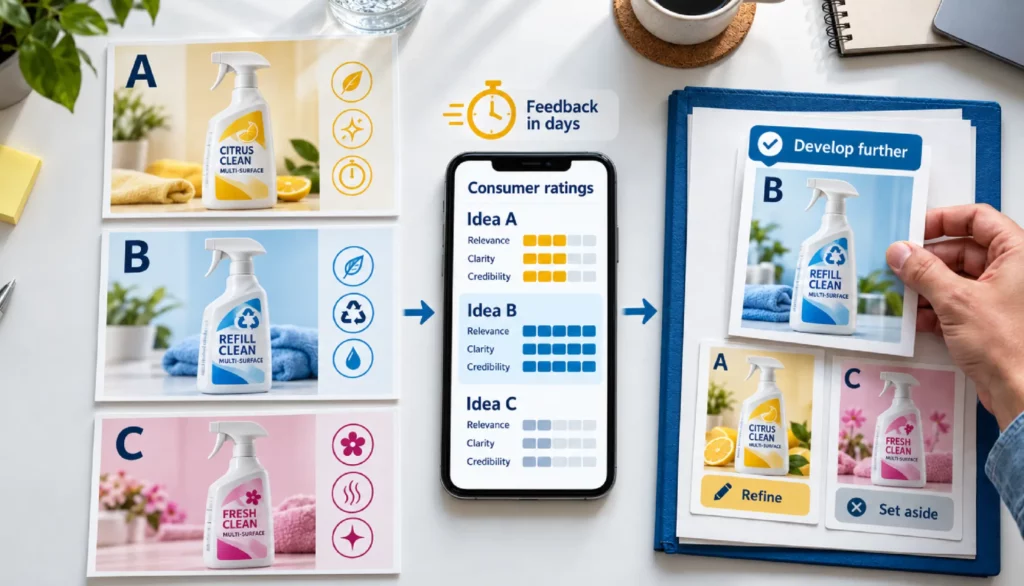
Fast concept testing helps brands decide which ideas deserve further investment by gathering feedback from relevant consumers within days rather than weeks. It gives marketing, innovation, and insights teams evidence to compare options, understand weaknesses, and decide what to advance, refine, or set aside.
When several ideas compete for a limited budget, internal enthusiasm is only part of the picture. The more useful question is whether consumers understand the proposition, find it relevant, and see a reason to choose it.
FlashSight by Borderless Access is a fast concept testing and speed-testing solutions that brings consumer feedback into early decisions. Suitable studies can return results in around two days after the questionnaire is finalized.
Features | Details |
What it tests | Ideas, product concepts, claims, taglines, key visuals, pack artwork, ingredient propositions, celebrity associations |
Typical turnaround | Around two days after the questionnaire is finalized, depending on audience, sample size, quotas, and reporting |
Questions | Customized, or selected from an existing question battery |
Audience | General population (fastest route) or targeted audience profiles |
Design | Sequential evaluation of multiple ideas or assets in one study |
Deliverables | Online dashboard, Excel tables, or PowerPoint, depending on agreed scope |
Fast concept testing is a research approach that gathers consumer feedback on proposed ideas, concepts, or marketing assets within a short timeframe. It helps teams screen options and identify improvements while changes are still practical.
Product concept testing examines how consumers respond to a proposed product and its benefits. Fast concept testing research applies the same logic to a wider range of materials, including taglines, claims, and pack artwork, and can also answer a specific business question through a short survey.
A study should begin with a clear decision. Which proposition should progress? Which message communicates the benefit most clearly? What needs to change before an idea earns further investment?
Fast concept testing answers a focused screening question quickly, while traditional concept testing research examines a shortlisted idea in greater depth. The two work best in sequence, with the fast study narrowing options and the deeper study building the evidence for larger commitments.
| Fast concept testing | Traditional concept testing |
Purpose | Screen and compare early ideas or assets | Evaluate a shortlisted concept in detail |
Scope | Focused question set | Broader, more detailed questionnaire |
Timeline | Days (FlashSight: around two days after questionnaire sign-off) | Typically longer, depending on design |
Best used for | Shortlisting, refining wording, early go/no-go | Final-stage validation and larger investment decisions |

Early testing helps brands separate an appealing internal idea from a proposition consumers actually value. That distinction matters before budgets, briefs, and creative directions become harder to change.
An idea may feel distinctive but address no meaningful consumer need. Another may offer a relevant benefit that its wording fails to communicate. The first may need reconsideration; the second may deserve refinement and another test.
Fast ides and concept testing helps teams recognize these differences and direct development resources accordingly. It also gives stakeholders a shared basis for evaluating an idea beyond personal preference.
Fast concept testing can evaluate early propositions and individual marketing elements, provided the material gives consumers enough information to assess it fairly.
What to test | What the feedback can clarify |
Ideas and product concepts | Which needs, benefits, or propositions merit further development |
Claims and taglines | Whether the promise is clear, relevant, and believable |
Key visuals and calls to action | Whether the intended message is understood and gives consumers a reason to respond |
Pack artwork | How consumers interpret the design and the information it communicates |
Ingredient propositions | Whether a described ingredient or formulation benefit is appealing and understood |
Celebrity associations | Whether the proposed association feels appropriate for the brand and message |
Fast concept testing survey evaluates reactions to what consumers see or read. Assessing actual taste, performance, or ease of use requires a product test with a suitable product experience.
A well-designed fast concept test connects a business decision with relevant consumers, comparable materials, and clear evaluation criteria.
Specify what the research must help the team do. “Choose two ideas for further development” gives a study a clearer purpose than “understand consumer behavior” Agree on the criteria for progression before reviewing results.
Choose respondents whose category use, needs, and buying behavior fit the proposition. Feedback from frequent category buyers may differ from feedback from consumers who rarely consider the category.
Go/No-Go testing requires comparable materials. Keep the level of detail and finish reasonably consistent across options, and account for presentation order when respondents evaluate several ideas.
Ask questions that reveal both appeal and potential weaknesses. Preference or purchase intent can indicate which option leads; relevance, clarity, and credibility help explain why and what needs improvement.
Translate findings into specific actions: progress, revise, investigate further, or stop. Consider the strength of the evidence and the size of the differences before declaring a winner. Close results may call for further investigation.
Fast concept testing should measure the qualities that matter to the development decision of the product. It’s proposition and a campaign tagline may require different measures.
Measure | What it helps the team understand |
Appeal | Do consumers like the idea or asset overall? |
Purchase intent | Would consumers consider buying or choosing it? |
Relevance | Does the idea address a need that matters to the target consumer? |
Uniqueness | Does it feel meaningfully different from available alternatives? |
Value for money | Does the proposed benefit justify the stated price, where a price is included? |
Message clarity | Do consumers understand what the idea or asset communicates? |
Credibility | Do consumers find the promise believable? |
These are possible measures to select for the brief, not a fixed checklist for every study. FlashSight’s sample concept-screening output, for example, considers relevance, uniqueness, and value for money together.
Read the results together. A distinctive idea with low relevance may need a stronger consumer benefit. A relevant idea with low clarity may need better wording. An overall preference score alone would leave those development priorities unexplained.
FlashSight by Borderless Access supports focused surveys and the evaluation of ideas and marketing assets. Teams use it to shortlist concepts, assess communication elements, and gather feedback before committing to further development.
Studies can use an existing question battery or customized questions. Audience profiles help identify relevant respondents, and the sample design can be tailored to the study. General-population studies offer the fastest route, while more specific targeting needs to be reflected in the plan.
Suitable studies can return results in around two days after the questionnaire is finalized. Results can be delivered through an online dashboard, Excel tables, or PowerPoint, depending on the agreed scope.
The audience, number of options, sample size, and reporting requirements should be agreed at the outset, as these determine the study scope and delivery timeline.
Fast concept testing suits focused screening decisions. Deeper research is appropriate when teams need to understand complex motivations, investigate unclear findings, or evaluate a shortlisted proposition more thoroughly.
Qualitative research can explore why a benefit feels unconvincing or which unmet needs shape reactions. More detailed concept, packaging, or advertising research can assess the strongest options against the requirements of the next development stage.
The right research insight matches the decision and the consequences of getting it wrong. Early screening can narrow the options; later research can build the evidence for larger commitments.
Consider a hypothetical household-care brand comparing three messages for a new cleaning product: convenience, a product feature, and value for money.
The team tests each message with relevant category buyers, assessing relevance, clarity, and credibility. Suppose the convenience message addresses a common frustration, the feature message attracts interest but fails to explain its benefit, and the value message is clear but feels insufficiently distinctive.
The findings suggest different actions: develop the convenience route, clarify the feature benefit, and reconsider what makes the value proposition compelling.
The test guides development priorities. Actual market performance will also depend on the product, price, availability, and execution.
Let our proprietary speed testing solutions help you identify winning concepts faster. Talk to our team to get started.
How Long Does FlashSight Concept Testing Take?
Suitable FlashSight studies can return results in around two days after the questionnaire is finalized. The exact timeline depends on the audience, sample size, quotas, and reporting requirements, which are confirmed before fieldwork begins.
How Much Does Fast Concept Testing Cost?
Cost depends on the number of ideas or assets, the length of the questionnaire, the audience, the sample size, and the reporting format. General-population studies are the most efficient route, while narrower targeting increases scope. Borderless Access scopes each FlashSight study against the brief, so the team can see what is included before fieldwork begins.
How Many Respondents Does a Concept Test Need?
The right sample size depends on the number of options, how many audience groups need separate results, and how large a difference the team needs to detect. Larger samples and more segments increase the precision of comparisons and affect the timeline. FlashSight sample design is tailored to the study objective and agreed at the outset.
Who Can Participate in a FlashSight Study?
Participants are selected to match the research question. This can be a general-population sample, which is the fastest option, or consumers selected through audience profiles for specific characteristics, category use, or buying behavior.
Can FlashSight Test Several Ideas in One Study?
Yes. FlashSight supports testing multiple ideas or assets, including sequential evaluation. The number of options and questions should be planned so comparisons remain useful and the survey stays manageable for respondents.
Can Fast Concept Testing Support a Go/No-Go Decision?
Yes. Fast concept testing can support a go/no-go decision when the team defines progression criteria and uses a suitable study design. A “go” may mean advancing to the next development stage; a final launch decision generally requires broader evidence.
Does Fast Concept Testing Require Finished Creative?
No. Early concepts and individual assets can be tested before development is complete. They must communicate enough for consumers to evaluate them, and the findings should be read in light of their stage of development.
What Is the Difference Between Concept Testing and A/B Testing?
Concept testing gathers consumer reactions to ideas or assets before launch, often with materials still in development. A/B testing compares live variants, such as two versions of a web page or ad, based on real behavior once they are in market. Concept testing helps decide what to build; A/B testing helps optimize what is already live.
What Is the Difference Between Concept Testing and Product Testing?
Concept testing evaluates how consumers respond to a described or visualized idea. Product testing evaluates the actual experience of using or tasting the product. Concept testing indicates whether an idea is worth developing; product testing indicates whether the finished product delivers on it.
When Should a Brand Retest an Idea?
Retest when a meaningful change could alter consumer response, such as a revised benefit, different wording, or new pack artwork. Keep relevant measures and study conditions comparable where possible to assess whether the revision addressed the original issue.
Which Idea Should Your Team Take Forward?
The value of early testing lies in knowing what deserves investment and what needs to change first. FlashSight helps bring consumer feedback into that choice while teams still have room to act.
Explore FlashSight to discuss your ideas, your audience, and the decision you need to make.
© 2026 Borderless Access Pvt Ltd. All Rights Reserved.