
A Complete Guide to Measuring the Real Impact of Your Marketing Spends
You ran the campaign. The creative was strong. The media plan looked solid and the budget was well spent. And now comes the question that makes every marketer slightly uncomfortable: did any of it actually work?
Did it move the needle on how real consumers think and feel about your brand? Did it lift awareness among the right people? Did it shift into consideration in a way that will eventually show up in sales?
That is what a brand lift study is designed to tell you. And it is one of the most direct ways to connect media investment to brand outcomes, because it measures the gap between what consumers in your exposed group feel versus those who were not exposed. Instead of guessing and correlation, it is a measurement of actual impact.
A brand lift study is a research method that measures the incremental impact of a specific advertising campaign or media investment on brand metrics, by comparing consumers who were exposed to the campaign against a matched group who were not.
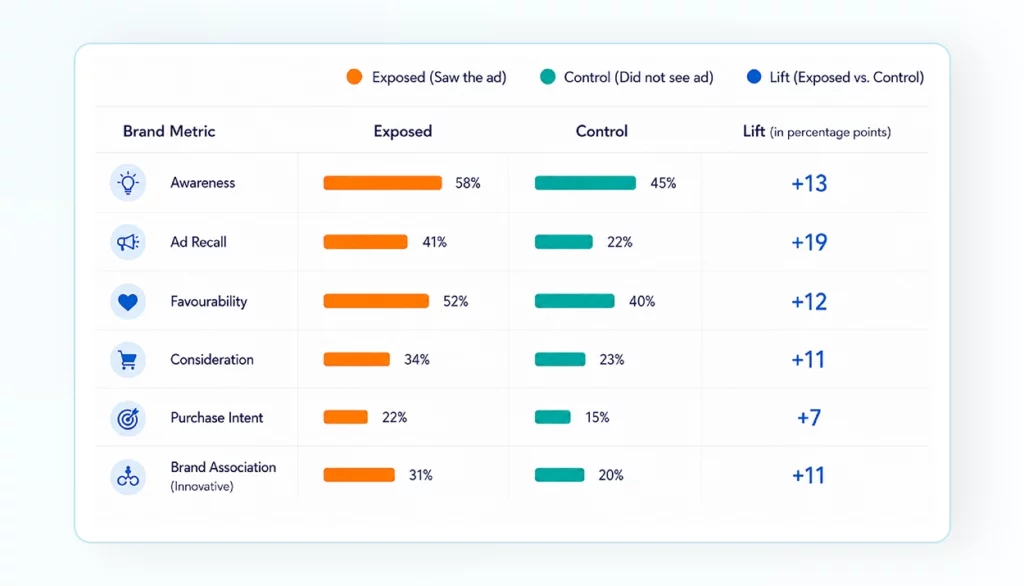
The metrics it typically measures include brand awareness, ad recall, brand consideration, brand favorability, purchase intent, and brand association. The difference in scores between the exposed group and the control group is the “brand lift”: the measurable uplifts your campaign produced, separate from any other influences happening in the market at the same time.
Brand lift studies are used across digital platforms, TV, out-of-home, radio, and multi-channel campaigns. They are particularly common in digital advertising because digital platforms can identify exposed versus unexposed audiences with greater precision, but the methodology applies equally to any media environment where you can define and separate the two groups.
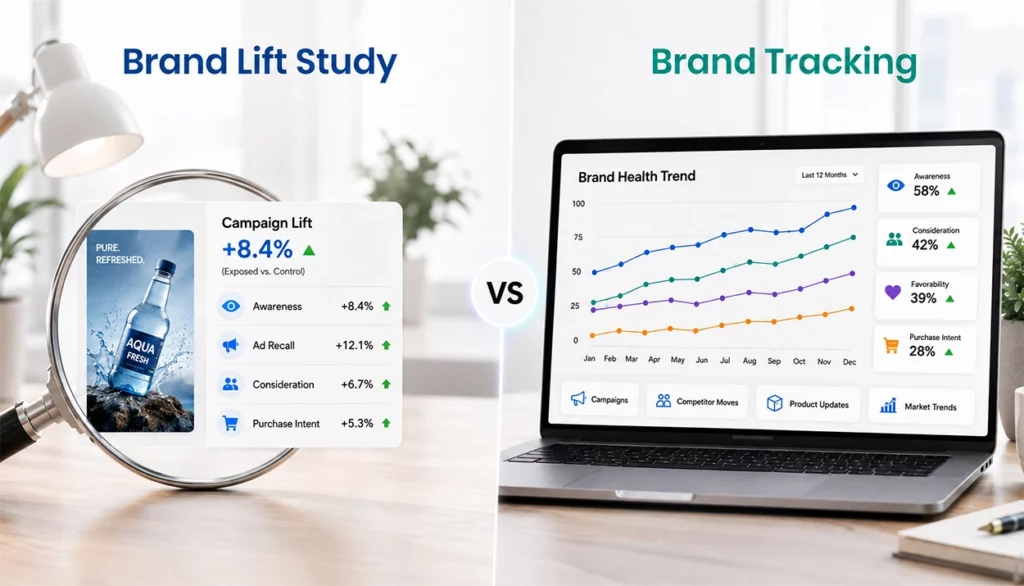
These two terms come up together often enough that the distinction is worth being clear about.
Brand tracking is a continuous measurement programme that monitors how a brand is perceived across multiple waves over time, covering all influences on the brand: campaigns, competitor activity, distribution changes, product performance, and broader market shifts. It answers the question: how is our brand doing overall?
A brand lift study is specific and isolated. It measures the impact of one campaign or one media buy on one set of metrics during one defined period. It answers the question: what did this specific piece of activity contribute to our brand?
Both are valuable. They answer different questions and work best when used together. Brand tracking provides the longitudinal context. A brand lift study attributes movement within that context to a specific cause.
Brand awareness and brand lift are closely related, but they measure different aspects of marketing effectiveness.
Brand awareness measures how familiar consumers are with your brand. It answers questions such as: Have consumers heard of your brand? Can they recognize it? Will they recall it when thinking about a particular category? It’s a foundational metric for understanding brand visibility.
Brand lift, on the other hand, measures the change in awareness and other brand metrics after consumers are exposed to a marketing campaign. Rather than measuring awareness at a single point in time, it evaluates whether advertising has increased brand awareness, improved consideration, strengthened purchase intent, or influenced consumer perceptions.
For example, if 45% of consumers recognized a brand before a campaign and 58% recognized it afterward, the campaign generated a measurable brand lift in awareness.
In short, brand awareness tells you where your brand stands today, while brand lift tells you how much your campaign changed that position.
Although they are often used together, brand lift and brand equity serve different purposes.
Brand lift measures the immediate impact of a specific advertising or marketing campaign. It helps brands understand whether their communications have influenced metrics such as awareness, consideration, favorability, purchase intent, or message association.
Brand equity is much broader. It represents the long-term value consumers associate with a brand, built through consistent experiences, product quality, trust, and effective marketing over time. Strong brand equity makes consumers more likely to choose a brand, remain loyal, and even pay a premium.
Brand lift studies help marketers evaluate whether individual campaigns are contributing to these long-term brand-building goals. While a single campaign may generate positive brand lift, sustained improvements across multiple campaigns are what ultimately strengthen brand equity.
Simply put, brand lift measures short-term campaign effectiveness, while brand equity reflects the long-term strength and value of a brand.
Most campaign measurement focuses on performance metrics: impressions, reach, clicks, video views, cost per acquisition. These numbers tell you how efficiently the media was delivered. They tell you almost nothing about whether the campaign changed how people think about your brand.
A campaign can deliver millions of impressions and zero brand lift. It can generate impressive click-through rates while leaving brand awareness completely unmoved among the people who matter most. And the reverse is also true: a campaign with modest performance metrics can produce significant brand lift among a specific high-value segment that more than justifies the investment when viewed correctly.
The gap between media delivery metrics and brand impact is where a lot of marketing budget gets misread. Without a brand lift study, you are filling that gap with assumption.
The cost of that assumption compounds over time. Campaigns that are not working get renewed because the performance dashboard looked acceptable. Channels that produced genuine brand uplift get cut because their direct response metrics were weaker than a lower-funnel channel’s. Media and creative decisions pile up over quarters and years, each one made in the absence of the one piece of data that would have made it clearer: did our audience’s perception of our brand actually change?
The specific metrics included in a brand lift study depend on the campaign’s objectives, but most complete studies cover the following.
Brand awareness lift measures the change in spontaneous or prompted brand awareness among the exposed group. This is the foundational metric: did more people know about your brand after seeing the campaign than before, relative to those who were not exposed?
Ad recall lift measures whether consumers in the exposed group remember seeing an ad from your brand in the recent period. High ad recall indicates that the creative broke through and registered. Low ad recall in a campaign with strong delivery metrics is a signal that the creative was not memorable, the placement was not noticed, or the context was wrong.
Brand consideration lift measures the increase in the proportion of consumers who would consider your brand when next making a relevant purchase. This is often the most commercially significant metric because consideration is the direct precursor to purchase. Brands that are not considered are not bought, regardless of how positively they are perceived.
Brand favourability lift measures the change in the proportion of consumers who view the brand favourably. This reflects emotional and reputational impact rather than just recall.
Purchase intent lift measures whether the campaign increased the proportion of consumers who say they are likely to buy from the brand. It is the closest to a sales proxy that a brand study can provide, and tends to be strongest when the campaign included direct product or offer messaging.
Brand association lift measures whether specific attributes or values are more strongly associated with the brand after exposure. If a campaign was designed to reinforce that a brand is innovative, or trustworthy, or relevant to a specific life stage, association tracking confirms whether that positioning is landing.
The core logic of a brand lift study is simple: measure the same metrics in two groups that are as similar as possible in every way except one. One group saw your campaign. The other did not. The difference between their responses is your lift.
The exposed group consists of consumers who were reached by the campaign during the defined study period. The control group consists of consumers who were not reached but are otherwise comparable in profile, demographics, and category behaviour.
In digital environments, this matching can be done with considerable precision because platforms can identify which users were served an ad. In traditional media environments, proximity-based or survey-based designs are used to approximate the exposed and unexposed distinction.
The quality of the match between exposed and control groups is critical. If the exposed group is systematically different from the control in ways that affect brand perception, any measured lift may reflect those pre-existing differences rather than the campaign’s actual impact.
Brand lift studies typically use one of two survey approaches.
A pre-post design surveys both groups before the campaign begins and again after it ends, comparing the change in brand metrics between the two groups. This is the most rigorous design because it accounts for any pre-existing differences between the groups by establishing a baseline.
A post-only design surveys both groups only after the campaign, comparing the scores of the exposed group directly against the control group. This design is simpler and faster to execute, and is appropriate when pre-existing differences between groups can be reliably controlled through matching rather than measurement.
Sample sizes for brand lift studies vary based on the size of the expected lift and the metrics being measured. Awareness and ad recall are typically high-frequency responses that can be detected with smaller samples. More subtle shifts in brand favourability or purchase intent may require larger samples to detect reliably. A study measuring lift across multiple segments or geographies needs samples large enough to produce reliable findings within each cell, not just overall.
A brand lift study needs to run long enough for the campaign to have had sufficient opportunity to reach and expose consumers, but not so long that other market influences contaminate the measurement. Campaign lift studies typically run concurrently with the media flight, with the survey fielded toward the end of or shortly after the campaign period.
A 5-point lift in brand awareness sounds meaningful. But whether it is meaningful depends on context. Five points of lift in a category where the leading brand has 90 percent awareness is very different from five points of lift in a category where the brand was starting from 15 percent awareness.
Brand lift results need to be read against three reference points to be fully interpretable.
Category norms and benchmarks: Lift results mean more when compared to what is achievable in your category. Some categories see average awareness lifts of 2 to 3 points from a well-executed campaign. Others routinely produce 8 to 10 points. Knowing where your campaign sits relative to category norms tells you whether you produced strong lift or just average lift.
Your brand’s starting position: A brand building from low awareness has more room to grow than a market leader. Lift expectations should reflect where the brand started, not an absolute threshold.
The specific campaign objective: A campaign designed to drive consideration should be evaluated primarily on consideration lift, not on ad recall, even if recall numbers are easier to report. Results should be read against the metric the campaign was built to move.
Brand lift measurement sounds straightforward in principle. In practice, several things can compromise the validity of results.
Exposed and control groups that are not truly comparable. If the campaign reached only certain types of consumers because of how the media was targeted, the “exposed” group will systematically differ from the general audience in ways that inflate apparent lift. A luxury automotive campaign that reached only high-income consumers will show strong consideration lift because high-income consumers were predisposed to consider the brand before the campaign started.
A study period that is too short. Brand metrics, particularly deeper ones like favourability and purchase intent, take time to shift. A study running only one or two weeks may not capture the full impact of a campaign that builds over time.
A survey that introduces bias. Questions that prime respondents about the brand before asking awareness or consideration questions will inflate scores in both groups and mask real differences. Good brand lift survey design follows the same discipline as any brand research instrument: category-level questions first, brand-specific questions later.
Insufficient sample size. Small samples produce wide confidence intervals that make it impossible to distinguish real lift from statistical noise. A study that reports a 3-point lift on a sample of 200 may be reporting an interval that runs from minus 2 to plus 8. That is not evidence of lift. It is uncertainty.
A brand lift study that ends at “the campaign produced X points of awareness lift” has not yet produced its full value. The findings only pay off when they connect to specific decisions.
Which creative version produced the most brand association lift? That answer informs which route to scale and which to retire. Which channel produced the strongest consideration lift among the priority segment? That informs next quarter’s media allocation. Which audience group showed the least lift despite heavy exposure? That suggests a targeting or message mismatch that needs to be addressed before the next flight.
This is why the most effective brand lift programmes are integrated with wider brand measurement from the start. When lift studies are designed alongside a continuous brand health programme, the results can be placed in context that makes them far more decision-ready: not just “we produced lift” but “we moved consideration among the segment we most needed to reach, and this is what it means for where we stand against our competitors.”
Measuring lift from a single campaign is useful. Understanding how that lift contributes to brand equity growth over time is more powerful, and that requires a framework built for both.
Brand Kompass, Borderless Access’s proprietary brand health and diagnostics framework, is built around the principle that brand growth is not linear and not uniformly distributed. Different consumer groups have fundamentally different relationships with a brand, and lift measurement that does not account for those differences misses much of the intelligence available.
The Brand Kompass Brand Affinity Relationship Segmentation model classifies consumers into distinct groups based on the strength and nature of their relationship with the brand: core loyalists, fringe loyalists, potential loyalists, and other segments that represent genuinely different commercial opportunities. When brand lift is measured within this segmentation framework, the findings become significantly more actionable.
A campaign might produce modest overall awareness lift but substantial consideration lift specifically among potential loyalists, which is exactly where conversion-focused investment should be directed. Or it might show strong lift among existing loyalists while barely registering with the fringe loyalist segment, suggesting that the creative is reinforcing existing relationships rather than expanding the brand’s reach into conversion-ready audiences.
Brand Kompass covers the four metric dimensions that make lift results interpretable in brand context: mind metrics including awareness, salience, and brand association; usage metrics including purchase history and recency; equity and loyalty metrics including affinity scores, NPS, and repeat purchase intent; and media and communication impact metrics including ad recall, message resonance, and campaign effectiveness measurement. Brand equity within Brand Kompass is tracked independently of specific product or messaging attributes, which preserves the longitudinal trend line through brand evolution and allows lift results from different campaign periods to be compared consistently.
The practical output is a brand measurement programme where individual campaign lift studies do not sit in isolation but contribute to a running picture of which investments are building brand equity, among which consumers, and at what rate. This is what allows brands to move from asking “did this campaign work?” to knowing “which campaigns are building the brand we need in three years.”
Download our Global Retail Banking Study to discover a smarter framework for tracking brand affinity, consumer segments, and drive sustainable brand growth.
Brand lift varies considerably across media channels, and understanding what is realistic for each channel prevents misread results.
Digital video typically produces the strongest brand lift per exposure, particularly for brand awareness and ad recall, because video format allows time for the brand message to develop. Pre-roll and mid-roll placements in relevant content contexts tend to outperform interruption-based placements where audience intent is lower.
Social media produces strong reach and frequency at lower cost, but also higher skip rates and shorter effective exposure windows. Social brand lift tends to be strongest on consideration and brand association when the creative is natively formatted for the platform.
Display and banner advertising generally produces lower per-exposure lift than video but contributes to cumulative awareness at scale. Display lift is often more visible at a population level than at a per-person level, which means single-wave lift studies may underestimate the cumulative effect of display campaigns.
Connected TV is increasingly important for brand lift measurement because it combines television-scale reach with the audience targeting precision of digital. Brand lift from connected TV campaigns often reflects the premium attention environment that television delivers alongside digital targeting flexibility.
Search operates differently from the above channels. It typically produces lift in purchase intent and direct consideration because consumers are already in an active mindset, but it contributes less to the awareness and familiarity dimensions of brand building that upper-funnel channels address.
Multi-channel campaigns consistently produce higher total lift than single-channel campaigns, but also complicate attribution. Brand lift studies for multi-channel campaigns need to be designed to identify which channels drove which types of lift, not just total campaign impact.
Want to know more about how Borderless Access supports brand lift measurement through its proprietary brand health and diagnostics framework? Connect With Our Experts Today
What is a brand lift study?
A brand lift study measures how an advertising campaign influences key brand metrics such as awareness, ad recall, consideration, favorability, and purchase intent. By comparing consumers exposed to the campaign with a similar control group, brands can quantify the true impact of their marketing efforts.
Why is a brand lift study important?
A brand lift study helps marketers understand whether a campaign changed consumer perceptions, not just how many people saw it. It reveals what influenced brand awareness, consideration, and purchase intent, enabling brands to optimize future campaigns and maximize marketing ROI.
What metrics are measured in a brand lift study?
Most brand lift studies measure brand awareness, ad recall, brand consideration, favorability, purchase intent, and brand associations. The metrics selected depend on the campaign objectives and the stage of the customer journey being evaluated.
How is a brand lift study conducted?
A brand lift study compares survey responses from consumers who were exposed to a campaign with those from an unexposed control group. This approach isolates the campaign’s impact and provides reliable insights into changes inbrand perception and purchase intent.
What makes a successful brand lift study?
A successful brand lift study relies on verified respondents, representative sampling, a well-matched control group, and robust research methodology. High-quality data ensures brands can confidently measure campaign effectiveness and make informed marketing decisions.
When should you conduct a Brand Lift Study?
A brand lift study is typically conducted during or immediately after a campaign to measure its impact while consumer exposure is still fresh. It can also be used to compare different creative or media strategies.
Is Brand Lift statistically significant?
Yes, when conducted with the right methodology and an adequately sized sample. Statistical significance ensures that the measured lift reflects a genuine campaign impact rather than random variation.
What industries benefit most from Brand Lift Studies?
Brand lift studies are valuable across industries, including FMCG, retail, automotive, healthcare, financial services, technology, telecommunications, and consumer electronics, especially where advertising plays a key role in influencing purchase decisions.
How often should brands run Brand Lift Studies?
Brands should run brand lift studies after major advertising campaigns or product launches. Organizations with continuous marketing activity may conduct them regularly to monitor campaign effectiveness and optimize future investment
© 2026 Borderless Access Pvt Ltd. All Rights Reserved.