
Every advertising campaign starts with a bet. You brief the agency, approve the creative, and commit a media budget to the idea. Some of those bets pay off. Many don’t. And the frustrating thing is that in most cases, you could have known which was which before a single dollar was spent on the market.
That is what ad testing is for.
Ad testing, also called advertising testing or creative testing, is the process of showing your ad to real consumers before it goes live, measuring how they respond to it, and using that information to either improve the ad or decide whether it is strong enough to run. It sounds straightforward. The reason so many brands still skip it comes down to two things: time and money. Traditional testing was slow and expensive. Neither excuse holds the way it used to.
This guide covers what ad testing is, why it matters, how it works, what you measure, and how modern approaches have made it faster and more accessible than the industry once assumed.

Most marketers consider advertising the most important part of the brand mix. It builds familiarity, shapes perception, creates cues that make a brand recognisable, reinforces loyalty, and drives purchase interest. Done consistently and done well, advertising builds brands that grow faster than their competitors.
And yet most marketers test very little of their advertising before they run it.
The reason is usually practical. Running a traditional ad test could take weeks and cost a significant portion of the campaign budget on its own. By the time results came back, the media plan was already locked, the agency had moved on, and there was no practical window to act on the findings. So the test got skipped, and the creative went out on instinct.
The problem with instinct is that it is calibrated to the inside of your organisation, not to the consumers sitting on the outside of it. What feels fresh and compelling in a boardroom presentation often lands differently in the real world, and vice versa. An ad that your creative team considers too simple might be exactly the kind of message that cuts through for a time-poor consumer scrolling past it in three seconds.
Ad testing closes that gap between inside perspective and outside reality. And because the tools available today are significantly faster, more affordable, and more technically sophisticated than they were even five years ago, the excuse of “it takes too long and costs too much” is increasingly hard to justify.
A good ad test is not a general opinion survey asking people whether they liked the ad. It is a structured evaluation that answers specific questions about whether the creative will achieve its strategic objectives.
The core questions an ad test should address are:
Does the communication deliver on its strategic objectives? An ad can be entertaining and still fail to communicate the brand message it was designed to carry. The test should confirm that the creative does the job it was briefed to do, not just that it generates a positive general response.
Is it engaging enough to hold attention? In a media environment where a consumer can skip, scroll, or look away within seconds, engagement is not a nice-to-have. An ad that doesn’t hold attention doesn’t deliver anything else.
How well is the brand integrated? Brand linkage measures how closely consumers associate the ad with the brand it is advertising. Low brand linkage means the ad might be remembered, but the brand won’t be. That is an expensive way to build a competitor’s awareness.
Does it deliver the key message clearly and forcefully? Message comprehension is about what consumers actually take away from the ad, not what the brief intended them to take away. These are frequently different things.
How strongly does it motivate purchase? Purchase intention is the bridge between communication effectiveness and commercial impact. An ad that entertains but doesn’t shift purchase intent is a creative success and a commercial failure.
Where are the opportunities to optimise? The best ad tests don’t just pass or fail a creative. They identify the specific moments, elements, and messages that are working well and those that are dragging performance down, giving the creative team something to improve against.
One of the most important and least well understood aspects of advertising is that consumers respond to it on two levels at once, and traditional research only captures one of them reliably.
The rational layer is what people say when you ask them about an ad. They describe what they thought of it, what message they took away, whether they found it relevant, whether they would consider buying the product. These are conscious, verbal responses that a standard survey question can capture effectively.
The emotional layer is what people feel while they are watching or experiencing an ad. Emotion is much harder to measure in a conventional research setting because it operates below the level of conscious awareness. You cannot simply ask someone how they felt second by second through a thirty-second television ad and expect an accurate answer. By the time they answer the question, the moment has passed, the feeling has been processed and filtered, and the verbal response reflects a rationalisation rather than the original emotional experience.
But emotion matters enormously to advertising effectiveness. Emotional engagement is what makes an ad memorable. Emotional resonance is what makes brand associations stick. And emotional response at specific moments within an ad predicts engagement and recall far better than post-exposure ratings alone.
Testing advertising properly requires capturing both layers: what consumers consciously think and feel about the ad, and what they actually experience emotionally while it is playing. This is the fundamental challenge that modern advertising testing technology has been built to solve.
Although they are often used together, ad testing and concept testing answer different business questions.
Concept testing evaluates an idea before it is developed into a finished product, service, or advertising campaign. It helps brands understand whether a concept is relevant, differentiated, and appealing enough to pursue further.
Ad testing evaluates a finished or near-finished advertisement to determine how effectively it captures attention, communicates the message, builds brand linkage, and influences consumer attitudes or purchase intent.
Simply put, concept testing helps decide what to create, while ad testing helps ensure the final creative will perform effectively in the market.
Creative testing is a broad term that evaluates different creative assets, including advertisements, packaging, messaging, visuals, and campaign concepts.
Ad testing is a specific type of creative testing focused on advertising. It measures how consumers respond to TV commercials, digital videos, social media ads, banners, and other advertising formats before or during a campaign.
In short, all ad testing is creative testing, but not all creative testing is ad testing.
Pre-testing takes place before an advertisement is launched. It helps brands optimize creative, reduce campaign risk, and improve performance before media budgets are spent.
Post-testing is conducted after a campaign has run to evaluate how well it performed against objectives such as awareness, recall, brand perception, or purchase intent.
Together, pre-testing and post-testing provide a complete view of advertising effectiveness—from predicting success to measuring actual impact
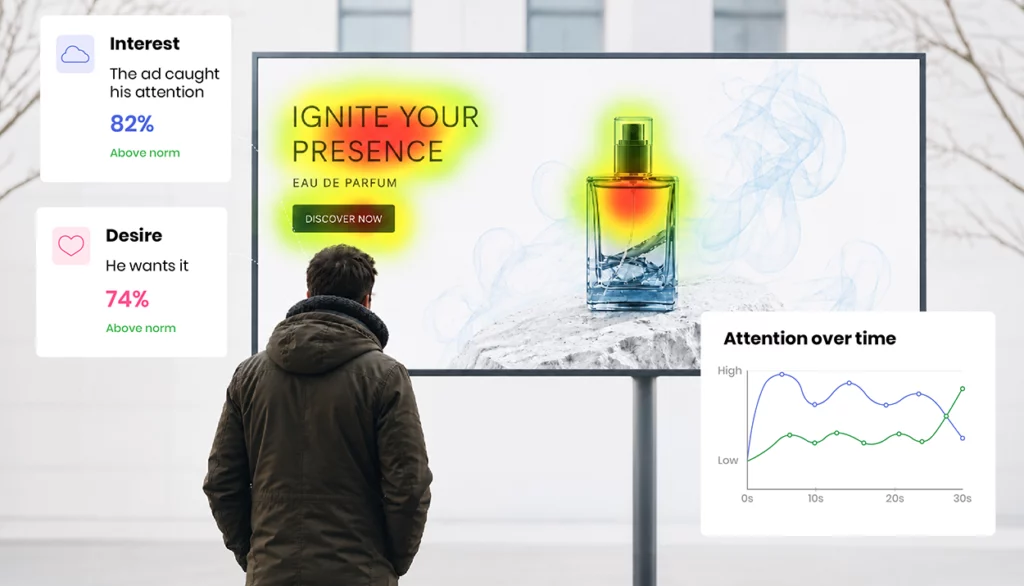
Modern ad testing combines a structured survey with technology that captures consumer responses in real time as they watch an ad, rather than relying only on what they recall and report after the fact.
The most valid testing approaches show the ad in the digital context where it will actually run: within a Facebook feed, a YouTube video, or an Instagram scroll.
This two-exposure approach, combined with real-time emotion capture during viewing, produces a more accurate picture of in-market performance than a single forced-viewing exposure ever could.
Modern ad testing combines a structured survey with technology that captures consumer responses in real time as they watch an ad, rather than relying only on what they recall and report after the fact.
Here is a problem that is more common than it sounds: an ad gets tested with the wrong people, the scores come back acceptable, the campaign launches, and it quietly underperforms. Nobody connects the dots back to recruitment because the panel “matched the brief” on paper.
Matching on paper is not the same as reaching the right consumers. A test audience that looks correct on demographics but misses the attitudinal, behavioural, or life-stage characteristics of your real target will tell you how your ad lands with people who were never going to buy the product. That is not useful data. It is misleading data dressed up as validation.
For an ad test to be predictive, the respondents need to genuinely represent the media target group for the campaign: the people most likely to be exposed to the ad when it goes live, and who account for the 75 to 80 percent of category volume that matters most commercially. Getting there requires access to a panel with the depth and profiling precision to go beyond broad demographics.
This is where the quality of the underlying panel becomes the deciding factor.
Borderless Access brings a consumer panel of over 8 million verified respondents across 40 markets, profiled across hundreds of attributes that go well beyond age and income. That means reaching respondents defined not just by who they are but by what they do and what they buy: online shoppers, frequent category buyers, OTT subscribers, homeowners, vehicle owners, gamers, pet owners, people managing specific health conditions, and dozens of other segment types that reflect how real media targeting actually works.
If a campaign is aimed at urban millennial parents who stream content daily and purchased a competitor product in the last month, that audience can be reached with genuine precision rather than approximated from a broader pool. If it is aimed at affluent women aged 35 to 50 who regularly travel internationally, those respondents are in the panel, verified and profiled, not assembled through ad hoc screening that takes days and still misses.
What this means practically is that the people evaluating the creative are the people the creative was made for. Their response to the ad is not a proxy measure. It is the signal the campaign team actually needs.
From the Respondent’s Side of the Screen
It is worth thinking for a moment about what an ad test feels like from the person completing it.
A respondent who genuinely belongs to the target audience for a campaign brings something that a loosely recruited panel member cannot: real category involvement. They have opinions about the brands in the space. They have purchase history that makes their consideration and intent scores meaningful. They notice things in the creative that a disengaged or off-profile respondent would scroll past, and they react to brand cues and messaging in the way the real target market will.
When a panel prioritises profile precision over headcount, the quality of these responses compounds. A verified frequent traveller watching a hotel chain’s ad is not just completing a survey. They are telling the brand something true about whether the creative will work on someone who actually books hotels. That distinction is what makes the test worth running.
Where and how an ad is seen changes how it feels. This is not a minor methodological detail. It is the difference between measuring a consumer’s real response and measuring their response to a research exercise.
An ad shown in isolation on a plain white background, with a prompt telling the respondent they are about to watch an advertisement, creates a context that does not exist anywhere in the actual media environment the ad will run in. Consumers in the real world encounter advertising inside content they chose to consume, on platforms they use for entertainment or connection, often while doing something else at the same time. Their attention is partial, their defences are up, and they have a skip button. Testing outside that reality produces scores that are inflated, because a captive respondent giving their full attention to a research task responds more generously than a consumer scrolling through Instagram who has not consciously agreed to watch your ad.
In-context digital testing addresses this directly. The ad is served within the actual platform environment it is designed to run in: a Facebook feed, a YouTube pre-roll, an Instagram story. The respondent sees it the way a real consumer would, at the pace and in the surroundings that match live deployment.
The exposure sequence matters too. The first viewing is skippable after a few seconds, exactly as most digital advertising is. This is where genuine engagement is measured: which respondents chose to watch on, and which skipped. The second viewing captures the full creative without skipping, allowing emotional response and rational evaluation to be completed across the whole ad. Evaluation questions follow the second exposure rather than interrupting the viewing, preserving the natural flow of response.
This approach puts respondents in the same state of mind they will be in when the campaign actually reaches them. The scores that come back are not scores from people who agreed to sit and watch an ad in a research context. They are scores from people who encountered the ad the way it was designed to be encountered, and responded to it the way a real audience will.
A complete ad test measures both layers of consumer response. The survey component covers core rational metrics: enjoyment, engagement, brand linkage, brand fit, purchase intention, brand appeal, whether the ad feels new and different, and its relevance to the consumer’s life. Open-ended questions capture message comprehension, key elements that stick in memory, overall impressions, and likes and dislikes.
The emotion capture component, using facial coding technology via a standard webcam, records emotional responses in real time as each second of the ad plays. The technology identifies emotional states including happiness, surprise, contempt, sadness, detachment, fear, and anger at every moment in the creative, producing a second-by-second map of the emotional journey a consumer takes through the ad. Eye tracking data captures where attention goes and how long it stays there.
Individual ad results become much more meaningful when they can be placed in context. The most useful benchmarks come from the same category, because emotional response norms, attention spans, and brand integration standards vary by category type. Building up norms across markets and categories over time means that a new ad test can be evaluated not just on its own terms but against what genuinely strong creative looks like in the same space.
When testing multiple creative routes against each other, a like-for-like comparison using matched panels of 150 respondents per creative ensures that differences in results reflect real differences in creative performance rather than sampling variation.
Enjoyment measures how much consumers liked the ad as an experience. High enjoyment correlates with attention and recall, but enjoyment alone is not sufficient. An ad can be highly enjoyable and still fail to deliver brand linkage or purchase intent.
Engagement measures the degree to which the ad captured and held consumer attention. Low engagement is an early warning sign that the creative will struggle to cut through in a cluttered media environment.
Brand linkage measures how strongly consumers connect the ad to the brand it advertises. This is one of the most commercially critical metrics, because an unmemorable brand linkage means all the attention and enjoyment the ad generates benefits the category rather than the specific brand.
Brand fit measures whether the ad feels like it belongs to the brand. A creative that feels tonally or visually mismatched with the brand can damage brand perception even while generating positive responses on other metrics.
Purchase intention measures how much the ad motivates consumers to want to buy the brand. It is the metric most directly connected to the commercial case for running the creative.
Brand appeal measures the overall impression the ad creates for the brand. It sits between brand fit and purchase intention and reflects the degree to which the ad makes the brand more attractive to the consumer.
New and different captures whether the creative feels fresh and distinctive. In competitive categories, differentiation matters as much as quality.
Relevance measures whether the ad feels personally meaningful to the consumer’s life and circumstances. An ad can be beautifully produced and entirely irrelevant to the person watching it.
Attention is measured through eye tracking as a score from 0 to 100 reflecting visual appeal and the degree to which the ad captured the consumer’s gaze.
Engagement via facial coding is a 0 to 100 score reflecting the emotional intensity the ad evoked second by second through the viewing experience.
Positive emotions capture happy and surprised responses during viewing. Higher positive emotion during key message and brand moments correlates with stronger recall and more favourable brand associations.
Negative emotions capture sadness and anger responses. Some negative emotion is appropriate and intentional in certain creative strategies; unexpected negative emotion at brand moments is typically a problem to address.
Net score is an overall efficacy score from 0 to 100 that combines facial coding and eye tracking metrics with reference to category benchmarks, providing a single comparable measure of overall creative performance.
Time to discovery measures how quickly consumers notice a specific area of interest within the creative. Lower time to discovery is better, particularly for the brand, the key message, and the call to action.
Earned attention measures how long consumers spend looking at a specific element. Higher earned attention is better for brand and message elements.
Attention Score measures how effectively an advertisement captures and holds viewers’ attention during exposure. It indicates whether consumers are actively engaging with the creative or losing interest at different moments. A higher Attention Score generally suggests that an ad is more likely to communicate its message, strengthen brand recall, and improve overall campaign effectiveness.
Most ad testing solutions force brands to choose between speed and depth. Fast solutions give you a handful of survey metrics and a score. Comprehensive solutions give you rich data but take weeks and cost enough to make the test feel like a second campaign in its own right.
Borderless Access built AdSight to avoid that compromise.
AdSight is a pre-launch creative testing solution that captures both the rational and emotional dimensions of consumer response to advertising, quickly and cost-efficiently, using device-agnostic technology that works on any PC, smartphone, or laptop a respondent happens to be using.
It tests TV videos, online videos, and online banners. Creatives can be submitted in finished format or as an animatic or storyboard, which means testing can happen earlier in the production process when changes are still cheap, not after the final edit when changes are expensive.
The emotional measurement in AdSight uses neuromarketing technology to capture facial expressions in real time as consumers watch the creative. The webcam on a respondent’s device records micro-expressions that indicate emotional states without requiring any active response from the respondent. This passive measurement approach captures genuine real-time emotional response rather than the post-rationalised version that a survey question produces.
The in-context digital creative exposure methodology shows ads to respondents within the actual digital environments where the ad will run: Facebook, YouTube, Instagram, or whichever channel carries the highest planned media expenditure for the campaign. This matters because context shapes response, and testing an ad in a simulated environment produces results that are less predictive of in-market performance than testing it in the real one.
AdSight Lite is a lighter version of the solution designed for speed and cost-efficiency. It focuses on core metrics and is particularly useful for screening multiple creative routes early in the development process, where the goal is to identify the strongest direction rather than produce a comprehensive diagnostic.
Benchmarking within AdSight is built around branded noticeability measures including excitement, likeability, brand attribution, and persuasiveness. In-study benchmarking allows a client to compare creative routes against each other directly, and the comparison can include a competitive creative from the same category to establish whether the new ad outperforms what consumers are already seeing from rivals.
There is a finding pattern in ad testing that appears often enough to be a reliable warning: brand introduction timing.
In two video ads tested for a home-selling platform, AdSight’s dropout data showed that in one ad the brand was not introduced until 26 seconds into a 30-second video, by which point 92 percent of viewers had already disengaged or dropped out. In the second ad, the brand was introduced at 27 seconds with 95 percent dropout before that point. In both cases, the majority of viewers who were exposed to the campaign never received the brand message at all.
From the inside, both of those creatives had been approved because they told a compelling story. The story was absorbing enough that nobody questioned when the brand appeared. The test revealed that the story was not absorbing enough to hold 90 percent of consumers all the way to the reveal.
This is the kind of finding that changes creative decisions in a way that genuinely improves in-market performance. Not a judgement about whether the ad is “good” or “bad,” but a specific, actionable diagnosis of where the creative is losing its audience and what needs to change.
Test early, not just late. The most common mistake is treating ad testing as a final quality check before a campaign goes live. By that point, the creative is finished and the media plan is booked, which means the only decision available is whether to pull the campaign or run it as is. Testing earlier, even at animatic or storyboard stage, creates options: change the brand integration, adjust the messaging sequence, recut the ending.
Test multiple routes when you can. Comparing two or three creative routes against each other at the concept stage is far more valuable than testing a single execution and asking whether it passes a threshold. The monadic testing approach, where each respondent evaluates only one ad, ensures that comparison results reflect genuine differences in creative performance rather than contrast effects.
Test cut-downs separately. A thirty-second ad that tests well does not automatically mean the fifteen-second cut-down will perform equally well. Ad testing can identify how to optimise the shorter version and whether it maintains the brand integration and message delivery of the longer format.
Retest after significant changes. If testing leads to meaningful creative changes, retesting the revised version confirms that the change improved what it was intended to improve and didn’t introduce new problems elsewhere.
Advertising is one of the biggest investments a brand makes. But even the best creative idea can fall short if it doesn’t connect with the people it’s meant to reach.
Ad testing helps remove the guesswork. It shows what consumers notice, understand, remember, and feel, giving brands the confidence to improve creative before it reaches the market.
That’s why ad testing has become an essential part of modern marketing. By combining consumer feedback with behavioral and emotional insights, brands can make better creative decisions, reduce risk, and get more value from every advertising dollar.
Want to know more about how Borderless Access’ AdSight is helping brands validate creative, measure emotional and rational responses, and make evidence-based advertising decisions before campaigns go live? Talk to Our Experts Today!
What is ad testing?
Ad testing evaluates how consumers respond to an advertisement before or during a campaign. It measures factors such as attention, brand linkage, message clarity, emotional response, and purchase intent to help brands optimize creative performance.
Why should brands test ads before launching them?
Testing identifies what works—and what doesn’t—before media budgets are spent. It helps brands refine creative, strengthen messaging, and reduce the risk of underperforming campaigns.
What does an ad test measure?
A comprehensive ad test measures brand recall, message clarity, engagement, relevance, purchase intent, brand linkage, and emotional response to understand how effectively an ad connects with its target audience.
Can you test an advertisement before it is finished?
Yes. Ads can be tested at storyboard, animatic, rough-cut, or finished stages. Early testing helps identify creative improvements before production costs are fully committed.
Why is emotional response important in ad testing?
Many purchase decisions are influenced by emotion rather than logic. Measuring emotional reactions alongside survey feedback provides a more complete picture of how consumers are likely to respond to an advertisement.
How does AI improve ad testing?
AI helps analyze consumer responses faster, detect behavioral patterns, automate reporting, and support emotional measurement at scale. Combined with human expertise, it enables deeper and more actionable creative insights.
Why is ad testing important?
Ad testing helps brands understand how consumers are likely to respond before a campaign goes live. It reduces creative risk, improves campaign effectiveness, and supports more confident marketing decisions.
How does ad testing work?
Ad testing exposes a target audience to an advertisement and measures responses such as attention, message clarity, brand recall, emotional engagement, and purchase intent using surveys, behavioral techniques, or neuromarketing tools.
What are the benefits of ad testing?
Ad testing helps optimize creative, strengthen messaging, improve brand linkage, increase campaign effectiveness, reduce media wastage, and maximize return on advertising investment.
Which ad testing metrics matter most?
The most commonly measured metrics include attention, brand linkage, message clarity, emotional response, purchase intent, brand recall, relevance, and overall creative effectiveness.
Which industries benefit most from ad testing?
Ad testing is valuable across industries including FMCG, retail, automotive, healthcare, financial services, technology, telecommunications, entertainment, and consumer electronics—any sector that relies on advertising to influence consumer decisions.
How accurate is AI in ad testing?
AI improves the speed and scale of ad testing by identifying patterns, analyzing consumer responses, and supporting emotion measurement. However, human expertise remains essential for interpreting results and making strategic decisions.
What is Facial Coding?
Facial coding is a research technique that analyzes viewers’ facial expressions while they watch an advertisement. It helps measure emotional reactions in real time, providing insights that consumers may not be able to express through surveys alone.
What is Eye Tracking?
Eye tracking measures where people look, what captures their attention, and how long they focus on different elements within an advertisement. It helps brands understand visual engagement and optimize creative design for greater impact.
When should brands conduct ad testing?
Ad testing is most valuable before launch, whether at the storyboard, animatic, rough-cut, or finished ad stage. It can also be conducted during or after a campaign to evaluate performance.
© 2026 Borderless Access Pvt Ltd. All Rights Reserved.