
An Essential Playbook to Measure, Monitor, and Grow Your Brand
A brand tracker is one of the most common investments a marketing team makes, and also one of the most commonly underused. Quarter after quarter, the same dashboard gets refreshed: awareness is up half a point, consideration is flat, NPS has dipped slightly. The numbers get reported. Nobody is quite sure what to do differently because of them.
This is not a flaw in the idea of tracking. It is a flaw in how most trackers are built. A tracker that tells you the score without telling you which consumers actually matter to your growth, and what is standing between them and genuine loyalty, is measuring brand health the way a thermometer measures a patient. It tells you something is happening. It does not tell you what to treat.
This guide looks at what brand tracking is actually meant to do, where conventional tracking falls short, and what a tracking framework needs to include if it is going to function as a genuine growth tool rather than a recurring report.
Brand tracking is a continuous research programme that measures the health of a brand in the minds of its consumers over time. Unlike a one-off brand health survey, tracking repeats core measurement across multiple waves, building a longitudinal dataset that reveals trends rather than snapshots.
The purpose is not simply to monitor. It is to inform decisions: which consumer segments to invest in, whether marketing campaigns are delivering measurable impact, where competitive threats are emerging, and how brand equity is holding up through product or messaging changes.
Brand health tracking matters because brand perception changes faster than most organisations can detect without a structured measurement programme. A competitor launches an aggressive campaign. A product quality issue spreads through social media. A cultural moment makes a brand’s messaging feel out of step. Without ongoing brand monitoring, these shifts are discovered only when they have already translated into lost consideration or declining sales.
Brand tracking is the broader process of continuously monitoring brand performance across multiple dimensions over time. Brand health tracking is a specific focus within that process, concerned with the key indicators of brand vitality: awareness, consideration, preference, loyalty, and equity. In practice, most modern brand tracking programmes include brand health tracking as a core component alongside competitive benchmarking, communication impact measurement, and consumer segmentation.
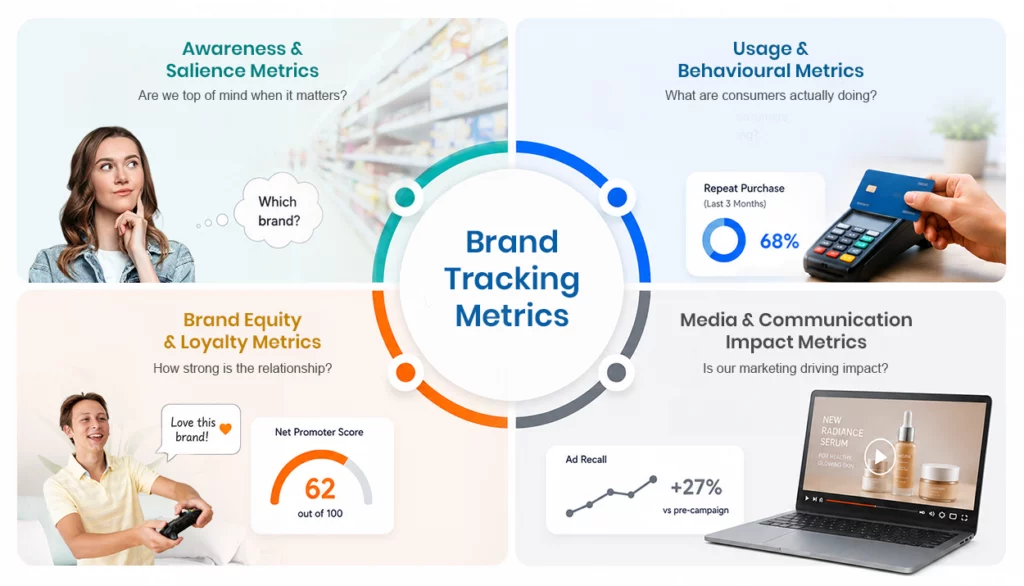
A brand tracker that measures only awareness and consideration is measuring the surface of brand health. A complete brand tracking framework covers four distinct metric categories, each capturing a different dimension of the relationship between a brand and its consumers.
These establish whether a brand is present in consumers’ minds when a relevant need arises. Key measures include spontaneous brand awareness, prompted brand awareness, top-of-mind recall, and brand salience. Together they answer the foundational question: when a consumer thinks about this category, does this brand come to mind?
Brand awareness tracking over time reveals whether marketing investment is building mental availability or simply maintaining it, and whether a brand is gaining or losing ground against competitors in the consideration set.
Behavioural metrics ground attitudinal data in actual consumer behaviour. They cover purchase history, recency of purchase (last three months, last month), frequency of usage, and category consumption patterns. Usage data frequently reveals gaps between what consumers say and what they actually do, and is essential for distinguishing genuinely loyal buyers from occasional or lapsed ones.
Brand equity measurement assesses the depth and durability of the relationship a consumer has with a brand. This includes brand affinity scores, repeat purchase intent, net promoter score, and likelihood to recommend. These brand performance metrics indicate not just whether a consumer currently uses a brand, but how resilient that relationship is to competitive pressure or pricing changes.
Brand equity tracking is most valuable when it is consistent across time, independent of changes to specific product attributes or messaging, so that the longitudinal trend line remains interpretable even as the brand evolves.
These measure whether marketing investment is actually working. Ad recall, message resonance, campaign recognition, and shifts in brand association following a specific communication period close the loop between spend and outcome. Without this dimension, a tracker can show a brand metric moving without ever establishing whether marketing activity had anything to do with it.
A brand tracking study is not a single survey. It is a repeating measurement programme, structured to produce comparable data across waves while remaining sensitive to genuine change.
Before designing the questionnaire, establish what decisions the tracking programme needs to support. Are you monitoring competitive position? Evaluating the impact of a relaunch? Building an evidence base for sustained brand investment? The objectives determine which metrics take priority and how frequently the study needs to run.
Identify whose perceptions you need to measure. For most brand tracking surveys, this includes category users and non-users within the relevant demographic or behavioural target, with consistent quota controls across waves to ensure comparability. For brands tracking performance across multiple markets, sampling methodology must be consistent across geographies.
A brand tracking survey typically opens with category-level questions before introducing brand names, to avoid priming effects. Core sections cover awareness and salience, usage and recency, brand perception and association, equity and loyalty measures, and communication impact. The questionnaire should remain consistent across waves for core metrics, with modular sections that can be updated to address specific business questions within a wave.
Tracking frequency should match category dynamics and the pace at which the business needs to be able to respond. Quarterly tracking suits stable categories where month-to-month variation is low. Monthly or continuous tracking suits fast-moving categories, brands running active campaigns, or situations where competitive or reputational sensitivity is high.
Analysis should go beyond reporting scores. It should identify what is driving movement in key metrics, which consumer segments are contributing to or detracting from brand health, and what specific actions the findings recommend. Tracking data that ends at a topline readout produces limited value. Tracking data that connects to a specific next step produces growth.
A brand lift study measures the incremental impact of a specific marketing campaign or media investment on brand metrics, typically by comparing exposed and unexposed consumer groups before and after a campaign runs.
Where brand tracking provides a continuous view of brand health across all influences, a brand lift study isolates the effect of a specific activity. The two work together: brand tracking establishes the baseline and overall trend, and brand lift studies establish which specific investments are moving the needle within that trend.
Brand lift measurement typically covers prompted awareness, ad recall, message association, brand consideration, and purchase intent shifts attributable to the campaign. It is most useful for justifying ongoing media investment, optimising channel allocation, and making the case for brand-building spend in organisations where short-term performance metrics dominate.
One of the most persistent limitations of conventional brand tracking is the reporting of population-level averages that obscure meaningful variation beneath the surface.
Two consumers can report identical brand awareness, identical purchase frequency, and similar satisfaction scores, and still represent entirely different commercial opportunities. One might be a committed advocate who would never seriously consider a competitor. The other might be a price-driven occasional buyer one promotional offer away from switching permanently.
A tracker that groups both into the same “aware and satisfied” cohort is technically accurate and strategically useless. The marketing investment that would convert the second consumer into a loyalist is very different from the investment that deepens the first consumer’s existing advocacy. Spending against an undifferentiated average wastes budget on both.
This is the core problem that affinity-led brand tracking frameworks are designed to solve: classifying consumers not by broad demographic characteristics, but by the strength and nature of their relationship with the brand, so that marketing effort can be directed at the segments where it will actually change behaviour.
Borderless Access developed Brand Kompass specifically to solve the problem that standard trackers leave unresolved: what to do with brand health data once you have it.
Brand Kompass applies a proprietary Brand Affinity Relationship Segmentation model that moves beyond population-level scores to classify consumers into distinct groups based on the depth and character of their brand relationship. These groups include core loyalists, fringe loyalists, and potential loyalists, among other segments, each requiring a different type of marketing investment and each representing a different level of commercial opportunity.
The practical output of this segmentation is precision. Rather than recommending a broad increase in brand communication, Brand Kompass identifies the specific consumer segments where investment will generate the most movement, and pairs that identification with what is known about those segments’ media habits, retail behaviour, and geographic profile, enabling genuinely targeted rather than broadly distributed marketing activity.
Brand Kompass covers all four dimensions of brand health: mind metrics including awareness, salience, and brand association; usage metrics including purchase recency and consumption patterns; equity and loyalty metrics including affinity scores, NPS, and repeat purchase intent; and media and communication impact metrics including ad recall, message resonance, and campaign effectiveness.
Tracking within Brand Kompass operates longitudinally and is designed to remain consistent across waves even as a brand’s product portfolio, messaging, or positioning evolves. Equity is measured independently of specific brand attributes, which preserves the comparability of the trend line through brand change rather than breaking it.
The framework is designed for flexibility: brands can run Brand Kompass quarterly, bi-annually, or in continuous waves depending on category dynamics and the pace at which they need actionable insight.
AI is reshaping how brand tracking data is collected, processed, and interpreted, and the changes are material enough to affect how brands should evaluate tracking providers.
AI-powered analytics accelerate the identification of patterns within large, multi-wave brand tracking datasets, surfacing emerging trends and segment shifts faster than manual analysis alone. Natural language processing applied to open-ended survey responses allows sentiment and association analysis at a scale that was previously impractical. Automated anomaly detection flags unusual movements in brand metrics in near real-time, enabling faster response to potential issues.
In survey operations, AI-assisted scripting and logic validation reduce programming errors in complex tracking questionnaires. Machine learning models applied to respondent quality screening improve data integrity by identifying and removing disengaged or fraudulent responses during fieldwork. These operational improvements translate into faster delivery of clean data and more reliable wave-on-wave comparability.
AI accelerates pattern recognition. It does not replace the judgement needed to determine whether a pattern is strategically significant, what is causing it, and what a brand should do differently as a result. The interpretation of brand tracking data in the context of a competitive landscape, a specific category dynamic, and a brand’s particular strategic situation still requires experienced researchers who understand both the market and the measurement.
The most effective approach combines both: AI for speed, scale, and consistency across the operational and analytical mechanics of tracking, and human expertise for the decisions that determine whether the research is designed correctly and whether the findings are being used well.
A leading retail banking organisation used Brand Kompass to move beyond the standard brand health metrics it had been tracking for several years. The existing tracker showed broadly stable awareness and consideration scores, which had led the team to conclude that brand health was holding steady despite increasing competitive activity in the category.
Brand Kompass’s affinity segmentation revealed a more complex picture. While topline awareness was indeed stable, the composition of the aware consumer base had shifted significantly. The proportion of consumers classified as potential loyalists had declined, while the fringe loyalist segment had grown. These two shifts were offsetting each other at the aggregate level, producing a flat overall number that obscured a genuine erosion in brand conversion potential.
The insight redirected the organization’s marketing investment away from broad awareness activity toward a targeted program focused on the specific barriers preventing potential loyalists from converting to regular product usage. Subsequent waves showed an increase in the potential loyalist segment and improved conversion to active usage, demonstrating measurable commercial impact from a more precisely targeted allocation of the same marketing budget.
Maintain questionnaire consistency across waves. Core brand tracking metrics must be asked in exactly the same way across every wave for the data to be comparable. Changes to question wording, scale format, or question order are not minor adjustments. They can break the trend line and make it impossible to distinguish genuine change from measurement artefact.
Track competitors alongside your own brand. Brand health does not exist in isolation. Tracking competitive awareness, consideration, and equity alongside your own brand turns a self-referential score into a genuine competitive intelligence tool.
Segment before you report. Population-level averages should be the starting point for analysis, not the end point. Every tracking report should include segment-level analysis that identifies where movement is coming from and which consumer groups are driving it.
Connect tracking cadence to decision cycles. If marketing plans are set quarterly, quarterly tracking that delivers insight two weeks before the planning cycle is far more useful than monthly tracking that reports on a schedule the business cannot act on.
Design for action, not for reporting. Every brand tracking study should be commissioned with a specific decision in mind. What would the findings need to show you to change the media strategy? Adjust the messaging? Prioritise a specific segment? The answer to those questions should shape the study design from the start.
Use brand lift studies to isolate campaign effects. Continuous tracking tells you how your brand is performing overall. Brand lift measurement tells you which specific investments contributed to that performance. Both are necessary for a complete picture of marketing effectiveness.
Marketing and brand teams use brand tracking to monitor the return on brand investment, optimise messaging, measure campaign impact, and justify sustained brand-building spend to leadership.
Insights and strategy teams use it to build a longitudinal evidence base for planning, identify shifts in consumer perception before they reach the sales line, and brief agencies with findings grounded in actual consumer data.
Product and innovation teams use it to understand how product launches or portfolio changes affect brand equity and consumer perception, and to monitor whether new entrants are affecting the brand’s position in the consideration set.
Agency partners use client brand tracking data to evaluate creative effectiveness, inform media planning, and demonstrate the impact of their work against measurable brand performance metrics.
Why is brand tracking important?
Brand Tracking helps brands detect shifts in consumer perception and marketing performance early, enabling faster and more informed business decisions.
What's the difference between brand tracking and brand health tracking?
Brand tracking measures overall brand performance, while brand health tracking focuses specifically on awareness, consideration, preference, loyalty, and brand equity.
What metrics are included in a brand tracker?
Typical metrics include brand awareness, salience, usage, loyalty, brand equity, affinity, NPS, ad recall, and message effectiveness.
How do you conduct a brand tracking study?
A brand tracking study involves defining objectives, selecting the right audience, running regular survey waves, and analyzing trends using a consistent methodology.
What is a brand lift study?
A brand lift study measures the impact of a specific campaign by comparing consumers who saw the campaign with those who did not.
How is brand tracking different from brand monitoring?
Brand monitoring tracks online mentions and sentiment, while brand tracking measures consumer attitudes and behaviors through research. Both provide complementary insights.
How often should brand tracking be conducted?
Tracking frequency depends on your market. Stable categories may track quarterly or bi-annually, while fast-moving categories benefit from monthly or continuous tracking.
What is brand equity and how is it measured?
Brand equity reflects the value consumers associate with your brand. It is measured using metrics such as brand affinity, preference, repeat purchase intent, and willingness to pay.
How does brand tracking improve marketing ROI?
It identifies which audiences and campaigns drive results, helping brands allocate marketing budgets more effectively.
What is brand affinity and why does it matter?
Brand affinity measures the emotional connection consumers have with a brand. Strong affinity often leads to greater loyalty, advocacy, and lower price sensitivity.
Can brand tracking measure competitive performance?
Yes. Brand tracking benchmarks your brand against competitors across awareness, consideration, loyalty, and brand equity to reveal competitive strengths and gaps.
What is consumer segmentation in brand tracking?
Consumer segmentation groups audiences based on factors such as affinity, loyalty, or usage, helping brands identify high-value growth opportunities.
What is the biggest mistake brands make in brand tracking?
Relying only on topline metrics. Without segment-level analysis, brands can miss important shifts within different consumer groups.
How does AI improve brand tracking?
AI speeds up data analysis, detects patterns and anomalies, improves survey quality, and supports faster insights. Human expertise remains essential for interpretation.
How is modern brand tracking different from traditional brand tracking?
Modern brand tracking combines AI, consumer segmentation, competitive benchmarking, and actionable recommendations instead of simply reporting awareness scores.
What is brand salience and how is it measured?
Brand salience measures how easily consumers think of your brand in buying situations. It is tracked through spontaneous recall in relevant purchase contexts.
How do you measure customer loyalty?
Customer loyalty is measured using repeat purchase intent, brand affinity, NPS, likelihood to recommend, and likelihood to switch.
Can brand tracking be customized for different industries?
Yes. Brand tracking frameworks can be tailored to industry-specific metrics, consumer behaviors, and competitive dynamics.
Is brand tracking useful for regional or smaller brands?
Absolutely. It helps challenger and regional brands understand where they are gaining or losing ground and make smarter marketing decisions.
What is brand perception and how is it measured?
Brand perception reflects how consumers view your brand. It is measured through brand associations, attribute ratings, imagery, and emotional response.
How do you choose the right brand tracking methodology?
Choose a methodology based on your business objectives, audience complexity, and the decisions your tracking needs to support.
© 2026 Borderless Access Pvt Ltd. All Rights Reserved.